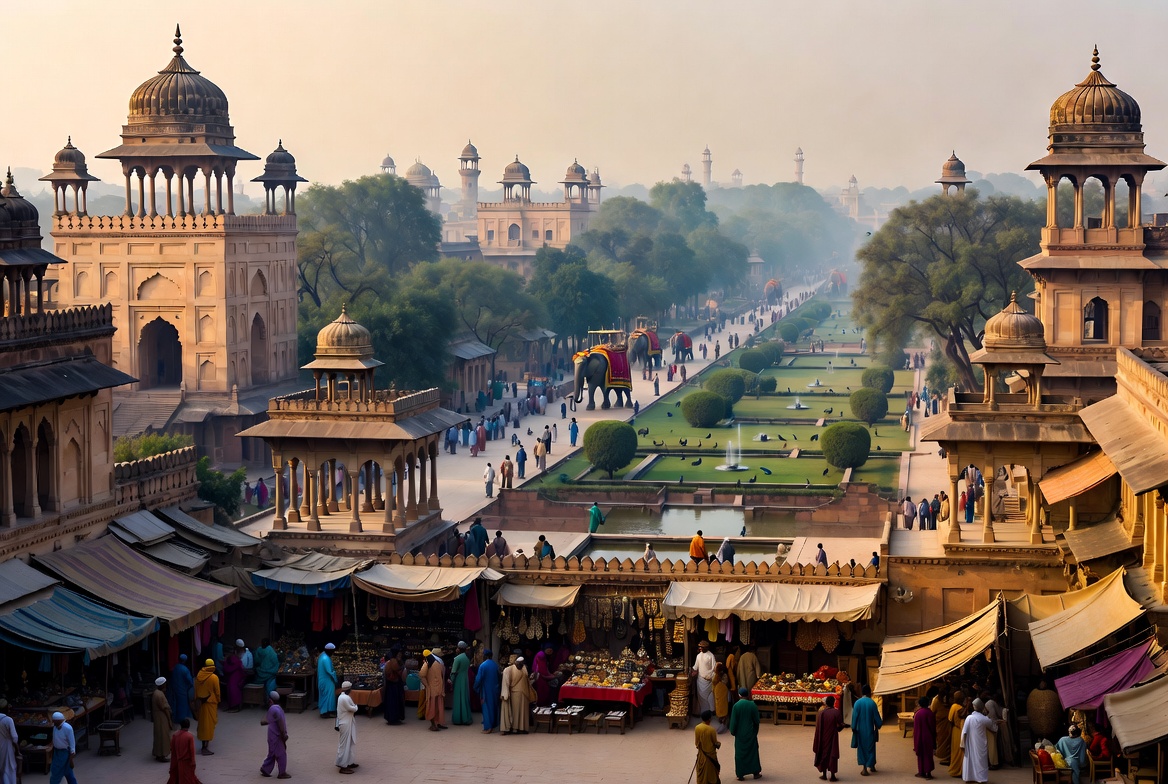
Long before European companies became territorial powers, the Indian subcontinent was home to planned cities, major religions, global trade networks, centres of learning and a succession of powerful states.
By Obnews Editorial Staff
India does not have a single ancient founding date. The country became independent in 1947, and the Constitution of the Republic of India came into force in 1950, but the history of the land and its peoples reaches back many thousands of years. The name India ultimately developed from Sindhu, the Sanskrit name associated with the Indus River, through related Persian and Greek forms, according to the Encyclopaedia Iranica. The word therefore began as a geographical description long before it became the name of a modern country.

For most of history, the subcontinent was not governed by one state. It contained kingdoms, republics, empires, tribal societies, temple towns, ports and farming communities whose borders changed repeatedly. At certain moments, rulers such as Ashoka, Akbar and Aurangzeb controlled very large territories. At many other moments, political power was divided among dozens of regional states. Diversity, rather than permanent unity under one capital, was the historical norm.
This article uses “India” broadly when discussing the civilization of the Indian subcontinent. Ancient sites and states did not follow today’s borders, and some of the most important places in this history are now in Pakistan, Bangladesh and other neighbouring countries. It is therefore important not to project the boundaries of the present Republic of India backward onto societies that understood geography, identity and sovereignty differently.
The first people and the first villages
Human history in South Asia began deep in prehistory, long before written records or named kingdoms. Modern humans were present in the region tens of thousands of years ago, living in varied environments that ranged from river plains and forests to coasts and highlands. The rock shelters at Bhimbetka in present day Madhya Pradesh preserve evidence of early human occupation and paintings from the Mesolithic period through later historical times, according to UNESCO.
There was never one isolated or biologically “pure” original Indian population. Genetic and archaeological research points instead to a long history of movement, contact and mixture among ancient populations. A major study published in Science found evidence of several ancestral sources and migrations contributing to the peoples of South and Central Asia over long periods. The findings describe interaction and admixture, not the simple replacement of one population by another, according to the peer reviewed study led by Vagheesh Narasimhan and colleagues.
By approximately the seventh millennium BCE, communities in the northwest were practising agriculture and raising animals. Mehrgarh, in present day Balochistan, Pakistan, is among the earliest known farming settlements in South Asia. Over thousands of years, different communities developed farming traditions in the Indus region, the Ganges valley, the Deccan and southern India. These societies did not all change at the same speed or in the same way. Hunting, herding, farming and forest based livelihoods often existed beside one another.
The Indus or Harappan civilization
The first great urban civilization of the subcontinent arose in the Indus region. Its mature phase is generally dated from about 2600 to 1900 BCE. It extended across a vast area that included much of present day Pakistan and parts of northwest and western India. Harappa and Mohenjo Daro are in Pakistan, while Dholavira, Rakhigarhi, Lothal and Kalibangan are among the major sites in India.
Harappan cities reveal sophisticated planning. Streets followed organized patterns, baked bricks were widely used, and many neighbourhoods had wells and drainage systems. Mohenjo Daro contained public structures, including the building now called the Great Bath. UNESCO describes it as one of the best preserved urban settlements of the Indus civilization and notes its carefully planned streets, drainage and monumental buildings. The city’s remains show that complex urban life existed in the subcontinent more than four thousand years ago, according to UNESCO’s account of Mohenjo Daro.
The Harappans produced standardized weights, seals, jewellery, pottery and metalwork. Their merchants participated in long distance trade, including exchanges with Mesopotamia. They also used a system of signs commonly called the Indus script. Because that script has not been conclusively deciphered, the names of Harappan rulers, languages and institutions remain unknown. Archaeologists can reconstruct much about material life, but claims about the civilization’s religion, government or direct relationship to later traditions must remain cautious.
The cities declined after about 1900 BCE, but their inhabitants did not simply vanish. Many settlements became smaller, populations shifted eastward and local cultures continued in altered forms. Changes in rivers, weakening monsoons, disruptions to trade and broader environmental pressures may all have contributed. Scholars do not accept one proven explanation for the transformation, and the old theory that a single invading army destroyed the civilization is not supported by present evidence.
The Vedic period and a changing social order
During the second millennium BCE, Indo Aryan languages became established in northern South Asia. The earliest Vedic hymns were composed orally in an early form of Sanskrit, probably beginning in the northwest. The word “Aryan” in this historical setting refers principally to a linguistic and cultural category. It should not be confused with later racial ideologies created in Europe.
The Vedic period, conventionally dated from about 1500 to 500 BCE, was not static. Early communities described in the Rigveda placed great importance on cattle, kinship, sacrifice and mobile pastoral life. In later centuries, settlement and agriculture expanded eastward into the Ganges plain. Larger political units appeared, iron tools became more common and social distinctions became more formal. Ideas connected to varna, ritual authority, duty and cosmic order developed during this long period, although caste as lived across India would become far more complex than a single four part model.
The Vedas, later Upanishads and other bodies of thought helped shape traditions now grouped under Hinduism. That modern umbrella term covers many philosophies, deities, practices and regional traditions that developed across centuries. The Mahabharata and Ramayana also grew through long processes of composition and revision. They are foundational cultural and religious works, but historians do not treat every episode in the epics as a literal record of dated events.
The development of Vedic culture involved movement and interaction with populations already living in the subcontinent. Archaeology, linguistics and genetics all point to a more complicated process than either total foreign replacement or complete isolation. Modern South Asians descend from multiple ancient populations whose histories became deeply intertwined.
Cities, kingdoms, Buddhism and Jainism
From about the sixth century BCE, northern India experienced a second period of urban growth. Buddhist and Jain sources refer to sixteen major states, commonly called the mahajanapadas. Some were monarchies, while others had oligarchic or clan based forms of government. Cities expanded, merchants gained influence, coinage circulated and control of fertile land and trade routes became increasingly valuable.
Magadha, centred in what is now Bihar, gradually became the strongest of these states. Its position near fertile plains, forests, rivers and mineral resources helped successive dynasties build military and administrative power. This era also saw challenges to the authority of Vedic sacrifice and inherited status. Teachers and renunciants debated suffering, ethics, rebirth, liberation and the nature of the self.
Siddhartha Gautama, the Buddha, and Vardhamana Mahavira, the central teacher of Jain tradition, lived in this broader intellectual environment. Buddhism and Jainism created organized monastic communities and attracted patrons from many social backgrounds. Both traditions spread widely, though Hindu traditions remained influential and continued to change. South Asian religious history was rarely a story of one faith completely erasing another. Competition, patronage, borrowing and coexistence were more common.
The northwest also connected the subcontinent to powers beyond it. Parts of the region came under Achaemenid Persian authority. In 326 BCE, Alexander of Macedon crossed the Indus and fought King Porus, but his army refused to continue farther east. Alexander soon withdrew, leaving no durable Greek empire in India, although later Indo Greek kingdoms would become important in the northwest.
The Mauryan Empire and Ashoka
Around 321 BCE, Chandragupta Maurya established an empire centred at Pataliputra, near modern Patna. He overthrew the Nanda dynasty and expanded across much of northern India. A settlement with Seleucus I, one of Alexander’s successors, confirmed Mauryan authority in parts of the northwest. The Mauryan state, which lasted until about 185 BCE, became the first known empire to unite most of the subcontinent under one dynasty, although the far south remained outside its direct control. A Cambridge history of the Mauryan Empire identifies Chandragupta as its founder and Ashoka as its most famous ruler.
The empire reached its greatest extent under Chandragupta’s grandson Ashoka. After the bloody conquest of Kalinga, in present day Odisha, Ashoka publicly expressed remorse for suffering caused by war. He promoted dhamma, an ethical policy that encouraged restraint, respect for parents and teachers, concern for living beings and tolerance among religious communities. His messages were carved on rocks and pillars in several languages and scripts, giving historians some of the earliest direct statements by an Indian ruler.
Ashoka supported Buddhist institutions and helped Buddhism gain a wider geographic reach, but he did not declare a modern secular constitution or convert every subject. His edicts presented a royal moral programme for a diverse empire. The surviving pillars are also major works of political art. The lion capital from Sarnath was later adopted as the state emblem of the Republic of India, as explained in Smarthistory’s account of Ashokan art. The Buddhist complex at Sanchi, whose oldest monuments are associated with Mauryan patronage, records the long history of Buddhism in India, according to UNESCO.
Mauryan power weakened after Ashoka’s death. Provincial elites became more independent, successors ruled for shorter periods and the empire broke into regional states. Its collapse did not end Indian civilization. It returned the subcontinent to a political pattern that would recur many times: a large empire followed by several competing powers.
Regional powers and global trade
The centuries after the Mauryas were exceptionally diverse. The Shungas and Kanvas ruled parts of the north. Indo Greek, Shaka and Kushan rulers governed territories in the northwest. The Satavahanas became a major power in the Deccan. In the Tamil south, the Chera, Chola and Pandya dynasties were celebrated in Sangam literature and competed for land, ports and prestige.
India was closely connected to the wider world. Merchants travelled across the Arabian Sea and Bay of Bengal, while northern routes linked the subcontinent to Central Asia and the Silk Roads. Indian pepper, textiles, ivory, precious stones and other goods reached Roman and West Asian markets. Foreign coins and imported ceramics found at Indian sites testify to these exchanges. Commerce also carried artistic styles, technologies, stories and religious ideas in several directions.
The Kushan Empire, especially under Kanishka, connected north India with Afghanistan and Central Asia. Buddhist institutions flourished along trade routes, while the Gandhara and Mathura schools developed influential forms of sculpture. Buddhism spread from South Asia into Central, East and Southeast Asia. Sanskrit, Prakrit and Tamil literary cultures grew, and religious communities received support from rulers, merchants and ordinary donors.
The Gupta period and classical achievement
The Gupta dynasty rose in northern India during the fourth century CE. Under rulers including Samudragupta and Chandragupta II, the Guptas controlled a large part of the north and influenced neighbouring states. Their empire was important, but it did not govern the entire subcontinent. Southern India and several frontier regions retained their own rulers. By the end of the fourth century, the dynasty claimed dominance across a broad northern zone, according to Smarthistory’s overview of the Gupta period.
The period produced major achievements in Sanskrit literature, mathematics, astronomy, sculpture, painting and temple architecture. Aryabhata calculated astronomical quantities, described mathematical methods and argued that the apparent movement of the stars was related to Earth’s rotation. Indian mathematicians developed the decimal place value system over centuries, and the use of zero as both a placeholder and number became one of South Asia’s most consequential contributions to global knowledge.
Writers such as Kalidasa produced works that remained central to Sanskrit literature. Buddhist, Jain and Hindu institutions all continued, while forms of devotional worship and temple patronage became increasingly prominent. The caves at Ajanta preserve Buddhist art from more than one period, with early caves dating to the centuries before the Common Era and a celebrated later phase associated with the fifth and sixth centuries, according to UNESCO.
The Gupta era is often called a “golden age,” but the phrase can conceal as much as it reveals. Courtly culture and scholarship did flourish, yet prosperity and power were unevenly distributed. Social hierarchy, caste restrictions and gender inequality remained significant. A useful history can recognize extraordinary intellectual and artistic production without assuming that every person experienced the period as golden.
Gupta authority declined in the fifth and sixth centuries as succession problems, regional powers and Huna invasions weakened the empire. Once again, political fragmentation did not mean civilizational collapse. New states and cultural centres appeared across the subcontinent.
The rise of regional kingdoms
From roughly 550 to 1200 CE, regional kingdoms shaped much of Indian history. The Pallavas, Chalukyas and Rashtrakutas competed in the south and Deccan. The Palas, Gurjara Pratiharas and Rashtrakutas struggled for influence in the north. Rajput dynasties established states across western and central India. In the east, rulers supported temples, ports and expanding agrarian settlements. These centuries saw the growth of regional languages and identities alongside the continuing prestige of Sanskrit.
Temple construction became a major expression of political authority, religious devotion and economic organization. Temples could own land, employ craftspeople, support festivals and attract markets. The Bhakti traditions emphasized personal devotion and produced poetry in Tamil and, later, many other regional languages. These movements were varied and did not form one centralized organization, but they helped make religious expression accessible beyond Sanskrit court and priestly settings.
Centres of Buddhist scholarship also remained important. Nalanda in present day Bihar developed into a major monastic and educational institution that attracted students and teachers from across Asia. Its archaeological remains span many centuries, and UNESCO describes a long tradition of organized teaching and the transmission of knowledge at the site. Nalanda’s influence on monastic and scholastic institutions across Asia is recognized in its World Heritage listing.
The northeast also had political histories that cannot be treated as a footnote to events in Delhi. The Kamarupa kingdoms governed much of the Brahmaputra valley during portions of the first millennium CE. The Ahom kingdom was established in Assam in 1228 and endured for nearly six centuries, developing a distinctive state through interaction among Tai speaking newcomers and local communities. Ahom forces repeatedly resisted Mughal expansion, most famously at the Battle of Saraighat in 1671. Manipur, Tripura and numerous hill societies likewise followed their own political and cultural paths, maintaining connections with the rest of the subcontinent and with Southeast Asia.
In the south, the Cholas became an imperial power from the ninth century onward. Rulers such as Rajaraja I and Rajendra I extended authority across much of southern India and into Sri Lanka, while Chola fleets and merchants projected influence across the Bay of Bengal. Their state drew revenue from agriculture and worked through local institutions, merchant associations and temple networks. The great Chola temples at Thanjavur, Gangaikondacholapuram and Darasuram demonstrate exceptional achievements in architecture, sculpture, painting and bronze casting, according to UNESCO.
Islam reached different parts of the subcontinent through more than one route. Arab merchants had traded with India’s western coast for centuries, and Muslim commercial communities developed in port towns through relatively peaceful exchange and settlement. An Arab army conquered Sindh in 711 CE, but that conquest did not immediately bring most of India under Muslim rule. Trade, migration, intermarriage, Sufi networks and military expansion would all play distinct roles in the much longer history of Islam in South Asia.
The Delhi Sultanate
Turkic and Afghan dynasties based in Central and West Asia made repeated incursions into northern India. Mahmud of Ghazni raided wealthy cities and temples in the eleventh century but did not create a lasting state across the Ganges plain. A more durable change followed the Ghurid victories late in the twelfth century. In 1206, Qutb al Din Aibak established the first dynasty of what became the Delhi Sultanate.
Five principal dynasties ruled from Delhi between 1206 and 1526: the Mamluks, Khaljis, Tughlaqs, Sayyids and Lodis. Their territory expanded and contracted dramatically. Some sultans controlled large parts of northern and central India, while others struggled to command areas beyond Delhi. The Qutb Minar complex, begun in the early Sultanate period, records the architecture and political ambition of the new ruling order, according to UNESCO.
The conquests involved warfare, enslavement, plunder and the destruction or conversion of some religious sites. Those realities should not be hidden. At the same time, several centuries of Sultanate rule cannot be reduced to a permanent conflict between two fixed religious communities. Muslim rulers employed Hindu officials and soldiers, fought other Muslim rulers, allied with Hindu kings and governed overwhelmingly non Muslim populations. Political loyalty, revenue and regional rivalry often mattered as much as religious identity.
The Sultanate strengthened Persian as a language of administration and high culture. It introduced and adapted architectural forms, military technologies and systems of taxation. Sufi teachers established centres across the subcontinent, while Bhakti poets questioned social hierarchy and emphasized personal devotion. New forms of music, language, food and art developed through sustained interaction. What emerged was neither simply foreign nor unchanged from the past. It was a set of Indo Persian and regional cultures made in South Asia.
Delhi never represented all of India. Bengal, Gujarat, Kashmir, Malwa and other regions formed powerful independent sultanates. In the Deccan, the Bahmani Sultanate was founded in 1347 and later divided into successor states. Farther south, Harihara I and Bukka I founded the Vijayanagara Empire in the fourteenth century. Its capital at Hampi became a vast urban and ceremonial centre, and UNESCO identifies it as the capital of a powerful kingdom that flourished from the fourteenth through sixteenth centuries. The remains of markets, temples, palaces and water systems survive at the Hampi World Heritage Site.
Vijayanagara and the Deccan sultanates competed fiercely, but they also borrowed from one another and employed people across political and religious lines. In 1565, a coalition of Deccan sultanates defeated Vijayanagara forces at the Battle of Talikota, after which the capital was heavily damaged. The empire continued from other centres, though it never fully recovered its former strength.
The Mughal Empire
In 1526, Babur, a Central Asian prince descended from Timur and Genghis Khan, defeated the Delhi sultan Ibrahim Lodi at the First Battle of Panipat. This victory founded the Mughal dynasty. Babur’s son Humayun temporarily lost the empire to the Afghan ruler Sher Shah Suri, whose short lived Sur state improved roads, currency and revenue administration. Humayun later regained Delhi, but it was his son Akbar who transformed the Mughals into a durable imperial power.
Akbar ruled from 1556 to 1605. He expanded through conquest and alliances, including marriages and political agreements with several Rajput houses. His administration organized nobles through the mansabdari ranking system and developed methods for assessing agricultural revenue. Akbar abolished the jizya tax on non Muslims, welcomed religious debate at court and included Hindu elites in high office. He remained an absolute monarch, not a modern democrat, but his policies helped a Muslim led dynasty govern a large and religiously diverse population.
The planned city of Fatehpur Sikri, built during Akbar’s reign, embodied a court culture that combined influences from different parts of the empire. It served only briefly as the imperial capital, but its palaces, audience halls and religious buildings survive as evidence of Mughal political imagination. UNESCO dates its construction as an imperial capital to the 1570s in its Fatehpur Sikri listing.
Under Jahangir and Shah Jahan, the empire remained wealthy and artistically influential. Mughal workshops produced refined painting, textiles, metalwork and manuscripts. Shah Jahan built a new capital at Shahjahanabad, including the Red Fort, and commissioned the Taj Mahal as a mausoleum for Mumtaz Mahal. These monuments drew on Persian, Central Asian and Indian traditions. They were products of imperial wealth and labour as well as works of extraordinary design.
Aurangzeb, who ruled from 1658 to 1707, expanded Mughal territory to its greatest extent. He spent decades campaigning in the Deccan and absorbed the sultanates of Bijapur and Golconda. His reign remains heavily debated. He reimposed the jizya, supported a more orthodox public policy than Akbar and ordered action against some temples, while also employing many Hindu officials and issuing grants to some Hindu religious institutions. Neither the image of a ruler motivated only by religious hatred nor the image of a completely impartial monarch captures the full historical record.
The Mughal Empire was a conquering, hierarchical state that collected substantial revenue from cultivators. It was also deeply rooted in the subcontinent. Its governing class included Indian Muslims, Rajputs, Marathas, Persians and many other groups, and its wealth was spent largely through a South Asian court, army and administration. For that reason, historians generally distinguish the Mughal Empire from later European colonial rule, which transferred power and resources through overseas companies and an imperial state centred in Europe. Distinguishing them does not require presenting Mughal rule as peaceful or equal. It recognizes that different kinds of empire operated through different political economies.
Mughal India was one of the world’s major centres of agriculture, textile production and skilled craft. Cotton cloth from Gujarat, Bengal and the Coromandel Coast reached markets across Asia, Africa, Europe and the Americas. Indian merchants and bankers financed trade, while Armenian, Arab, Persian and European communities participated in commercial networks. The empire was not an isolated land waiting to be connected by Europe. Indians had traded with the wider world for millennia, a point emphasized in Cambridge scholarship on India’s long economic history.
Marathas, Sikhs and the eighteenth century
The Mughal state faced growing resistance and fiscal strain during the late seventeenth century. In western India, Shivaji built a Maratha kingdom through mobile warfare, forts, taxation and alliances. He was crowned Chhatrapati in 1674. After his death, Maratha power survived Mughal attempts to crush it. During the eighteenth century, the Maratha Confederacy expanded under the Peshwas and became the strongest political network across much of India, although it remained divided among major houses.
Sikh history also entered a new political phase. Guru Nanak founded the Sikh tradition in Punjab in the late fifteenth and early sixteenth centuries. Successive Gurus developed its scripture, institutions and community. After periods of conflict and persecution, Guru Gobind Singh founded the Khalsa in 1699. In the eighteenth century, Sikh warrior bands called misls became significant regional powers. They would later be united under Maharaja Ranjit Singh, whose empire belonged mainly to the early nineteenth century.
Other states asserted increasing autonomy as Mughal central authority weakened. The Nizam governed Hyderabad, while Bengal and Awadh developed into powerful successor states. Mysore rose in the south, and Jat, Rajput and other rulers controlled important territories. The eighteenth century was therefore not simply an empty interval between Mughal and British rule. It was a competitive Indian political world in which several powers might have shaped the future.
The invasion of Nader Shah in 1739 exposed the weakness of Delhi and resulted in a devastating sack of the Mughal capital. Ahmad Shah Durrani then launched repeated invasions from Afghanistan. In 1761, his forces defeated the Marathas at the Third Battle of Panipat. The battle weakened Maratha expansion in the north, but it did not deliver India automatically to Britain. Maratha power recovered in important regions, and British conquest still required many decades of warfare and diplomacy.
When did colonization begin?
There is no single date on which all of India moved from a precolonial to a colonial age. Vasco da Gama reached the Malabar Coast by sea in 1498, and the Portuguese captured Goa in 1510. If colonization means the creation of any European ruled territory, then it began along parts of the coast in the early sixteenth century, while large Indian empires still dominated most of the subcontinent.
The Dutch, English, Danish and French later established trading companies and fortified settlements. At first, these Europeans operated largely with the permission of Indian rulers and depended on Indian producers, financiers, brokers and armies. They were commercial and military actors in an existing political system, not yet masters of India.
The decisive change came when the English East India Company gained the ability to control territory and collect its revenue. Its victory at Plassey in 1757 placed Bengal’s politics under growing Company influence. In 1765, the Mughal emperor granted the Company the diwani, or revenue collecting rights, in Bengal, Bihar and Orissa. Those events gave a private European corporation the financial base for further conquest and are often treated as the beginning of large scale British territorial rule.
Even then, colonization remained a gradual process. Mysore, the Marathas, the Sikhs and many other states continued to resist or negotiate with the Company. British supremacy across most of the subcontinent emerged through a long series of wars, annexations and alliances extending into the nineteenth century. Portuguese and French enclaves remained outside British India, and some princely states retained limited internal authority under British paramountcy.
A civilization older than any one empire
The history before colonization cannot be reduced to a parade of dynasties or a contest between supposedly permanent religious blocs. It includes hunter gatherers, farmers, pastoralists, artisans, merchants, monks, poets, soldiers and rulers. It includes the Indus cities, Vedic traditions, Buddhist and Jain movements, Tamil literature, Mauryan government, Gupta scholarship, temple networks, Sultanate courts, Mughal workshops and regional states that never disappeared into one uniform culture.
Nor does this long history prove that the modern Republic of India existed unchanged for five thousand years. Ancient and medieval people had identities connected to village, clan, language, occupation, sect, region and kingdom. Larger ideas of sacred geography and cultural belonging did exist, but modern nationalism and citizenship emerged in a later political world. Recognizing change does not diminish India’s antiquity. It makes that antiquity more accurate and more human.
European colonial powers entered a subcontinent that was already wealthy, connected and politically complex. They did not introduce civilization, trade, government or learning to an empty space. What they eventually achieved was control over existing revenue systems, armies, ports and commercial networks, followed by the restructuring of those systems for imperial purposes. Understanding what came before colonial rule is therefore essential to understanding both how conquest became possible and what colonialism transformed.
India’s precolonial past is not one simple origin story. It is the accumulated history of many peoples and regions whose encounters produced one of the world’s oldest and most varied civilizational landscapes. The next chapter begins not with the “discovery” of India, but with European powers struggling to gain control inside a world that Indians had been building for millennia.