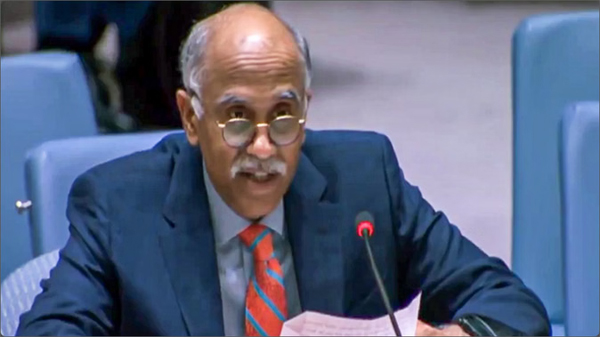
New York. India has emphasized on the positive use of new technologies during the conflict. India especially presented its views regarding Artificial Intelligence (AI). He said that there is a need to adopt a human-centric approach while using technology. Human understanding and monitoring should remain most important in the use of technology.
A high-level open debate took place in the United Nations Security Council (UNSC) on Tuesday. This debate was organized by Latvia. Ambassador Harish Parvatneni, India's Permanent Representative to the United Nations, said technology is progressing rapidly. This is affecting the nature of conflicts. Due to this the international security environment is also changing.
How is technology changing the nature of conflicts?
Parvataneni made four important points on the topic 'Conflict resolution in the rapidly changing technological era'. He explained what the international community should pay attention to regarding the increasing role of new technologies in conflicts.
“Rapid advances in technology are fundamentally changing the nature of conflicts and the international security environment,” he said. AI, autonomous systems and new digital technologies present unprecedented opportunities. But with them new vulnerabilities and risks also arise. These risks can emerge at every stage of the conflict. The use of AI has increased rapidly in military, intelligence and civilian sectors. It has fundamentally changed the landscape of international peace and security'.
What should be the purpose of technology?
The Indian Ambassador said, technology should be focused on humans. It should become a means of peace. It should be used to fulfill the goals set by humans. Technology should not be the end in itself.
Parvataneni said, 'Technology is a means to achieve the objectives and goals set by humans. It is not an end in itself'. He said, 'New technologies can play a positive role in conflict situations. With these, early warning systems can be strengthened. Better information about the situation can be obtained. Mediation may help. Peacekeeping operations can also be made safer and more effective.
He further said that AI-driven analytical tools can be helpful. Pictures obtained from satellites are also useful. Digital platforms can also help. With these, the United Nations can anticipate crises in advance. He can deal with crises more effectively.
use technology responsibly
Parvataneni told another important thing. He said, 'New technologies should be used responsibly during conflict. It should be human-centred. Sovereignty of countries should be respected. At the same time, it must be consistent with international law'.
He said, 'Technology should be used for security in every sector and at every level. It should be used to protect civilians, peacekeepers and humanitarian aid workers'.
What about lethal automatic weapons?
The Indian ambassador also expressed concern about lethal automatic weapons systems. He said that their use raises legal and ethical questions. India is committed to discussing these questions. The purpose of this conference is to try to strike a balance between military needs and humanitarian considerations.
“Human judgment and monitoring remain necessary, taking into account the operational context and characteristics of the weapon system,” he said. The responsibility for the use of such systems should always lie with humans.
What is the threat from terrorists and non-governmental groups?
In the third important point, Parvathneni raised the issue of misuse of new technologies. He particularly expressed concern over the misuse of AI by terrorist groups and non-state actors.
“The risks associated with AI are real,” he said. We must deal with them without any hesitation. The possibility of misuse of these new technologies by terrorists and non-state actors is a matter of grave concern. Incomplete, inaccurate or deliberately altered data through AI can undermine the decision-making process'.
What has India done for digital security?
The Indian Ambassador also mentioned India's digital infrastructure and cyber security. He said that India has made great progress in the field of new technologies. Attention has been paid to the security of essential information infrastructure in the country. Efforts have also been made to ensure continuous continuity of essential civil services.
He said, 'Within the country, the Information Technology Act and its related rules provide strong security. These prevent unauthorized access. Provides protection against data tampering. Also protects against disrupting computer systems. These safeguards remain relevant even during armed conflict'.
Can technology increase inequality between countries?
In the fourth important point, Parvataneni raised the issue of increasing technological inequality between countries. He said that technological change should not deepen the already existing inequalities. Especially the gap between developed countries and countries of the global south should not increase.
“We are concerned about emerging trends of technology exclusion,” he said. Technology is also being used to gain strategic advantage. For this, export control and licensing system is being used. There is also a tendency to consider countries in the global south as only consumers. They are not given any role or stake in how new technologies like AI will be developed, how they will be regulated and how they will be used.
AI threatens to increase social discrimination
Parvathaneni raised another concern with AI systems. He said that these systems can further the discrimination that already exists in society. He stressed that technological development should not harm human dignity.
“AI systems may inadvertently perpetuate discrimination based on gender, language and socio-economic background,” he said. AI should not reduce humans to mere data or raw materials'.
Participation of all countries is necessary in regulation of technology
He said that India supports international cooperation on regulation of technology. This cooperation should take place by taking all the countries together. The role of the United Nations is also important in this. However, it is important to keep in mind the countries' own priorities. Their developmental needs should also be understood.
He said, there is a need to reform the multilateral system. Especially reform in the United Nations Security Council is necessary. He said that the number of both permanent and temporary members in the council should be increased. This will reflect today's realities in a better way.