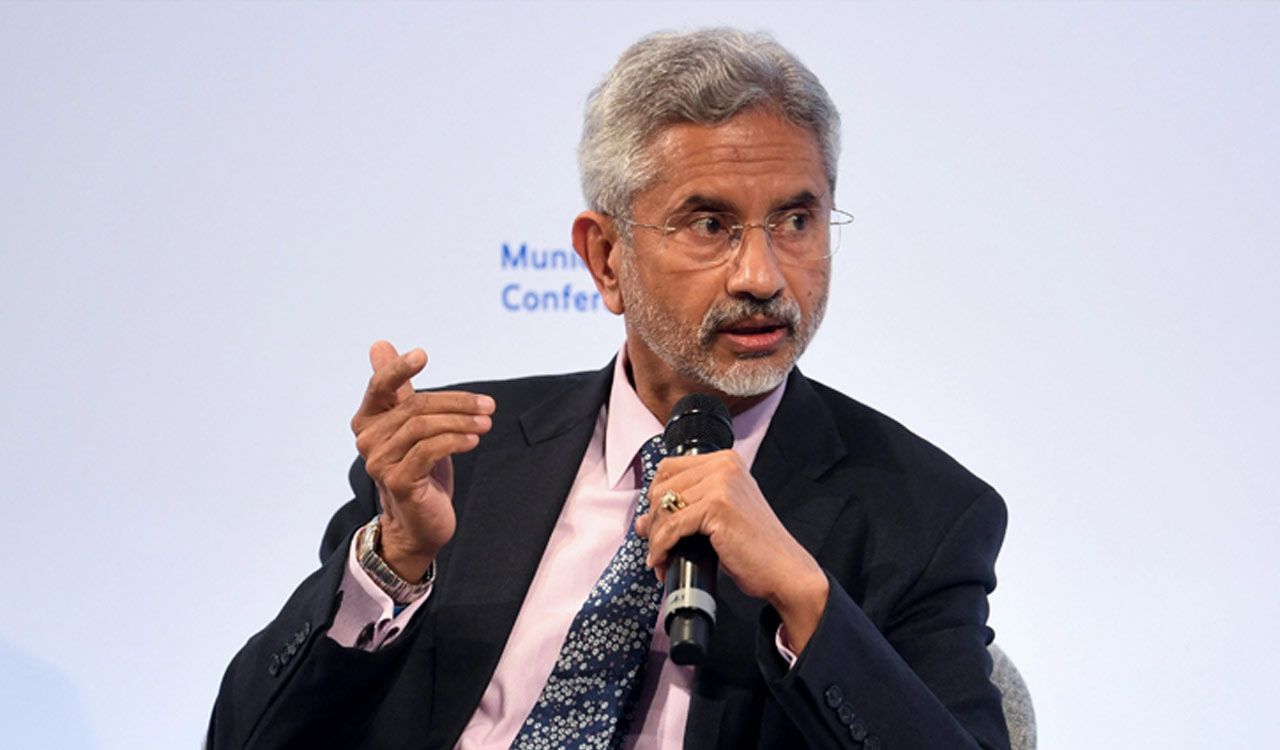
External Affairs Minister S Jaishankar said India’s border with China has become “more alive” and needs sustained troop deployment. He highlighted infrastructure upgrades since 2020 and discussed the economic gap with China, urging India to accelerate industrialisation and strengthen industry
Published Date – 14 November 2026, 05:49 PM
New Delhi: India’s border with China has become “more alive” and requires a much greater commitment of Indian troops on a sustained basis, External Affairs Minister S Jaishankar said on Saturday, as he outlined the government’s approach to enhancing infrastructure along the frontier.
Jaishankar also said India has bolstered its military capabilities along the Line of Actual Control (LAC) since the deadly clashes in Eastern Ladakh’s Galwan Valley in 2020.
His remarks at an interactive session at the HT Leadership Summit came amid ongoing efforts by New Delhi and Beijing to normalise relations, which came under severe strain following the over-four-year border face-off in Eastern Ladakh.
“Just think about the last few years. How often do you now read — a new tunnel has been built, some new bridge has been built, another airfield has been commissioned. You’re getting this news with greater and greater frequency,” he said.
“What has happened today is the border with China has become more alive in a way. It has required a much greater commitment of troops on a sustained basis.
“The fact is that the work we had already done allowed that kind of numbers to be deployed out there, and the work we continue to do will maintain those numbers,” he said.
After more than four years of frosty ties over the eastern Ladakh military standoff, India and China began repairing relations following a meeting between Prime Minister Narendra Modi and Chinese President Xi Jinping in the Russian city of Kazan in October 2024, after the face-off ended.
The talks between Modi and Xi covered a range of issues, including reducing their trade deficit, tackling challenges such as terrorism and ensuring fair trade on multilateral platforms.
“I would say when it comes to the border, I would honestly make this point, and I think there’s a lot of data and evidence to back it up, which is that the border infrastructure was really neglected till about a decade ago. I mean, people spoke about it, people drew up plan,” Jaishankar said.
“If you actually go on the ground and see year-by-year how many kilometres of roads, what was the tunnelling, what was the positioning, I think anybody, and certainly anybody associated with the armed forces dealing with that sector knows the truth,” he noted.
Jaishankar added: “It’s really been in the last decade that that kind of attention, resources, policy push has been given.”
The External Affairs Minister said India’s capability to “deploy” its troops along the border had improved “very markedly”.
Jaishankar also responded to a question on the economic asymmetry between the two countries.
“On the economic side, the 1960s, 1970s, 1980s, this was the time the world was industrialising, developing countries were industrialising. Remember, when around the time when Rajiv Gandhi went to China in 1988, the Indian and Chinese economies were about the same size,” he said.
“But the fact was that China, in the 1980s particularly, made a huge push towards modernisation and industrialisation. I’m sorry to say India in the 1980s simply missed the bus. Now in the 1990s, we did some corrections, reforms, but we did not carry through the reforms sector by sector and keep building and raising it,” he said.
“I don’t want you to think of it as a political point.”
The External Affairs Minister listed efforts by the Modi government in the areas of manufacturing and industrialisation.
“The fact is, there were decades where we missed out; now we have to play catch up; you can’t play catch up by following the same track. You have to do leap-frogging. We’ll have to build up our particular strengths to deal with this asymmetry issue.
“In asymmetry, you don’t go toe-to-toe on every issue. You pick the issues where you feel you have the ability to make a big change. That’s really what we think we’re doing right now,” he said.