
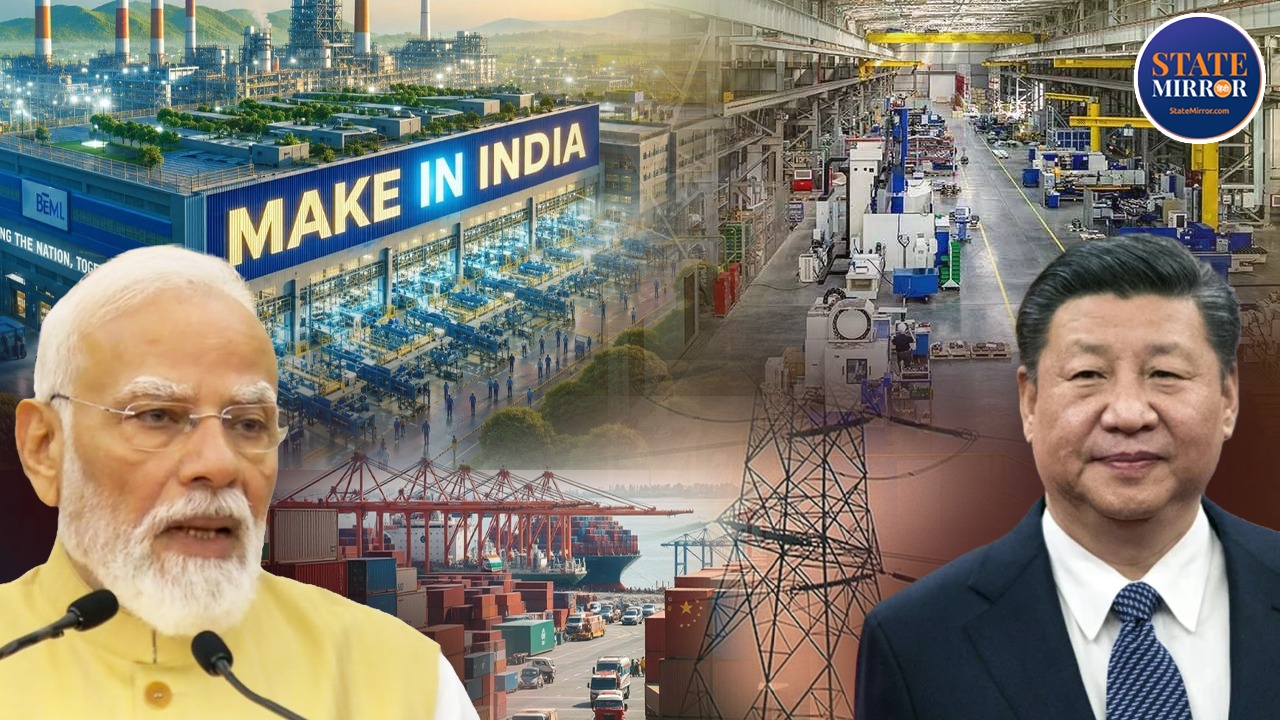
Is China necessary or a compulsion for India? Modi government approved government tender to 4 Chinese companies

Relations between India and China were not going normal for the last six years due to Galwar War. After the violent clash in Galwan Valley in 2020, the Indian government took many major decisions against China. Chinese apps were banned, investment rules were tightened, entry of Chinese companies in government tenders was stopped and many new conditions were imposed for security. At that time the message of the government was clear that there would be no compromise in matters of national security.
Now the same Modi government has taken a decision which has started a new debate. The government has given permission to four Chinese companies running manufacturing units in India to participate in government tenders for important power projects. In such a situation, questions are being raised whether India’s attitude towards China is changing or is this decision a result of the country’s industrial needs and economic compulsions?
Is India still so dependent on China in some important sectors that the government has to give limited concessions?
Which four companies have got relief?
The Central Government has given special relaxation in the rules of government procurement to TBEA Energy, Nanjing Electric India, New Northeast Electric India and Taikai Electric (India). These four companies run factories in India and manufacture equipment necessary for the power transmission sector. These include power transformers, high-voltage switchgear, gas insulated switchgear (GIS), transmission line equipment, cables and other electrical systems. These equipment play an important role in the big power projects going on in the country. This means that these are not ordinary industrial products but are equipment considered to be the backbone of the power system.
What were the rules earlier?
After the Galwan violence, the Central Government made major changes in the rules of public procurement. Under this, special registration was made mandatory for companies from countries sharing land borders with India (China, Pakistan, Nepal, Bhutan, Bangladesh and Myanmar) before participating in government tenders.
Apart from this, it was also necessary to obtain security and political clearance from the Home Ministry and the External Affairs Ministry. The government’s objective was to ensure that foreign companies operating in sensitive sectors are thoroughly vetted and there is no risk to national security.
What has changed now after six years?
The Expenditure Department of the Finance Ministry issued an order on June 24 exempting these four companies from this rule for two years. However, the government has also made it clear in its order that this exemption will be limited only to these companies and for a fixed period. This will not be considered a future policy or a permanent precedent. This means that the same rules will remain applicable to the remaining Chinese companies and they will have to go through the entire approval process to participate in government tenders.
Why did the government take this decision?
In January this year, the Energy Ministry had requested the Finance Ministry to give limited relaxation in government procurement to some Chinese companies already producing in India.
The biggest challenge before the government was that many big projects related to power generation and transmission are going on at a fast pace across the country. Some of the special equipment used in these projects is still manufactured by very few companies. If these companies were completely kept out, many projects would be delayed, costs would increase and the pace of expansion of power infrastructure would be affected.
On this basis, this approval was given after the recommendation of the Committee of Secretaries and the Registration Committee of DPIIT.
What do these companies make?
All four companies produce such equipment without which expansion of power transmission network is considered almost impossible.
These include power transformers, high voltage switchgear, gas insulated switchgear (GIS), transmission line equipment, electrical cables and high voltage control systems. They are used in high voltage transmission lines like 220 KV, 400 KV and 765 KV.
Of these, New Northeast Electric India claims on its website to work in at least 11 transmission projects across the country. It is clear from this that these companies have already been a part of the Indian power structure.
Why were restrictions imposed after Galwan?
On June 15, 2020, there was a violent clash between Indian and Chinese soldiers in the Galwan Valley in eastern Ladakh. After this, the Indian government took many big steps against China.
Hundreds of Chinese mobile apps were banned. FDI rules were changed. Participation of Chinese companies in government tenders was made difficult. Scrutiny of Chinese investments in sensitive sectors was tightened.
Meanwhile, in April 2020, the government implemented Press Note-3 (PN-3). Under this, government approval was made mandatory for any investment coming from countries sharing land borders with India, so that foreign companies cannot acquire Indian companies by taking advantage of weak valuations during the Corona epidemic.
Is India still dependent on China?
This is the most important question of this entire matter. The government is constantly talking about self-reliant India and Make in India, but the reality is that many strategic industries are still largely dependent on China.
Many critical parts of power equipment, high voltage switchgear, control systems, electronic modules and special industrial components still come from China in large quantities. This is why the government often has to strike a balance between national security and industrial needs.
Why is dependency in some areas greater than ever?
Compared to 2014, India has definitely increased domestic production in many sectors, but there are some important sectors where dependence on China has increased instead of decreasing.
Mobile phones have started being manufactured in India, but most of their components come from China. Assembly of solar panels is being done in India, but a large part of solar cells and many essential raw materials come from China. The situation is almost the same for electronics, machinery and many industrial equipment. That means the final product is being manufactured in India, but a large part of its supply chain is still connected to China.
Why is the pharmaceutical industry also dependent on China?
India is considered the world’s largest generic drug manufacturer, but about 65 percent of the active pharmaceutical ingredients (API) required to make medicines are imported from China.
If for some reason the supply of API from China is affected, then India’s pharmaceutical industry can also be directly affected. This is the reason why the government is continuously running schemes to increase domestic production in this sector also.
Why were projects stuck without Chinese engineers?
Last year, many Indian industry organizations had demanded the government to ease visa rules for Chinese engineers and technical experts.
The industry argued that the machines have been imported from China, but the experts to install and commission them are not able to come to India. Many projects in electricity, electronics, manufacturing and leather sectors were affected by this.
Many companies said that machines worth crores of rupees are installed in the plant, but due to lack of trained technicians, production is not being started.
What does the mathematics of trade with China say?
According to government data, India imports goods worth about 112 billion dollars from China every year. About 60 percent of this is engineering and electronic products.
A large part of mobiles, machinery, electrical equipment, electronic parts, chemicals and industrial components come from China. In comparison, India’s exports to China are very less. This is the reason why trade deficit between the two countries continues to persist.
What is the government doing to reduce dependency?
The government has promoted domestic manufacturing in the last few years through schemes like Make in India and Production Linked Incentive (PLI).
Incentive schemes worth billions of rupees have been launched to increase domestic production in mobile phones, electronics, semiconductor, automobile, batteries, solar equipment and pharmaceutical industries. Apart from this, many steps have also been taken to increase monitoring of cheap imports and to make the domestic industry competitive. Experts believe that it may take several years to completely change the supply chain.
Has India’s attitude towards China changed?
At present it is too early to say so. The government has given relief to only four companies for a limited period and has also made it clear that this is not a new policy.
However, this decision definitely indicates that the government now seems to be adopting a policy of ‘selective permission’ instead of imposing a complete ban. That is, where industrial needs have to be met without compromising national security and domestic alternatives are not available, relaxation can be given in a limited and controlled manner.
Necessary or compulsion?
This exemption given to four Chinese companies is not just an administrative decision, but it also brings out the current industrial reality of India. On one hand, the government is moving forward with the aim of self-reliant India, on the other hand, China’s role in many important sectors like electricity, electronics, machinery and medicine has still not ended completely.
This is the reason why at present India’s policy does not appear to be one of complete ‘distance from China’, but of ‘self-reliance where alternatives are available and controlled dependence where alternatives are not’. In such a situation the question still remains. Is China just a trading partner for India, or is there still a compulsion in some strategic areas, from which it will take time to get out completely.

Comments are closed.