
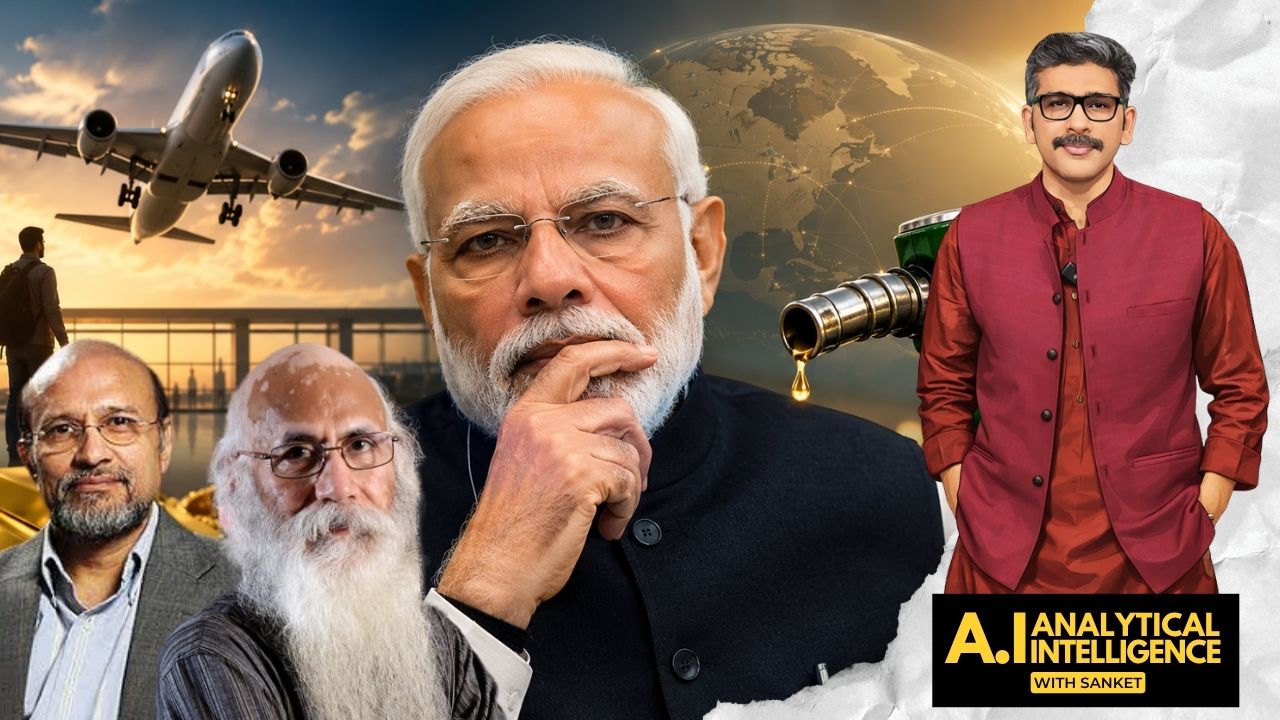

“The prime minister should act as the prime minister of the country, not the prime minister of the ruling party.” This is what prominent economist Prof. Arun Kumar said bluntly, warning that India’s deepening economic crisis demands national consensus — not political posturing.
India is currently reeling from a supply shock triggered by the Strait of Hormuz crisis, with crude imports, foreign exchange reserves, and the rupee all under severe stress. Against this backdrop, The Federal spoke to Prof. Santosh Mehrotra, Visiting Professor at the Centre for Development, University of Bath, UK, and Research Fellow at the IZA Institute of Labour Economics, Bonn, and Prof. Arun Kumar, Distinguished Economist and Professor at Jawaharlal Nehru University (JNU), to understand what ails the Indian economy and what the government must urgently do.
73 days late
The timing of the government’s response has drawn sharp criticism. Prof. Kumar was unequivocal: the steps now being announced should have been taken 73 days ago. “We should have been looking at these issues right from day one because we didn’t know how long the war would last and we still don’t,” he said. That 73-day window coincided precisely with India’s election season — a period during which queues vanished from petrol stations.
The supply shock is not limited to crude oil alone. Prof. Kumar pointed out that fertilisers, plastics, active pharmaceutical ingredients (APIs), and a range of other goods that flow from West Asia are all affected. “20 per cent of the crude and the gas coming from West Asia cannot be replaced by anything else,” he said. Meanwhile, India was simultaneously exporting 20 to 30 per cent of its refined petroleum products, allowing private sector companies to book large profits while domestic stocks were being depleted.
Also read: Iran effect | Polls done, PM seeks Covid-era measures from people: WFH, don’t buy gold
The consequences are now cascading. Crude imports fell by 40 per cent in March compared to the previous year. Energy shortages are disrupting production, transportation and household consumption. Workers are returning to villages from cities. People cannot access cooking gas. “When there is a shortage of energy, it affects your production, it affects your distribution, it affects your consumption,” Prof. Kumar said.
Windfall wasted
Prof. Mehrotra offered the longer historical arc. For a decade, this government benefited from unusually low global oil prices — a windfall that the preceding government of Dr Manmohan Singh did not enjoy, as high global demand from China, India, and Latin America kept prices elevated. Instead of using that fiscal breathing room wisely, the current government went on what Prof. Mehrotra called “a spending spree”.
Infrastructure spending was part of it, which he acknowledged as productive. But a large portion went into welfare expenditure — free goods and subsidies driven by electoral calculations — rather than into health, education, and nutrition, which he said should have been the priority. State governments followed suit. The result: the debt-to-GDP ratio ballooned from 56–58 per cent when this government came to power to 82 per cent today. “The absolute level of central and state government debt went from 62 lakh crores in 2014 to over 230 lakh crores. Horrible situation,” Prof. Mehrotra said.
Compounding this, the government made what he called “stupid mistakes” — cutting corporate income tax and personal income tax, which reduced revenues by an annualised 3 lakh crore rupees per year. Oil marketing companies are now under-recovering at 30,000 crore rupees per month. The fiscal crisis is now colliding headlong with a foreign exchange crisis.
PM’s 7 appeals
Against this backdrop, Prime Minister Narendra Modi made a public appeal in Telangana and later in Gujarat’s Vadodara, requesting citizens to avoid foreign travel, reduce petrol and diesel use, not buy gold for a year, work from home, and cut consumption of cooking oil, among other things. Both economists were sharply critical of these moral exhortations.
Also read: Soaring govt spending versus PM Modi’s austerity call to citizens
All the points that have been mentioned are largely things that the top 1 per cent of this country’s population consumes, which holds about 41 per cent of the nation’s wealth. The bottom 50 per cent is only holding about 6.3 per cent of the wealth. The Jewellers Association even sought a meeting with the PMO, protesting that the gold appeal had struck at their livelihoods.
Prof. Mehrotra was equally dismissive of the approach, comparing the Prime Minister’s tone to that of former PM Lal Bahadur Shastri’s wartime austerity call in 1965. “He is attempting to be this great statesman, likening himself to Shastri ji,” Prof. Mehrotra said. “Fact of the matter is the kind of actions he is proposing are literally at best cherry on the cake — and he is literally just mainly talking about the cake-eating people, not those who are eating dal roti.”
The real crisis
For the poor, the inflation figures are not the headline numbers cited by the government. Prof. Kumar laid out the arithmetic starkly: a family earning Rs 10,000–11,000 a month that was paying Rs 950 for a 14-kg LPG cylinder is now paying Rs 5,000 for the same. “Your rate of inflation is 60 per cent. Your rate of inflation is not 4 per cent,” he said. Rural employment guarantee schemes, which provided a buffer during the pandemic, are not operational in most parts of the country, leaving rural households without a safety net.
Prof. Kumar argued that if the wealthy are being asked to sacrifice, they must also be asked to pay more — through wealth taxation, estate duty, or gift taxation. “The rich will continue to use cooking oil as much as they like, while the poor suffer if we reduce the import of cooking oil because we are running short of foreign exchange,” he said. “We have to go for more equity in the society.”
Both economists agreed that without national consensus — which requires bringing the opposition on board — none of the steps will be effective. “Whether a nation responds to a call by the prime minister depends on whether they think it is credible at all,” Prof. Kumar said. “If he continues to attack the opposition, why would they come on board? You will not have a national consensus, and the kind of steps he is suggesting will not be effective.”
Hard choices ahead
On what must actually be done, the economists were direct. Prof. Mehrotra said petrol prices must be raised, diesel prices should preferably not be raised as they would spike inflation further, and urea prices must be raised. Currently, 85 per cent of the chemical fertiliser applied to soil in India is urea — far more than is agronomically optimal — simply because it is heavily subsidised while other fertilisers are not. Raising urea prices would reduce over-consumption, lower import and production requirements, improve soil health, and reduce the fertiliser subsidy bill, which last year stood at Rs 1.85 lakh crore and is expected to cross Rs 2 lakh crore this year.
Also read: Why PM Modi urged Indians to avoid buying gold; experts decode
“There is just no getting away from that. You have to raise prices,” Prof. Mehrotra said. “Let’s get down to serious macroeconomic policy making.”
Prof. Kumar outlined both short and long-term measures. In the near term, the government must distinguish between essential and non-essential consumption, and tax the latter — for instance, by levying higher taxes on cars while protecting spending on necessities. In the long term, India must invest seriously in R&D, education, health, renewable energy, and build a strategic energy reserve. China holds six months of reserves; India holds approximately 15 days. Coal gasification was also suggested as a medium-term domestic alternative.
“Let us hope for the best, but prepare for the worst,” Prof. Kumar said. “The worst is that the situation will continue to deteriorate.” Both economists were in agreement: unless the government acts decisively, the fiscal deficit, the trade deficit, and the rupee are all headed in one direction — haywire.
(The content above has been transcribed from video using a fine-tuned AI model. To ensure accuracy, quality, and editorial integrity, we employ a Human-In-The-Loop (HITL) process. While AI assists in creating the initial draft, our experienced editorial team carefully reviews, edits, and refines the content before publication. At The Federal, we combine the efficiency of AI with the expertise of human editors to deliver reliable and insightful journalism.)

Comments are closed.