0
New Delhi: India and Japan have agreed to significantly expand their defence and security cooperation, including allowing Japanese Self-Defence Forces to conduct live-fire training at firing ranges in India for the first time, as the two countries seek to deepen their strategic partnership amid growing geopolitical uncertainties in the Indo-Pacific region.
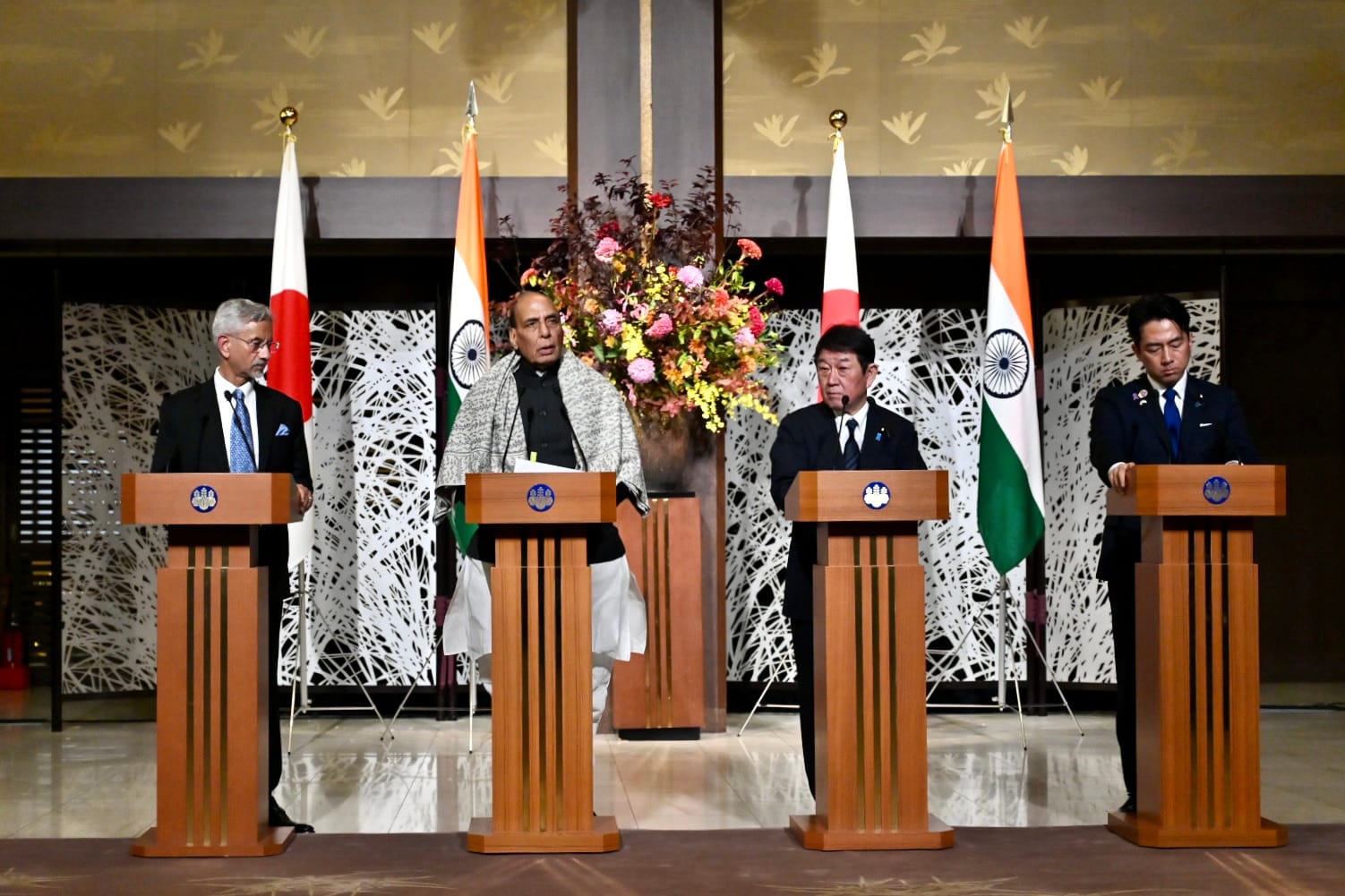
The decision was among the key outcomes of the fourth India-Japan 2+2 Foreign and Defence Ministerial Meeting held in Tokyo on November 19, attended by Defence Minister Rajnath Singh, External Affairs Minister S Jaishankar, Japan’s Foreign Minister Motegi Toshimitsu and Defence Minister Koizumi Shinjiro.
In a significant step towards strengthening military interoperability, the two sides welcomed the signing of a Letter of Intent (LoI) concerning the utilisation of firing ranges in India by Japan’s Self-Defence Forces. The arrangement will allow Japanese forces to undertake live-fire training, including exercises involving surface-to-ship missiles. Both countries agreed to accelerate coordination between their defence authorities to ensure its early implementation.
The ministers also expressed satisfaction over the expansion of bilateral military exercises, particularly following the first-ever deployment of Japan Air Self-Defence Force fighter aircraft to India for the joint air exercise Veer Guardian 26. They agreed to further increase the complexity of joint exercises, integrate unmanned systems and explore the possibility of conducting bilateral and multilateral exercises at short notice.
Another major focus was defence industrial cooperation, with both countries agreeing to accelerate arrangements related to the Unified Complex Radio Antenna (UNICORN) project. India is expected to complete the Acceptance of Necessity (AoN) process by February 2027. The initiative is part of the broader framework of ‘Design with Japan, Make in India’, aimed at combining Japanese technological expertise with India’s manufacturing capabilities. The ministers also welcomed the third India-Japan Defence Industries Forum, held in Tokyo in October 2026.
Maritime security emerged as another important area of cooperation. Welcoming the recently signed Memorandum of Arrangement on Maritime Security Cooperation, the two sides agreed to strengthen coordination between the Indian Navy and Japan Maritime Self-Defence Force. Cooperation will include Maritime and Air Domain Awareness, search and rescue operations, information sharing and humanitarian assistance and disaster relief.
The ministers also agreed to enhance mine countermeasure capabilities and explore possibilities for joint development in naval shipbuilding and design. Cooperation between the two countries’ coast guards will also be expanded, with India scheduled to host the fifth Coast Guard Global Summit in February 2027.
Beyond defence cooperation, the meeting placed considerable emphasis on strengthening economic security and creating resilient supply chains in strategic sectors. Both countries expressed concern over economic coercion, arbitrary export restrictions and non-market policies that create industrial overcapacity and disrupt global supply chains.
The ministers agreed to promote project-based cooperation in semiconductors, critical minerals, information and communication technology, clean energy and pharmaceuticals. They also welcomed progress under the second round of the Economic Security Dialogue and the first Private-Sector Economic Security Dialogue, encouraging closer collaboration between governments, industries and research institutions.
Artificial intelligence, cybersecurity and space cooperation also featured prominently in the discussions. The two sides agreed to strengthen cooperation in AI research and development under the Japan-India AI Cooperation Initiative (JAI), while also working towards secure digital connectivity through trusted and resilient undersea cable networks. They called for enhanced cybersecurity cooperation, particularly in protecting critical infrastructure and AI systems.
On the regional security front, the ministers reiterated their commitment to a free, open and rules-based Indo-Pacific, opposing unilateral attempts to change the status quo through force or coercion. They also emphasised greater coordination through the Quad and cooperation with ASEAN member countries to promote regional stability.
The two countries strongly condemned terrorism in all its forms, including cross-border terrorism, and called for concerted international action against UN-listed terrorist organisations, including Lashkar-e-Taiba and Jaish-e-Mohammad. They also reaffirmed their mutual support for reforms in the United Nations Security Council, including expansion of both permanent and non-permanent membership categories.
The meeting also assumed significance ahead of the 75th anniversary of the establishment of diplomatic relations between India and Japan in 2027. The two governments have decided to celebrate the milestone throughout the year as the ‘India-Japan Year of Shared Horizons’, with commemorative programmes and initiatives to strengthen people-to-people exchanges. Further, both sides agreed to continue regular consultations on regional and international security developments and decided to hold the fifth 2+2 Ministerial Meeting in India at a mutually convenient date.