
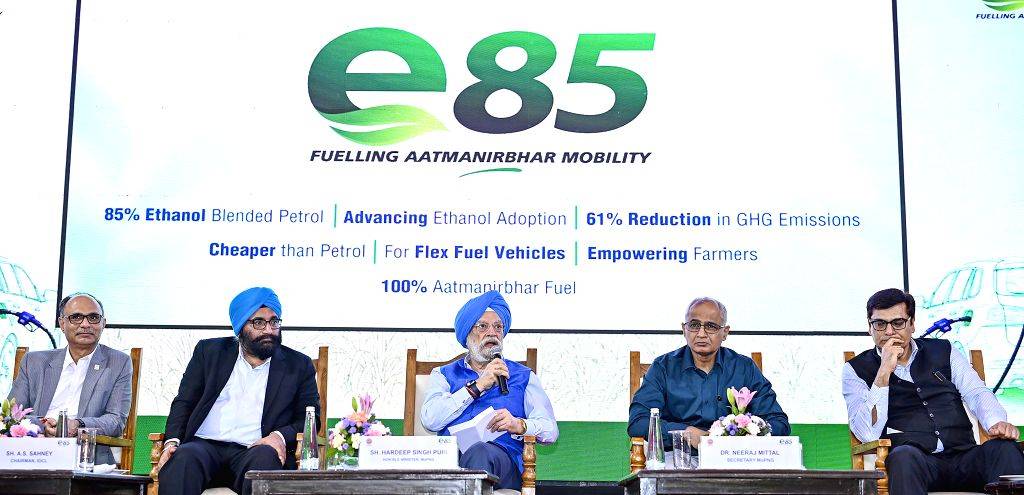

New Delhi: India Friday launched E85 fuel, a high-ethanol blend designed for flex-fuel vehicles, at Rs 20 a litre discount to normal petrol.
The fuel will initially be available at select petrol pumps and can be used only in vehicles with flex fuel engines.
Union Petroleum and Natural Gas Minister Hardeep Singh Puri unveiled the fuel at an IndianOil retail outlet in New Delhi on World Environment Day, with the rollout beginning at 48 public sector fuel stations nationwide.
He said the government plans to expand its availability to 500 outlets by December 2026 and to about 5,000 outlets by December 2027.
E85 contains 80-85 per cent ethanol and 14-19 per cent petrol, and can be used only in flex-fuel vehicles capable of operating on ethanol blends ranging from E20 to E100.
The expansion of E85 infrastructure is expected to help raise India’s overall ethanol blending level to nearly 26 per cent by 2030-31, he said.
Puri said India had successfully balanced energy security, affordability and sustainability, while shielding consumers from global energy market volatility. He noted that domestic fuel prices had seen among the lowest increases globally since February 2026.
India has increased ethanol blending in petrol from 1.53 per cent in 2014 to 20 per cent currently, achieving its target five years ahead of schedule, the minister said. The programme has helped save more than Rs 1.84 lakh crore in foreign exchange and reduced crude oil imports by nearly 302 lakh metric tonnes, he added.
The government has priced E85 at nearly Rs 20 per litre below conventional petrol, aiming to pass on the benefits of domestically produced ethanol to consumers, he said.
According to ministry estimates, flex-fuel vehicles running on E85 can reduce lifecycle greenhouse gas emissions by around 61 per cent compared with conventional petrol vehicles. Ethanol’s higher octane rating also enables improved engine performance and cleaner combustion with significantly lower particulate emissions.
Puri said that if half of all new two-wheelers and passenger vehicles sold in India shift to flex-fuel technology, annual ethanol demand could rise by more than 312 crore litres, generating roughly Rs 12,403 crore in additional income for farmers. Such a transition could also save about Rs 15,151 crore in foreign exchange annually and cut carbon dioxide emissions by 66.4 lakh metric tonnes, he said.
Drawing comparisons with Brazil, where more than 80 per cent of light vehicles operate on flex-fuel technology, Puri said India was moving from pilot projects to a structured national flex-fuel ecosystem.
He also sought to dispel concerns about ethanol-blended fuels, saying E85 is intended exclusively for flex-fuel vehicles and that no engine failures linked to ethanol blending had been reported since E20 became the national standard fuel.
The minister urged state governments to support the transition through favourable taxation policies for E85 fuel and flex-fuel vehicles, describing ethanol as a key component of India’s drive toward energy self-reliance.
“Every litre of ethanol replaces imported fossil fuel,” Puri said. “Every drop of E85 carries the spirit of an Atmanirbhar Bharat.”
PTI

Comments are closed.