
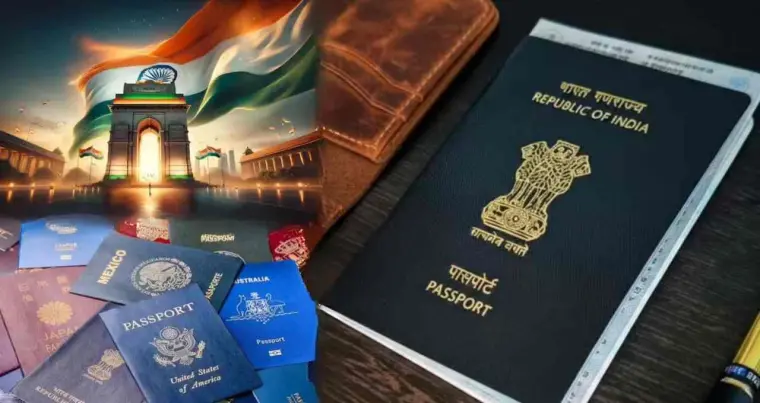

India is one of the largest and fastest growing economies in the world. There has been a significant expansion in the country’s economy in the last decade, due to which India has gained a place among the global economic powers. However, in terms of global passport power and freedom of international travel, the Indian passport has not yet been able to find a place among the top 50 most powerful passports in the world.
According to Henley Passport Index 2026, India is ranked 80th. This marks an improvement compared to last year, when India was ranked 85th. However, India still lags behind countries whose citizens enjoy visa-free or easy entry to most countries in the world.
The Henley Passport Index evaluates 199 passports and 227 travel destinations in the world. The ranking of a country’s passport is determined by the number of countries its citizens can travel to without prior visa, visa-on-arrival or Electronic Travel Authorization (ETA).
At present Indian passport holders have relatively easy entry facility into 56 countries. However, for approximately 170 countries, it is necessary to obtain a visa in advance. This is the reason why despite being an economic power, India’s passport ranking is comparatively low.
According to experts, the GDP or economic size of a country does not directly determine its passport power. The power of a passport is based primarily on diplomatic relations, visa agreements, immigration risks, security standards and international trust. That is why even America, one of the largest economies in the world, is not at the top position in the passport ranking. Similarly, China, the world’s second largest economy, is also lagging behind many developed countries in terms of passport power.
There has been a continuous change in India’s passport ranking in the last two decades. In the year 2006, India was ranked 71st. After that the ranking declined and in 2015 it reached 88th rank. Even during the Covid-19 pandemic, the global mobility of Indian passports was affected. The situation has improved after the pandemic and India is gradually moving towards better ranking. However, with other countries signing new visa-free agreements more quickly, India’s progress has been limited.
According to experts, the biggest challenge facing India is that passport ranking is a comparative system. Even if India is successful in getting visa-free entry to some new countries, if other countries sign such agreements more quickly, there will be no major change in India’s ranking. Additionally, factors such as per capita income, migration concerns, document security and border controls also influence the decisions of different countries.
For this reason, passports of many small but developed economies are considered stronger than Indian passports. According to experts, India needs to focus on more bilateral visa-free travel agreements. Additionally, increasing trade, tourism and diplomatic cooperation globally can further expand travel facilities for Indian citizens.
In recent years, countries such as the Philippines and Malaysia have decided to allow visa-free entry for Indian citizens, which is seen as a positive development. If the number of such agreements increases, a more significant improvement in India’s passport ranking may be possible in the coming years.

Comments are closed.