

New Delhi: India is undertaking one of the world’s largest dam rehabilitation and safety modernization programs as the country focuses on strengthening aging water infrastructure through policy reforms, digital monitoring systems and large-scale rehabilitation initiatives.
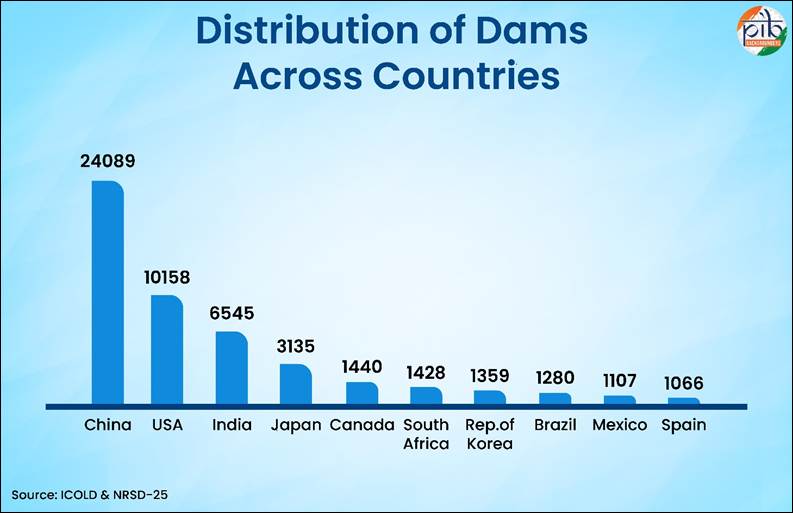
With 6,628 specified dams, India has the world’s third-largest dam network after the United States and China. These dams play a crucial role in irrigation, hydropower generation, drinking water supply, flood control and overall water security. However, with more than a quarter of the country’s dams now over 50 years old, the government has intensified efforts to modernize aging infrastructure and improve long-term resilience against structural risks and climate-related challenges.
According to Jal Shakti Ministry, 1,681 dams in the country are over 50 years old, while 291 are more than a century old. Another 42 percent fall within the 25–50 year age bracket. India’s oldest functioning dam, the historic Kallanai, also known as the Grand Anicut in Tamil Nadu, has remained operational for nearly 2,000 years.
The Ministry said aging infrastructure, sedimentation, changing rainfall patterns and rising climate variability have increased the urgency for systematic rehabilitation and risk-based safety management. A study of 439 reservoirs by the Central Water Commission found that reservoirs have lost an average of 19 per cent of their gross storage capacity due to sedimentation, with annual storage losses estimated at 0.74 per cent.
DRIP Emerges as Flagship Dam Safety Program
To address these concerns, the government launched the Dam Rehabilitation and Improvement Project (DRIP), a multi-phase program focused on improving dam safety and operational performance through structural repairs, spillway modernisation, digital monitoring and institutional reforms.
DRIP Phase I, implemented between 2012 and 2021 with assistance from the World Bank, covered 223 dams across seven states – Jharkhand, Karnataka, Kerala, Madhya Pradesh, Odisha, Tamil Nadu and Uttarakhand.
The program focused on structural rehabilitation, dam safety inspections, emergency action planning and institutional capacity building. It also introduced the Dam Health and Rehabilitation Monitoring Application (DHARMA), a digital platform aimed at improving monitoring and data management.
The second and third phases of DRIP, operational since October 2021, have significantly expanded the programme’s scale. Together, DRIP Phase II and III cover 736 dams across 19 states and three central agencies, including the Central Water Commission, Bhakra Beas Management Board and Damodar Valley Corporation.
The total financial outlay for the program stands at ₹10,211 crore, co-financed by the World Bank and the Asian Infrastructure Investment Bank (AIIB). Of this, ₹7,000 crore is being supported through external loans, while participating states and agencies are contributing ₹3,211 crore.
Major dams undergoing rehabilitation under the program include Bhakra Dam, Nagarjuna Sagar Dam, Gandhi Sagar Dam and several others across the country.
As of March 2025, rehabilitation proposals worth over ₹5,053 crore for 191 dams had been approved, while major physical rehabilitation work had been completed at 43 dams.
Dam Safety Act Brings Legal and Institutional Framework

A major institutional milestone came with the implementation of the Dam Safety Act, 2021, which came into force in December 2021.
The law established a nationwide framework for surveillance, inspection, operation and maintenance of specified dams to prevent dam-related disasters and improve accountability among dam owners.
Under the Act, a “specified dam” refers to dams over 15 meters in height or dams between 10 and 15 meters meeting specific technical criteria.
The Act created a four-tier institutional structure comprising the National Committee on Dam Safety (NCDS), the National Dam Safety Authority (NDSA), State Committees on Dam Safety and State Dam Safety Organizations (SDSOs).
All 31 dam-owning states have now established State Dam Safety Organizations responsible for inspections, monitoring and compliance.
The law also mandates regular inspections, installation of instrumentation systems, risk assessments, inflow forecasting systems, emergency action plans and early warning systems.
The Ministry said the Act has shifted dam safety from an advisory framework to a legally enforceable system with defined responsibilities and timelines.
Digital Monitoring and Real-Time Surveillance
Technology has emerged as a central pillar of India’s evolving dam safety ecosystem.
The DHARMA platform now hosts data for all 6,628 specified dams and supports digital inspection records, maintenance tracking and safety assessments.
Authorities conduct nearly 13,000 dam inspections annually, with findings digitally documented through the platform.
Rapid Risk Screening exercises have already been completed for 5,553 dams using web-based assessment tools designed to identify structural vulnerabilities and prioritize rehabilitation.
The government has also focused on installing instrumentation systems, hydro-meteorological stations and early warning mechanisms to strengthen real-time monitoring and disaster preparedness.
In a major step towards seismic safety, the National Center for Earthquake Safety of Dams is being established at Malaviya National Institute of Technology Jaipur.
Additionally, Centers of Excellence on dam safety are being developed at Indian Institute of Technology Roorkee and Indian Institute of Science Bengaluru, focusing on seismic hazard mapping, reservoir sedimentation, advanced rehabilitation technologies and risk assessment.
Dam Owners Face Mandatory Compliance Requirements

The new regulatory framework places extensive responsibilities on dam owners, including central and state governments, public sector undertakings, private companies and local authorities.
Dam owners are now required to establish dedicated dam safety units, conduct pre- and post-monsoon inspections, allocate maintenance funds, prepare emergency action plans and carry out periodic comprehensive safety evaluations.
Under the inspection framework introduced in April 2024, dams are categorized into three groups based on risk levels. Category I dams indicate critical deficiencies requiring urgent intervention, Category II includes dams with major deficiencies, while Category III includes dams with minor or no deficiencies.
According to the latest post-monsoon inspections for 2025, three dams were categorized under Category I and 188 under Category II.
The Act also prescribes penalties for non-compliance, including imprisonment and fines in cases where negligence or obstruction endangers lives or causes significant risks.
Focus Shifts from Expansion to Lifecycle Management
The Ministry said India’s dam policy focus is gradually shifting from building new structures towards improving safety, operational efficiency and lifecycle management of existing infrastructure.
With climate change increasing the frequency of extreme rainfall events and hydrological variability, the emphasis is now on strengthening resilience, modernizing monitoring systems and ensuring long-term structural integrity.
The integration of rehabilitation programs such as DRIP, legal oversight through the Dam Safety Act and digital platforms like DHARMA is being viewed as a major step towards creating a modern and data-driven dam safety ecosystem in India.
Experts believe the ongoing reforms will not only reduce disaster risks but also improve water security, operational efficiency and the long-term sustainability of critical infrastructure that supports agriculture, energy and urban water supply across the country.
(DD News)

Comments are closed.