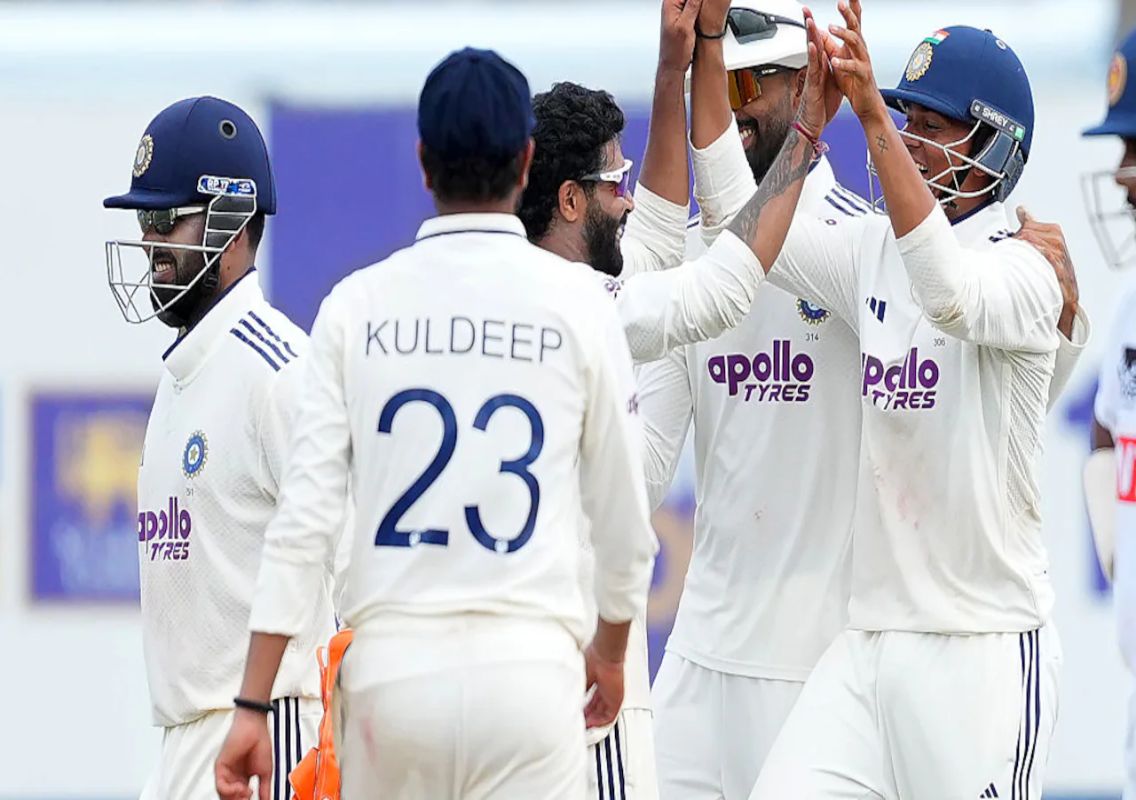
Galle: India will begin Day 4 of the first Test against Sri Lanka with a 178-run lead, but the visitors face a race against time as rain threatens to disrupt the remainder of the match. India had bowled Sri Lanka out for 284 on Day 3 after the hosts recovered from a precarious 99/5, leaving the visitors in a strong position going into the final two days.
India were bowled out for 462 in their first innings, with Devdutt Padikkal producing an outstanding 167, while KL Rahul made 82 and Dhruv Jurel contributed 51. Sri Lanka’s response was anchored by Sonal Dinusha, who scored his maiden Test century, but India’s spinners eventually completed the job.
With India holding a substantial lead, the key question on Day 4 is how aggressively Shubman Gill’s side bats in the second innings and when they decide to declare.
India take 178-run first-innings lead
India’s bowling attack managed to dismiss Sri Lanka for 284, giving the visitors a 178-run advantage.
Manav Suthar was the standout performer with the ball, claiming 4/76, while Ravindra Jadeja took 3/57. The pair played a crucial role in breaking Sri Lanka’s resistance after the hosts appeared to be in serious trouble earlier in the innings.
Sri Lanka had been reduced to 99/5 at one stage, putting India firmly in control. However, Sonal Dinusha and Niroshan Dickwella mounted a strong recovery and prevented the innings from collapsing completely.
Dinusha’s maiden century proved particularly important for Sri Lanka. His resistance helped the hosts reach 284 and reduced the damage caused by the early collapse.
Nevertheless, India emerged with the significant 178-run advantage that now puts them in command of the Test.
Devdutt Padikkal’s 167 gives India a strong platform
India’s first innings was dominated by a superb performance from Devdutt Padikkal.
The left-hander scored 167, providing the backbone of India’s total of 462. His innings was supported by Rahul’s 82 and Jurel’s 51, giving India the batting depth needed to build a sizeable first-innings lead.
The performance is particularly encouraging for India’s middle order, with Padikkal converting his opportunity into a major Test score.
India’s overall total also meant Sri Lanka had to bat under pressure from the beginning of their innings.
India need to balance aggression and caution
Although India are in a strong position, the match is far from over.
The biggest factor working against the visitors is time. Rain is forecast in Galle, with overcast conditions and a 70 per cent chance of rain reported around the start of Day 4.
That makes India’s second innings particularly important.
The visitors cannot simply bat for a long period and accumulate runs at a conventional Test-match pace. They need to create enough time for their bowlers to dismiss Sri Lanka again.
Former India batter Cheteshwar Pujara has urged the team to be brave with its declaration. He suggested that India should look to give their bowlers around 90 to 100 overs and potentially declare with a lead of between 350 and 375 runs.
That approach would require India to score quickly rather than prioritising a huge second-innings total.
Aakash Chopra also calls for an aggressive approach
Former India batter Aakash Chopra has made a similar argument.
Chopra believes India should look to bat for around 40 overs on Day 4 and set Sri Lanka a target of approximately 350. He suggested that India’s deep batting line-up gives the team the freedom to attack and score rapidly.
Chopra specifically called on Yashasvi Jaiswal to play his natural aggressive game and urged KL Rahul to use the different gears available to him.
His concern is that a delayed declaration could leave India exposed if the weather improves and Sri Lanka get enough time to chase a target.
The balance is therefore delicate. India need a sizeable target, but they also need enough overs to take 10 wickets.
Galle’s fourth-innings history adds pressure
The conditions at Galle make India’s declaration decision even more interesting.
According to the data cited by NDTV, the average third-innings total at the venue is around 239, while the average fourth-innings score drops to approximately 154.
That suggests chasing a substantial target in the fourth innings can be extremely difficult.
However, Galle has also witnessed successful fourth-innings chases. Pakistan famously chased 342 at the venue four years ago, which remains the highest successful chase there. The next-highest successful chase is 268, while the third-best is only 164.
For India, this presents an interesting calculation.
A target in excess of 300 could put enormous pressure on Sri Lanka, but India must ensure they leave themselves enough time to take all 10 wickets.
Rain could change the entire Test
Weather could ultimately become the biggest factor.
There was already an early stoppage on Day 3, and the forecast for Day 4 is also uncertain. NDTV reported cloud cover in Galle and a 70 per cent chance of rain during the day.
If significant playing time is lost, India’s strategy will have to change.
A declaration that would normally provide sufficient bowling time could become risky if several hours are lost to rain. Conversely, waiting too long to declare could mean Sri Lanka escape with a draw despite India holding a significant advantage.
The Indian team management will therefore need to monitor both the scoreboard and the weather conditions closely.
Manav Suthar emerges as a major positive
One of the biggest positives for India has been the performance of Manav Suthar.
The spinner’s 4/76 helped India remove Sri Lanka’s lower order and secure the 178-run lead. His ability to extract drift, bounce and turn has attracted praise from Aakash Chopra, who described Suthar as an upgraded version of Ravindra Jadeja as a bowler.
That performance could be crucial if India get enough overs to bowl Sri Lanka out again.
Jadeja’s 3/57 further strengthens India’s spin options, particularly if the Galle surface becomes increasingly difficult to bat on during the final innings.
India have a clear opportunity to take control
India’s position at the beginning of Day 4 is considerably stronger than Sri Lanka’s.
The visitors have a 178-run lead, their bowlers have already shown they can take wickets and their batting line-up has produced a large first-innings total.
However, the match situation demands an aggressive approach.
India need to transform their first-innings advantage into a target that puts Sri Lanka under serious pressure while preserving enough time to bowl them out.
The weather makes that calculation even more complicated.
Conclusion
India enter Day 4 of the Galle Test in a commanding position with a 178-run lead after dismissing Sri Lanka for 284. Manav Suthar’s four-wicket haul and Ravindra Jadeja’s three wickets were instrumental in securing the advantage.
The bigger challenge now is India’s declaration strategy. With rain threatening and only two days remaining, the visitors cannot afford to waste too much time batting.
Experts including Cheteshwar Pujara and Aakash Chopra have called for an aggressive approach, with India potentially targeting a lead of around 350 before declaring.
If India’s batters can score quickly and their spinners get sufficient time on the field, the visitors have a strong opportunity to push for victory. But the weather in Galle could ultimately decide whether India’s advantage is enough to produce a result.