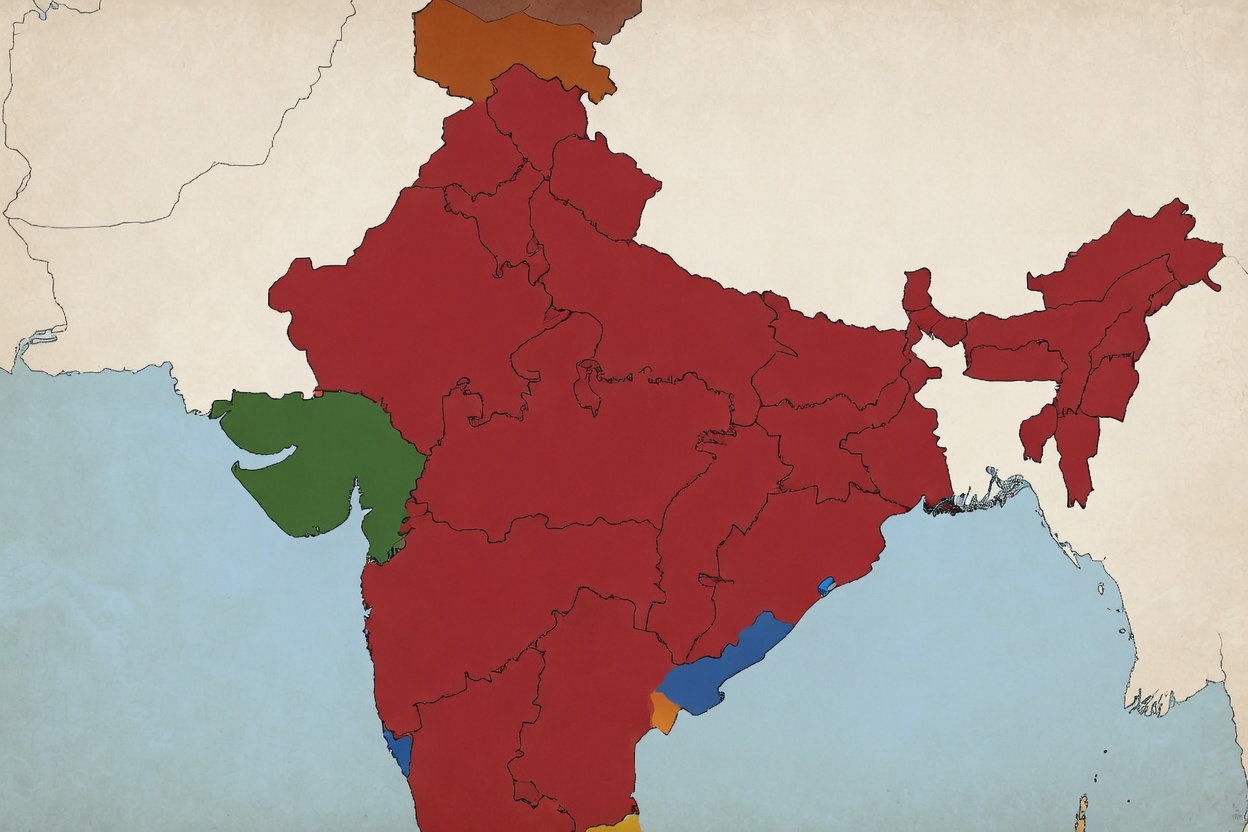
Portuguese, Dutch, Danish, French and British powers established settlements across India, while a separate European mistake caused Indigenous peoples in the Americas to also be called Indian
By Obnews Editorial Staff
When most people think about the colonization of India, they think almost exclusively about the British Empire. Britain certainly became the dominant colonial power across the subcontinent, but it was not the only European country to establish settlements and control territory in India. Portugal, the Netherlands, Denmark and France also governed ports, towns and coastal enclaves that remain part of modern India today.
The history is more complicated than five countries simply dividing India between them. European control developed gradually through trading agreements, corporate settlements, military alliances, conquest and competition with Indian rulers. Some European powers controlled only individual ports, while Britain eventually became the paramount power across most of the subcontinent. In several places, control passed from one European empire to another.

The story also creates an important question about identity. People originating from India are Indians, but Indigenous peoples in Canada and the United States were historically called Indians as well. These populations have no historical connection to India. The shared terminology resulted from a European geographical mistake that began with Christopher Columbus.
India Existed Long Before European Colonialism
India was not an empty or politically undefined territory waiting to be discovered. Long before European ships arrived, the subcontinent contained powerful kingdoms, empires, republics, commercial cities and tribal societies. Its history included the Indus Valley civilization, the Mauryan and Gupta empires, major southern kingdoms, the Delhi Sultanates, the Mughal Empire, the Maratha Confederacy, the Sikh Empire and hundreds of regional states.
The name India also predates European colonialism by thousands of years. It developed from Sindhu, the ancient Sanskrit name associated with the Indus River. The name travelled through Old Persian and Greek before becoming India in European languages. According to Encyclopaedia Iranica, the linguistic history of India’s name can be traced through these ancient geographical traditions.
It is also necessary to distinguish the modern Republic of India from the historical Indian subcontinent. Ancient Indian history includes important locations that are now in Pakistan and Bangladesh. British India covered present day India, Pakistan and Bangladesh, while Burma remained administratively connected to British India until 1937.
Portugal Established the First Major European Colonial Power
Vasco da Gama reached Calicut, now Kozhikode in Kerala, in 1498 after sailing around the Cape of Good Hope. He was not the first European in Indian history, but his voyage established a direct maritime route between Western Europe and India that could be controlled without relying on existing overland networks.
Portugal captured Goa in 1510 under Afonso de Albuquerque and transformed it into the administrative centre of its Asian empire. Portuguese possessions eventually included Goa, Daman, Diu, Dadra and Nagar Haveli. Portugal also controlled earlier territories and settlements around Cochin, Bombay, Vasai and other parts of India’s western coast.
Bombay provides one of the most striking examples of territory moving between European powers. The islands of Bombay were transferred from Portugal to the English Crown in the seventeenth century as part of the marriage arrangements between Catherine of Braganza and King Charles II. The English Crown subsequently leased Bombay to the East India Company.
Portuguese rule lasted considerably longer than British rule in parts of India. Dadra and Nagar Haveli broke from Portuguese control in 1954. Goa, Daman and Diu remained under Portuguese administration until Indian forces took control in December 1961. The Government of Goa records that Goa had been under Portuguese rule since 1510, creating a colonial period lasting more than four centuries.
The Dutch Built a Commercial Network
The Dutch East India Company, commonly known as the VOC, entered India during the early seventeenth century. Its primary objective was commercial domination rather than the conquest of the entire subcontinent. Dutch officials wanted textiles, pepper, spices, indigo, saltpetre and other products that could be sold throughout Asia and Europe.
Major Dutch settlements included Pulicat and Nagapattinam in Tamil Nadu, Cochin in Kerala, Surat in Gujarat and Chinsurah in Bengal. Records maintained by the Dutch National Archives identify Cochin, Nagapattinam, Pulicat, Surat and Chinsurah as important centres of Dutch administration and trade in India.
The Dutch captured Cochin from the Portuguese in 1663, demonstrating how some Indian ports passed through multiple colonial regimes. Dutch power in India eventually declined as the company concentrated more heavily on Indonesia and faced growing British competition. The remaining Dutch settlements in India were transferred to British control during the early nineteenth century.
Denmark Controlled Settlements in Tamil Nadu and Bengal
Denmark and Norway also maintained colonial settlements in India. Their most prominent possession was Tharangambadi in Tamil Nadu, which Europeans called Tranquebar. Danish representatives reached an agreement with Raghunatha Nayak of Thanjavur in 1620 and constructed Fort Dansborg along the coast.
According to the National Museum of Denmark, Tranquebar remained a Danish settlement from 1620 until 1845. It was primarily an Indian town containing merchants, fishermen, craftspeople and labourers, but it was governed by a small and powerful European colonial elite.
Denmark later established another settlement at Serampore in Bengal, known under Danish rule as Frederiksnagore. Serampore remained under Danish control from 1755 until 1845. Both Serampore and Tranquebar were eventually sold to Britain.
France Nearly Challenged British Dominance
France established settlements at Pondicherry, Karaikal, Mahé, Yanam and Chandernagore. French officials initially hoped to construct a larger territorial empire by combining European military power with alliances involving Indian rulers.
During the eighteenth century, France and Britain fought for influence through the Carnatic Wars and the wider global conflict between their empires. French governor Joseph François Dupleix pursued an ambitious policy of intervention in Indian political disputes, but British victories ultimately prevented France from becoming the dominant European power in the subcontinent.
France nevertheless retained several small enclaves even after Britain consolidated control over most of India. Chandernagore joined West Bengal during the early 1950s. Pondicherry, Karaikal, Mahé and Yanam were transferred to India in 1954. According to the Government of Puducherry, the remaining French possessions were transferred to the Indian Union on November 1, 1954, although the final legal process continued afterward.
Britain Turned a Company Into an Empire
Britain’s involvement began through the English East India Company, which received its royal charter in 1600. The company established commercial centres at Surat, Madras, Bombay and Calcutta. For much of its early history, it remained dependent upon permissions and agreements granted by Indian rulers.
The decisive transformation came during the eighteenth century. The company’s victory at the Battle of Plassey in 1757 gave it enormous influence in Bengal. In 1765, it acquired the right to collect revenue in Bengal, Bihar and Orissa. Indian tax revenues could then finance additional armies, wars and territorial expansion.
The East India Company expanded through military conquest, political agreements, revenue collection and subsidiary alliances with Indian princes. Its armies depended heavily on Indian soldiers, commonly called sepoys. Britain did not conquer India using only British troops. It built power by using Indian revenue, Indian military personnel and divisions among competing regional states.
Not all of India was administered directly by British officials. Large provinces were incorporated into British India, while hundreds of princely states remained under Indian rulers. These rulers often controlled domestic administration, but Britain controlled or heavily influenced defence, foreign relations and succession. Their states were not fully independent even though they were not administered in the same manner as British provinces.
Following the uprising of 1857, the British Parliament removed the East India Company’s governing authority. The Government of India Act of 1858 transferred its possessions and armed forces to the British Crown. Crown rule continued until India and Pakistan became independent in August 1947.
One Indian River Contained Five European Powers
The Hooghly River corridor in Bengal provides perhaps the clearest illustration of India’s multinational colonial history. Portuguese settlers established themselves around Bandel. The Dutch controlled Chinsurah, the Danes governed Serampore, the French held Chandernagore and the British built their capital at Calcutta.
According to research published by the International Council on Monuments and Sites, these settlements created a remarkable European colonial corridor along the Hooghly. Remnants of churches, forts, government buildings, cemeteries and trading centres from several empires remain visible.
Tamil Nadu experienced a similarly complex history. The Portuguese were associated with San Thomé, the Dutch with Pulicat and Nagapattinam, the Danes with Tharangambadi, the French with Pondicherry and Karaikal, and the British with Madras. Kerala experienced Portuguese, Dutch, British and French control in different locations and periods.
Were There “Native Indians” in India?
People were unquestionably native to India before European colonization, but “Native Indian” should not be presented as the name of a single Indian ethnic group. India contains thousands of communities, languages, regional identities and cultural traditions. There is no single biologically pure population representing all of India’s original inhabitants.
The term Adivasi is used by many tribal and Indigenous communities in India and conveys the idea of original or ancient inhabitants. However, not every tribal community accepts or uses that identity. India’s Constitution uses the formal category Scheduled Tribes rather than “Native Indians.” Under Article 342, recognition as a Scheduled Tribe is connected to specified communities in particular states or territories.
According to the Ministry of Tribal Affairs, India’s 2011 census counted approximately 104.5 million Scheduled Tribe residents, representing 8.6 per cent of the national population. These communities are extremely diverse and include hundreds of separate peoples with their own languages, histories and relationships with the land.
Modern genetic research also shows that the people of India descend from multiple ancient populations that migrated and mixed over thousands of years. Studies published in Science and Nature describe a complicated population history involving ancient South Asian hunter gatherers, populations connected to the Indus region, Iranian related ancestry, Steppe related migrations and additional eastern influences. This makes attempts to identify one genetically pure “first Indian race” scientifically misleading.
Why Indigenous Americans Were Called Indians
The Indigenous peoples of the Americas are entirely separate from the people of India. The confusion began after Christopher Columbus reached the Caribbean in 1492 and believed he had arrived near Asia or the Indies. Europeans consequently applied the Spanish term indios to the Taíno people and later expanded the label to hundreds of unrelated nations across North, Central and South America.
Columbus did not actually reach India, nor did he encounter people of Indian ancestry. He encountered Indigenous Caribbean peoples whose civilizations had developed independently over thousands of years. Nevertheless, the mistaken European name became embedded in colonial laws, government departments and popular language.
In Canada, Indigenous Peoples is the collective term for First Nations, Inuit and Métis. First Nations does not include Inuit or Métis. The word “Indian” continues to carry a specific legal meaning under the Indian Act, but many First Nations people do not use it as their preferred identity. Library and Archives Canada traces this historical terminology directly to Columbus and subsequent European colonial administration.
In the United States, both Native American and American Indian remain in use. Some Indigenous people prefer American Indian, while others prefer Native American or Indigenous. The National Museum of the American Indian recommends using the specific nation’s chosen name whenever possible, such as Cherokee, Diné, Lakota or Muscogee.
India’s Colonial History Was Not Exclusively British
Britain created the largest and most consequential colonial system in India, but focusing only on the British erases centuries of Portuguese, Dutch, Danish and French involvement. It also overlooks the competition between European corporations, monarchies and Indian states that shaped the eventual rise of British power.
The most accurate conclusion is not that five European countries divided all of India equally. It is that five principal European powers established possessions in India, several regions passed between competing empires, and Britain eventually subordinated most of the subcontinent through direct administration or indirect political control.
Understanding this history also resolves the confusion surrounding the word Indian. Indians are the people of India. First Nations, Inuit, Métis, Native Americans and the other Indigenous peoples of the Americas are distinct peoples whose connection to the word resulted from a colonial geographical mistake. The shared label reflects European history, not a shared origin.