
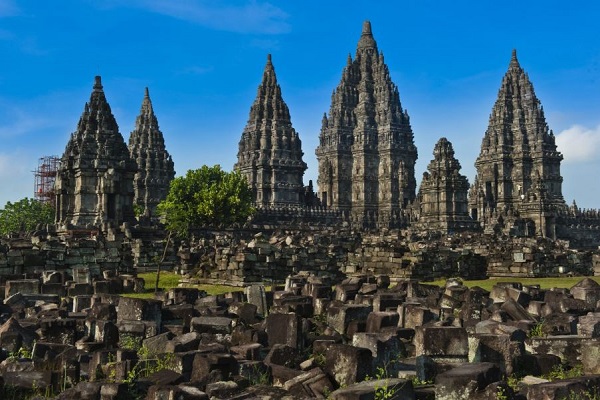
India will help in the conservation of ancient Shiva temple in Indonesia, PM Modi will launch this project tomorrow

Jakarta, July 7. Prime Minister Narendra Modi on Tuesday announced that he will join hands with Indonesian President Prabowo Subianto to launch a conservation project for the 1,000-year-old Prambanan temple in Yogyakarta. He described the monument as ‘another brilliant evidence’ of the deep cultural and civilizational ties linking India and Indonesia for more than a thousand years.
Addressing a joint press meet after delegation-level talks with the Indonesian President at Istana Merdeka in Jakarta, Prime Minister Modi said, ‘I, along with President Prabowo, will have the privilege of launching the conservation project of Prambanan Temple in Yogyakarta. Prambanan Temple, which is more than a thousand years old, is a symbol of the shared cultural heritage of India and Indonesia.
Actually, this conservation project is a part of India’s cultural diplomacy and ‘Act East Policy’ in South-East Asia. The Archaeological Survey of India (ASI) is working closely with Indonesian authorities to restore and conserve several small temples present in the Prambanan complex.
Prambanan is one of the largest temple complexes located near Yogyakarta on the island of Java, Indonesia. It includes the original structures built in the 9th century AD. The temples collapsed due to earthquakes (including the May 2006 Java earthquake), volcanic eruptions, and changes in political power beginning in the 11th century, and were rediscovered in the 17th century.
UNESCO has declared Prambanan Temple as a World Heritage Site.
Prambanan Temple is actually a complex consisting of 240 temples dedicated to Shiva, Vishnu and Brahma. Prambanan was designed as three square sections built inside each other. There are a total of 224 temples in the entire complex. The innermost square has 16 temples, the most important of which is the 47 meter high central Shiva temple. There is a temple of Brahma in the north and a temple of Vishnu in the south. UNESCO has declared it a World Heritage Site. According to this, the stone carvings of the temple depict the Indonesian version of the epic Ramayana.
The Prambanan Temple Complex represents the grand culture of Shiva art as a masterpiece of the classical period in Indonesia and the region. The global body said restoration work has been going on since 1918, using both the traditional method of joining stones together and the modern method of using concrete to strengthen the structure of the temple. On full moon evenings in the months of May to October, the Ramayana ballet is staged in the open theater built on the southern side of the temple.
Looking at the future, we agreed that our nations must work closely in areas such as space, telecommunications, artificial intelligence, Digital Public Infrastructure and other emerging technologies. pic.twitter.com/PWOf3mgtbs
— Narendra Modi (@narendramodi) July 7, 2026
Meanwhile, Prime Minister Modi declared the coming year as ‘Tagore-Dewantara Year of Cultural and Educational Diplomacy’ to honor the shared legacy of Gurudev Rabindranath Tagore and Indonesia’s first education minister Dewantara.
During the joint press statement with the Indonesian President, PM Modi said, “Both our countries will also celebrate the centenary of Gurudev Rabindranath Tagore’s historic visit to Indonesia with great pomp. The great educationist and its first Education Minister Devantara ji has made an important contribution in the development journey of Indonesia. Gurudev Tagore’s thinking had a deep influence on his thoughts regarding education. Therefore, India-Indonesia will celebrate this centenary year as “Tagore and Devantara year of Cultural and Educational.” Diplomacy”.
It is noteworthy that PM Modi reached Indonesia on Monday on a two-day visit at the invitation of President Subianto. Today PM Modi signed MoUs and cooperation agreements in several sectors including health and technology. The two leaders held a private meeting, which was followed by delegation-level bilateral talks.

Comments are closed.