Manoj Kumar Aggarwal
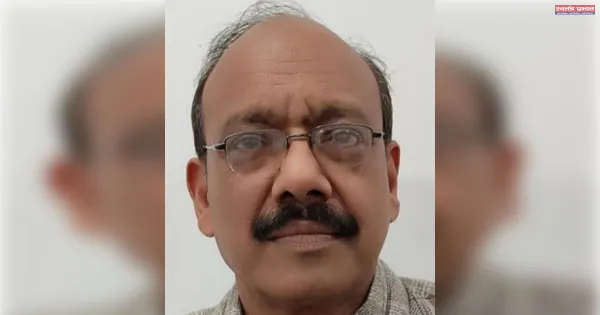
The need for fair opportunities, autonomy and professional respect for Indian scientists to do better research has been a topic of discussion for a long time. While on one hand new research schemes are being started in the country, on the other hand challenges also arise regarding work culture and resources. The latest addition to our list of scholars is Bengaluru-based mathematician 'Riddhi Pratim Basu' who has received the 'Infosys Prize-2026' in Mathematical Sciences for his work on solving complex problems in 'Probability Theory', solving the decades-old slow-Bond problem, random growth and statistical physics.
By solving this puzzle, he proved that even a small blockage at one point can slow down the flow in the entire system. According to a study, Riddhi Pratim Basu, a resident of Kolkata, did U.C. before joining Stanford. His Ph.D. from Berkeley. D. completed. His achievement has reminded us of India's great theoretical physicist and mathematician 'Satyendra Nath Basu' (Bose) (1894-1974), whose talent was recognized by the world.
Let us tell you that his contribution in the field of 'Quantum Mechanics and Statistics' is incomparable. While teaching at Kolkata University in the year 1924, 'Satyendra Nath Bose' wrote a very important research paper. In this he derived Planck's quantum radiation law, without taking the help of classical physics.
He sent his research paper to the famous scientist Albert Einstein, who recognized its importance, translated it into German and helped Satyendra Nath Bose in getting it published. Their joint work laid the foundation of Bose–Einstein statistics and predicted the existence of a fifth state of matter, the Bose–Einstein condensate.
Physicist 'Paul Dirac' named 'Boson' in honor of 'Satyendra Nath Bose', it is a class of sub-atomic particles whose spin is integer. These include photon and Higgs boson.
Satyendra (Bose's) photographs, his research papers etc. are present in Albert Einstein's house in Bern. It would be considered ironical that other people were given the biggest 'Nobel Prize' of science for the research based on the work of 'Satyendra Nath Bose', but 'Satyendra Nath Bose' himself was not given this prestigious award despite being nominated for it 4 times. After his death, when his discovery was recognized, the Nobel Prize selection committee refused to give it saying that they do not give the award to the deceased.
But do we respect our scientists as much as we should? Are there any statues of our scientists anywhere? Can't we dedicate even a day to the great scientists of India? When we talk about great thinkers like Aryabhata, about India being the first to give zero to the world, we should also respect our great scientists. Perhaps due to lack of support, among Indian scientists only Dr. C.V. Raman himself received the Nobel Prize in 1930.
It is not that there is dearth of great famous scientists in India, our scientists have made important inventions and discoveries in every field-physics, engineering, space and biology, like Jagadish Chandra Bose, Subrahmanyan, Chandrashekhar, Sir M. Visvesvaraya, Yellapragada Subbarao etc. There is also a long line of such Indian women scientists, like Anna Mani, Asima Chatterjee, Kamla Sohoni, Rajeshwari Chatterjee, Indira Hinduja, and many more.
Our scientists go to NASA and work in countries around the world. When we think of NASA, we think of Kalpana Chawla or Sunita Williams, but do we know that Kamlesh Lulla is the Chief Scientist for Earth Observation at NASA Johnson Space Center? Sharmila Bhattacharya is currently working as the Chief Scientist of Astrovionics at NASA Ames Research Center. Ashwin Vasavada is an MSL at NASA's Jet Propulsion Laboratory in California. He holds the important post of Deputy Project Scientist.
Ashwin is also an important member of NASA's most ambitious mission 'Mars Curiosity Rover'. So why don't we give them the respect they deserve in our own country? We, who have been considering ourselves world leaders in the field of mathematics and science since the beginning, have our inclination towards science reduced? If we had encouraged our scholars or remembered the contributions of our ancient scholars, who knows how many more could have received this award.
Certainly this is a great achievement, but how many Indians today know how talented our scientists were and are. Keep in mind that in many research institutions, there have been complaints of administrative control and respect on the basis of position instead of freedom to take scientific decisions. Due to lack of better opportunities, working environment and respect, many researchers go abroad or resign from institutions in the country.
Many experts believe that scientists should be judged on the basis of working on complex topics for long periods of time, the flexibility to learn from failure, and quality work that goes beyond mere paper standards. Research is being promoted and funded by the Government of India through initiatives such as the National Research Foundation, Research, Development and Innovation Scheme, Ramanujan Fellowship and INSPIRE. The contributions of scientists like Homi Jehangir Bhabha, Chandrashekhar Venkataraman, Vikram Sarabhai and Jagadish Chandra Bose have given India a strong identity in the fields of space, nuclear energy and science. There is a need to consider their contribution as an inspiration and move forward.