Digital Desk, Busted. The increasing role of private companies in India's space sector is now opening the way for new technologies. Many ambitious projects are underway in space, from satellite repair and refueling to garbage removal and medicine experiments. The special thing is that Indian companies are continuously getting new projects from the international market also.
Read :- India at new peak in the world of space, NASA invites ISRO to become partner in 'Moon Base Mission'
Indian space startups have received 8 new launch contracts in the last one month. Most of these are related to foreign customers. Companies are also moving towards selling satellite engines to other countries and creating ground station networks in different parts of the world. These engines of satellites help them to change their position in space for many years. Now preparations are on to extend the benefits of space technology to agriculture. Indian startups are planning to connect about 10 lakh farmers with satellite data. Through this, information related to weather, moisture present in the soil and condition of the crop can be collected. This is expected to help farmers in taking more accurate decisions related to farming.
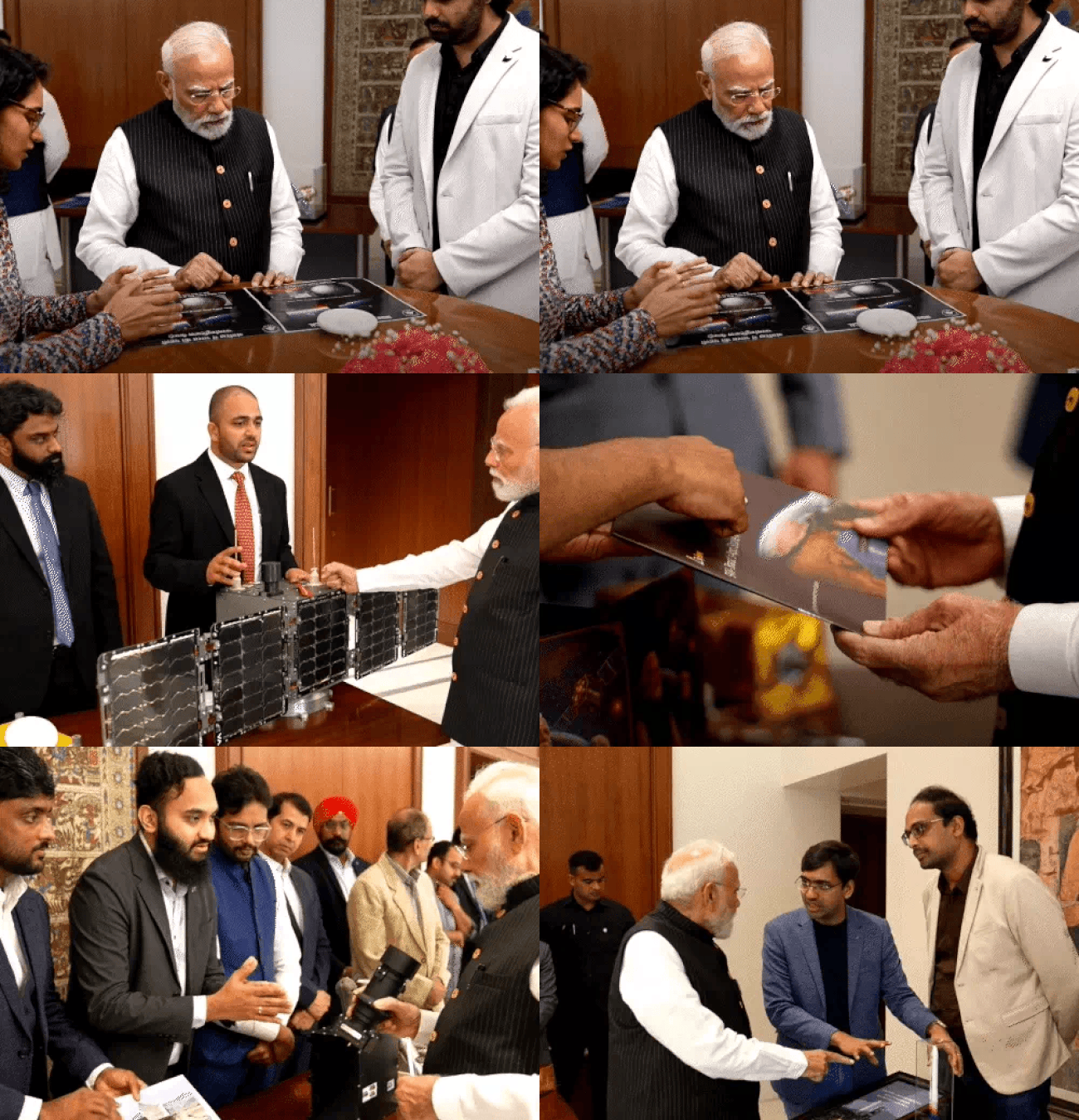
Regarding these changes, Prime Minister Narendra Modi talked to the founders of 20 space startups of the country on August 21. During this, companies gave information about their projects, technical achievements and future plans. The video of this conversation was released on 23 August. The PM assured the startups that entrepreneurs doing new experiments and taking risks will continue to get support from the government.
Return of engineers working abroad to India
The impact of the growing scope of private space companies is also visible on the talent pool of the country. Some Indian engineers working in America and Europe are now returning to India and working with space startups. The Prime Minister said that the country needs to create such an environment so that scientists and engineers of the world see the space sector in India as a better career option.
Read :- India's first private rocket Vikram-1 successfully launched, country's big flight in space
'Fuel station' in space for satellites
In future, technology is being developed to save a satellite mid-mission if its fuel runs out. An Indian company is working on a docking and refueling system. Through this, a spacecraft will be able to connect to another satellite and fuel it in orbit itself. In simple language, there is an attempt to create such a system in space itself, which can work like a petrol pump for satellites.
Robot will clean useless satellites
With the increasing number of satellites in orbit, old space debris is also becoming a challenge. Indian startup is preparing robotic spacecraft to deal with this problem. This technology can be used to capture defunct satellites and remove them from their current orbit. This will help in securing the path for future space missions.
Experiments on medicines in zero gravity
Read :- ISRO successfully tested 'Semi-Cryogenic Engine Power Head', big preparations to step on the Moon by 2040
Another Indian company is preparing to use the microgravity environment of space for pharmaceutical research. Gravity on Earth affects the behavior of proteins and other substances. New possibilities related to medicines and proteins are being explored by experimenting on these substances in the extremely low gravity environment of space. The plan to bring the finished products to Earth later is also part of this area.
The goal beyond making rockets every month
In the meeting, Skyroot also informed the Prime Minister about its production capacity and future plans. The company said that it has three factories ready and currently the capacity to make one rocket every month has been developed. The company's ambition is to continuously increase the pace of launches. On July 18, the company also shared information about successfully launching satellites into orbit with India's first private rocket.
India's space sector is no longer limited to government institutions. Private companies are entering into different areas like launch vehicles, satellites, space debris, refueling, pharma research and agriculture data. The government also aims to provide such an ecosystem to these companies in the country so that India can make a strong place in the global market with low-cost space technology.