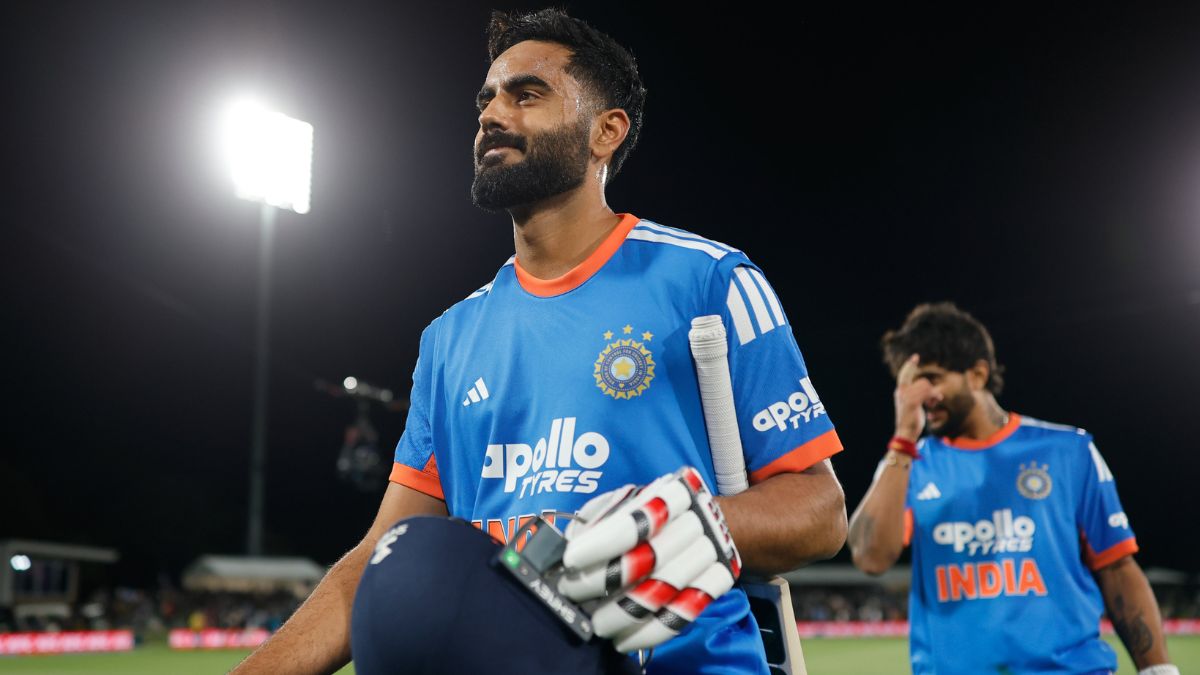
India's record chase against New Zealand may have been celebrated, but the innings also highlighted an issue of having a strong top order and middle order that were unable to accelerate when chasing targets.
At Hagley Oval in Christchurch, Naman Dhir scored a blistering 42 off just 15 balls to provide the reply with a fiery finish. Walking in with the chase hanging in the balance, the youngster produced a fearless innings to help India hunt down 226 in the opening T20I of the five-match series.
His innings of five fours and two sixes at a strike rate of 280 provided a much-needed turn of pace and also provided glimpses of what the lower order could deliver. However, there are questions being asked about the team's middle order and batting positions.
From a flying start to a middle-order collapse: Naman Dhir
India's chase got off to a spectacular start. New Zealand had posted 225/4, thanks to Glenn Phillips' unbeaten 82. The visitors needed to chase 226 in reply.
Sanju Samson and Abhishek Sharma struck a breezy 94 in the opening six overs. Samson hit 67 from 33 deliveries and the first stand got India off to the ideal start. The visitors got the momentum they needed to chase a score well above par.
However, the momentum shifted as soon as the powerplay ended. New Zealand struck early and removed both openers before Tilak Varma and Ishan Kishan were also out in quick succession. All of a sudden New Zealand turned their chase into a middle-order scrap.
Mitchell Santner and Michael Bracewell brought the pressure on through the middle overs, making life difficult for the incoming batters. Shreyas Iyer and Axar Patel then steadied the innings with a 45-run partnership, but Axar's dismissal in the 15th over left India with a mammoth 46 from the final four overs.
When Iyer was back in the pavilion, the pressure was on. India were six down and the rate was already above 12 an over. New Zealand seemed to have full control of the situation.
Also read: Ishan Kishan Injury Update: Vaibhav Sooryavanshi Could Replace Him for 2nd T20I
Naman Dhir delivers when India needs him most
With the situation going south, Dhir came in at number seven with little room for error. What happened next was a lesson in controlled aggression. Rather than be dictated by the situation, Dhir backed his strike-making abilities. His clean wristwork, powerful pulling and the gaps he found between the wide outsides saw India get a crucial new innings against Nathan Smith and Adam Milne.
Short but effective, Dhir's 15-ball innings ensured that whenever New Zealand went to wrap up the innings, there was a boundary to keep the required rate within touch. He backed his ability to score even as wickets tumbled around him.
The finale was fittingly dramatic, with India still needing runs in the dying moments. Dhir hooked over the boundary for a top-edged six to complete the chase and secure a dramatic win.
It was an innings that could change perceptions. Dhir hadn't just contributed in the quickfire manner of a lower-order finisher. He had shown the necessary attitude and attacking instincts of a specialist finisher when the pressure was on.
Dhir's emergence as a lower-order finisher is even more interesting given his development through the domestic and franchise T20 leagues. Having played for Mumbai Indians, he gets the opportunity to see many different situations in the high-intensity environment of the T20 IPL. His white-ball opportunities have ensured that he is in contention for a specialist finisher role in the longer format.
India have been looking for more options around the sixth and seventh positions, especially with their all-rounders struggling to contribute in the late stages. A batter that can quickly get the strike in hand is also a valuable option.
Dhir's emergence comes at a time when India are still looking to settle the lower middle-order. Nitish Kumar Reddy has yet to make a mark, and Hardik Pandya's recovery is also in doubt. With reports suggesting that Pandya may miss the 2027 IPL, which would make the search for a dependable lower-middle-order batter even more of a priority. The situation regarding Pandya's recovery should be treated as tentative until it is confirmed.
Captain Shreyas Iyer was quick to praise Dhir's temperament after the match, highlighting his ability to remain calm in a pressured situation.
“He gives us lots of options. I personally feel the calm and composed nature he showed tonight, it was magnificent,” Iyer said.
That praise will undoubtedly be seen as the situation was a crucial one for India. However, Dhir's innings could also prove valuable for his role as a finisher for a team that is looking to move forward and be a championship contender.
Naman Dhir's brilliance should not mask India's middle-order concerns
It would be easy to overlook the concerns that preceded Dhir's 15-ball masterclass. His strike rate of 280 is certainly something to note, but India's need for 46 from the final four overs highlights the precarious situation they were in.
After their explosive powerplay, India lost four wickets in a short space of time and struggled to consolidate their innings against New Zealand's spin. The uncertainty over the batting positions of Tilak Varma and Ishan Kishan also adds another concern to the equation.
Dhir's innings has certainly given the management a reason to consider him for a specialist finisher role, but one innings cannot answer all of the questions. India needs to find more of a balance between explosive starts and the consolidated efforts of the middle overs.
The remaining matches in the series should give India the opportunity to address this situation. Dhir was a good find for a batter in the final overs, but the bigger issue is to find a combination that can get the strike in hand early.
India will need to see if there is an effective combination that can get them to a situation where Dhir has the responsibility of getting the strike in hand. If they can achieve that, they may have a more effective middle and lower order.
For India, the Christchurch thriller could provide them with two valuable lessons – one for their options as a lower-order finisher and one for their need for greater balance in the middle order. Dhir may have saved a game for them, but they need to be ready to take advantage of the opportunities he has created.