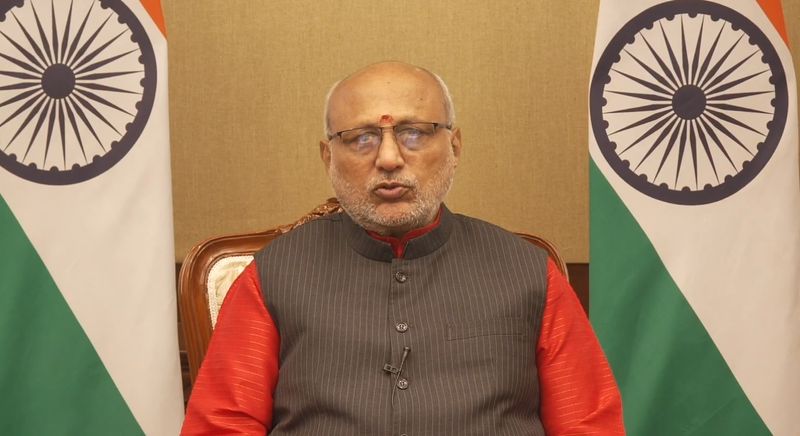
PUNE, Nov 21: Vice President C P Radhakrishnan on Saturday said India’s strength lies in welcoming, respecting and embracing different cultures.
Addressing the 23rd convocation ceremony of Symbiosis International (Deemed University) in Pune, Radhakrishnan said India now has over 1,400 universities, up from 760 in 2014-15.
“The number of IITs has risen from 16 to 23, while IIMs have increased from 13 in 2014 to 22 currently. Similarly, the number of AIIMS has increased from seven in 2014 to 23 across the country,” he said.
Noting that education must become a bridge between nations, cultures and communities, the Vice President said India is emerging as a global knowledge hub through international education partnerships.
He urged students to stay away from drugs and spread awareness against substance abuse.
He also stressed the importance of women’s education, lifelong learning and social responsibility on the occasion.
Maharashtra Governor Jishnu Dev Varma and Higher and Technical Education Minister Chandrakant Patil were also present.
“It is a pleasure to see students from different countries coming together to celebrate India’s cultural heritage while showcasing the diversity of their own traditions,” Radhakrishnan said.
Recalling his visit to Pune in September for the 38th Pune Festival, Radhakrishnan said he was particularly happy to remember the cultural performance presented by Symbiosis’ international students at that event.
“Such occasions reflect India’s strength in welcoming, respecting and embracing different cultures,” he added.
Speaking about women’s empowerment, Radhakrishnan said he had attended convocation ceremonies across the country, from Kashmir to Tamil Nadu, Assam, Nagaland and Tripura to Rajasthan, and Pune to Bhubaneswar.
“Providing women with the right education is the real way to empower them. Educated women will empower themselves,” the Vice President said.
He appreciated the establishment of Symbiosis Medical College for Women, saying it creates opportunities for women to pursue medical education and contribute to the healthcare needs of the nation and the international community.
“I appeal to students to say no to drugs, keep themselves away from substance abuse and create awareness among others to help them remain free from drugs,” the Vice President added.
Referring to the Indian philosophy of ‘Vasudhaiva Kutumbakam’ (one world, one family), Radhakrishnan said it was not merely a philosophy but a way of life in India for centuries.
“At a time when the world faced complex challenges, education must serve as a bridge between nations, cultures and communities to bring young people together,” he added.
The Vice President said the world was undergoing extraordinary transformation due to artificial intelligence, digital technology, renewable energy and scientific discoveries, and urged students not to stop learning after graduation.
He asked students to develop the courage to experiment, confidence to take calculated risks and determination to turn ideas into reality, while ensuring that economic and technological progress remained rooted in human values.
Noting that professional success is important, Radhakrishnan stressed that “character and ethical conduct earned lasting respect”.
He urged students to pursue excellence with integrity and remain sensitive to the needs of society and the nation.
Radhakrishnan said student enrolment in higher education institutions has increased from 3.4 crore in 2014-15 to more than 4.5 crore currently.
“Education offered opportunities but also placed an obligation on individuals to contribute to the welfare of others,” he said, adding that people should live for society along with themselves and give back what they received from it.
Radhakrishnan said nation-building was not solely the responsibility of governments but a collective effort involving citizens, educational institutions, the business community and others.
“Every honest professional, job-creating entrepreneur and socially committed individual contributed to the larger vision of a prosperous nation and the world,” he added.
Emphasising India’s role as a responsible global partner, the Vice President highlighted the Indian Technical and Economic Cooperation (ITEC) Programme, which benefits professionals and officials from over 160 partner countries.
“Since 2014, more than 80,000 professionals, including 30,000 women, from the Global South have benefited from ITEC training. India firmly believes in sharing knowledge, skills and expertise with partner countries on the basis of mutual respect and equality,” he said.
The Vice President further said that initiatives such as UPI and India Stack demonstrated the country’s growing contribution to global digital public infrastructure, financial inclusion and good governance.
He added that the international campus of IIT Madras in Zanzibar, Tanzania, was another example of India’s expanding educational and technological partnership with Africa.
Recalling India’s G20 Presidency in 2023, the Vice President highlighted the African Union’s admission as a permanent member of the G20, describing it as an important step towards strengthening Africa’s representation in global decision-making.
Referring to rapid technological changes driven by artificial intelligence, digital technology, renewable energy and scientific innovation, the Vice President urged graduates to embrace lifelong learning.
“Your degrees are valuable foundations, but lifelong learning will be your greatest asset,” he said.
Radhakrishnan said India is moving towards becoming a developed nation by 2047 under the leadership of Prime Minister Narendra Modi.
“The Prime Minister has repeatedly emphasised the transformative role of educational institutions in achieving national goals,” he said.
Radhakrishnan said Symbiosis (Deemed University) is taking the rich legacy of Indian higher education beyond the country’s borders.
He noted that the university established its first international branch campus in Dubai in 2024 and had emerged as one of the fastest-growing Indian universities in the Middle East.
“Such initiatives strengthen educational ties between India and the UAE and reflect India’s growing stature as a global knowledge hub,” he added.
The Vice President said the university had a student strength of over 62,000 during the 2025-26 academic year, including more than 29,000 female students.
“These figures reflect the institution’s commitment to inclusive education, women’s empowerment and equitable access to opportunities, and also include students from the northeastern region and other parts of India.
“The presence of over 3,000 international students from 85 countries further strengthened the university’s global character,” he said, recalling that students from several countries had proudly presented their national flags to him. (PTI)