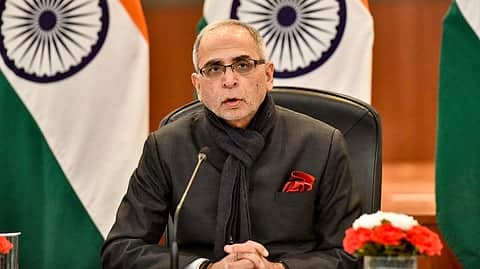
India’s Ambassador to the United States, Vinay Kwatra, has strongly defended New Delhi’s decision to place the historic Indus Waters Treaty (IWT) in abeyance.
Writing in a compelling opinion piece for Newsweek, Kwatra stated that Pakistan had effectively destroyed the spirit of the 1960 agreement long before India officially put it on hold.
According to Kwatra, the treaty was originally built on mutual goodwill and friendship. However, decades of cross-border hostility and obstructionist tactics by Islamabad completely eroded that foundation.
“Pakistan spent half a century dismantling that goodwill and friendship. The abeyance merely acknowledges what Pakistan’s conduct had already destroyed,” Kwatra emphasized.
Exposing Islamabad’s ‘Distraction Policy’
Ambassador Kwatra’s statement comes shortly after Pakistan hosted a conference in Islamabad to protest India’s decision. During the event, a former Pakistani official threatened military conflict over the Indus River system.
Kwatra dismissed these aggressive threats as a predictable tactic. He noted that manufactured foreign crises are frequently used by Islamabad to divert public attention from its pressing domestic and economic challenges.
By framing water access as a war trigger, Pakistan continues to rely on a “standard policy option” rather than addressing internal governance failures.
A Decades-Long Imbalance Honored by India
Signed in 1960, the Indus Waters Treaty allocated control of six major rivers:
- Eastern Rivers: Granted to India.
- Western Rivers: Granted to Pakistan.
This allocation meant Pakistan received roughly 80% of the total water basin, while India retained only 20%.
Despite this significant imbalance, New Delhi consistently honored its obligations for decades. However, Kwatra pointed out that Pakistan repeatedly blocked India’s diplomatic efforts to update the treaty for modern technological advancements, climate change realities, and sustainable hydropower development.
“Bit by bit, Pakistan eroded India’s faith that it could exercise its rights under the treaty, or hope for a better one suited to today’s realities,” Kwatra wrote.
Why ‘Terror and Talks Cannot Go Together’
Addressing international calls for renewed diplomatic dialogue between the two neighbors, Kwatra reiterated that engagement without accountability is unworkable.
He highlighted Prime Minister Narendra Modi’s firm stance on cross-border security:
- “Terror and talks cannot go together.”
- “Terror and trade cannot go together.”
- “Water and blood cannot flow together.”
India placed the treaty in abeyance following the tragic April 22, 2025 Pahalgam terror attack in Jammu and Kashmir, which claimed 26 innocent lives and was linked to Pakistan-backed terror groups.
Addressing Pakistan’s Internal Water Mismanagement
Kwatra also refuted claims that India is acting as a “water aggressor,” emphasizing that Pakistan’s water scarcity stems from severe internal mismanagement rather than external factors:
- Transit Loss: Over 30% of Pakistan’s water is lost in transit due to decaying infrastructure.
- Wasted Resources: A significant portion flows unused directly into the sea.
- Efficiency Deficit: Only 40% of the water Pakistan receives actually reaches its agricultural fields.
Kwatra urged Pakistani leaders to focus on fixing their domestic distribution systems and structural inefficiencies rather than deflecting blame onto neighboring nations.