
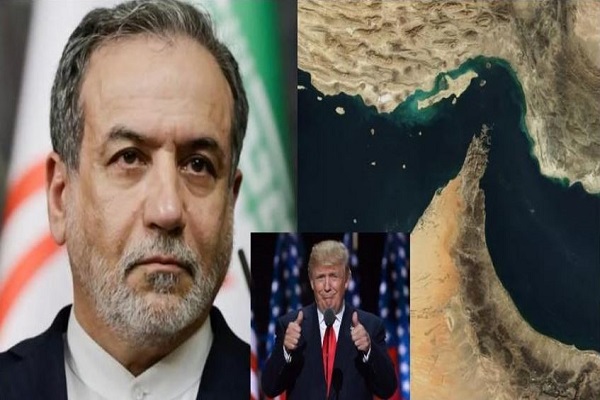
Iran completely opened Hormuz Strait, Foreign Minister Abbas Araghchi announced after Israel-Lebanon ceasefire

Lebanon, April 17. The tensions that have been going on in the Middle East for more than one and a half months are beginning to end. In this sequence, first a ceasefire was agreed between America and Iran for two weeks and then on Thursday there was a ceasefire between Israel and Lebanon for 10 days. After this temporary ceasefire in Lebanon, Iran has now announced to completely open the strategically important Strait of Hormuz for all merchant ships. Iran’s Foreign Minister Seyed Abbas Araghchi announced this effect on Friday.
Seyed Abbas Araghchi posted on This open path will remain for the remaining period of the ceasefire. The ships will have to pass through the coordinated route already announced by the Ports and Maritime Organization of Iran.
In line with the ceasefire in Lebanon, the passage for all commercial vessels through Strait of Hormuz is declared completely open for the remaining period of ceasefire, on the coordinated route as already announced by Ports and Maritime Organization of the Islamic Republic. of Iran.
— Seyed Abbas Araghchi (@araghchi) April 17, 2026
In this sequence, Iran has clarified that this exemption is linked to the ongoing ceasefire in Lebanon. Iran has already given information about the routes through which the ships can pass. Earlier, due to war and tension, there was a huge risk regarding the movement of ships on this route, due to which there was instability in the prices of crude oil in the international market.
US President Trump thanked Iran
Immediately after Iran’s announcement, US President Donald Trump thanked it. Trump said in a post on ‘Truth Social’, “Iran has just announced that the ‘Strait of Hormuz’ is wide open and ready for full passage of ships. Thank you!”
pic.twitter.com/6kgaxqC0tb
— Commentary Donald J. Trump Posts From Truth Social (@TrumpDailyPosts) April 17, 2026
Trump had made the reopening of this important trade route a condition of the ceasefire. However, later when Tehran did not open the strait and a peace agreement could not be reached between the two sides, Trump imposed a blockade on Iran’s ports.
This is why Iran had blocked Hormuz
The Strait of Hormuz, known as the world’s ‘oil lifeline’, is a narrow sea route between the Persian Gulf and the Gulf of Oman. About 20% to 25% of the world’s total crude oil trade passes through this route. Big oil producing countries like Saudi Arabia, Iraq, UAE and Kuwait depend on this route.
This sea route is so narrow that the distance at its widest part is only around 33 kilometers. Iran has a direct influence on this. Due to this, Iran had closed it during the conflict between America and Israel and was not allowing enemy oil ships to pass through here.
Crude oil prices rise as soon as Hormuz opens 11 percent decline
The impact of the announcement of opening of Hormuz was immediately visible on crude oil prices. At 7.21 pm Indian time, WTI crude was down 10.91 percent at $ 84 per barrel. Brent crude also declined by 10.49 percent and was trading at $ 88.97 per barrel. After the start of the Iran-America war, the price of crude had at one time increased to $ 118 per barrel. However, later it softened a bit.
Big relief for India also
To be honest, this is a big relief news for India, which imports 90 percent of its crude requirement from Gulf countries. It also imports 50 percent of the gas. The safety and reopening of this route is a positive sign for India’s energy security and economy.
After the war started in the Middle East, the supply of crude and gas in India was also affected. Due to this, the prices of both increased and there was problem in supply also. Due to this, private oil companies announced to increase fuel prices. However, government oil companies have not yet increased the prices of normal petrol and diesel.

Comments are closed.