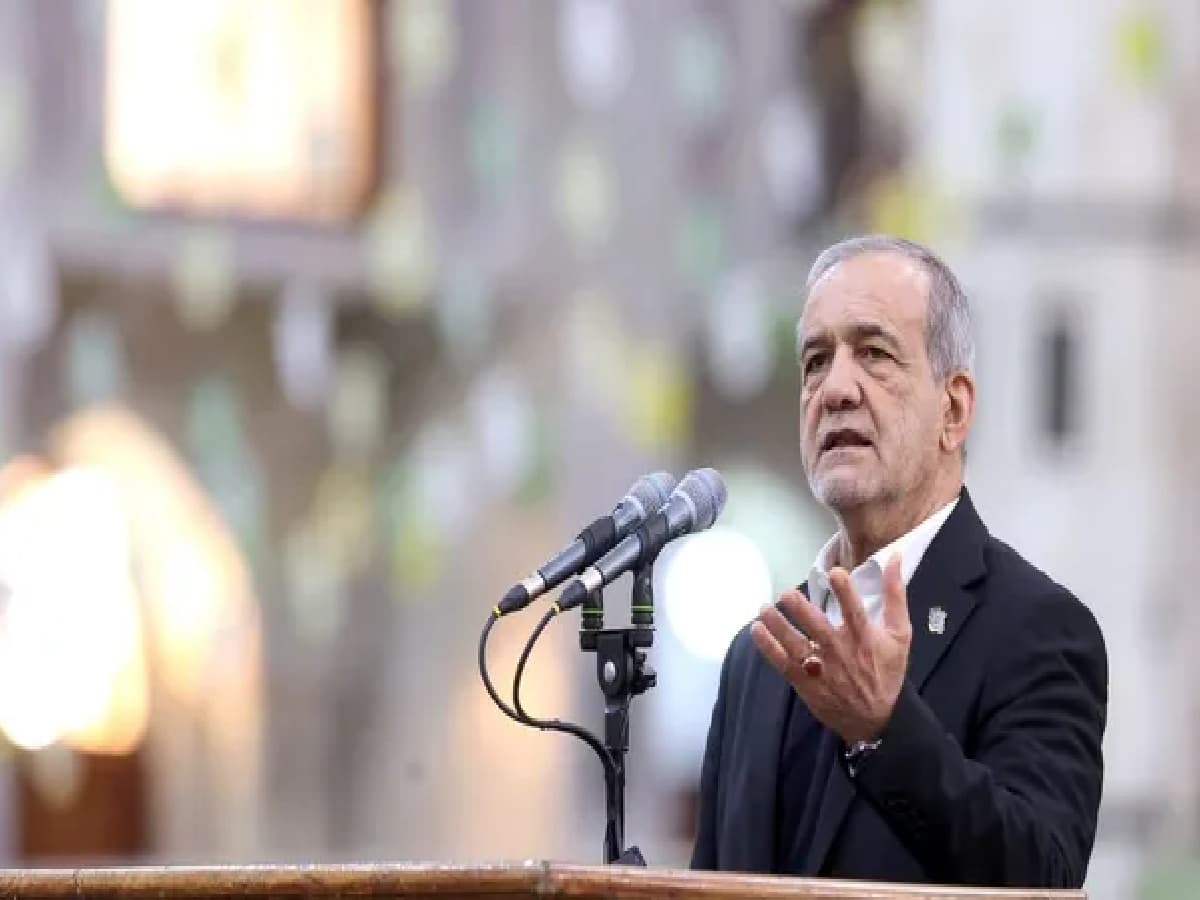
The decades-old bitter geopolitical standoff between the United States and the Islamic Republic of Iran has once again come to the fore in front of the entire world during the annual high-level session of the United Nations General Assembly (UNGA), the largest international forum for global diplomacy. Amidst the ongoing heavy military tension in Western Asia (Middle East), nuclear arms race and blockade of strategic waterways, Iran's new President Masoud Pejeshkian has reached New York to participate in this global conference. But as soon as he set foot on American soil, the State Department of the Joe Biden administration has imposed extremely stringent, extraordinary and unprecedented travel restrictions on him and the diplomatic delegation accompanying him. Due to these strict US security rules, the Iranian President will not be able to move freely within New York City like a normal head of state, which has further heated up the diplomatic stir in the corridors of the United Nations. Iranian President imprisoned between hotel and UN Headquarters: Strict American surveillance imposed on shopping and outings According to a special investigative report published by the international newspaper 'The Wall Street Journal', President Pejeshkian is facing strict administrative restrictions during his stay in New York in view of the ongoing military confrontation between Tehran and Washington for the last seven months. According to the new protocol of the US State Department, the Iranian President will be able to move only between his official hotel in Manhattan and the UN Headquarters complex. Apart from this, they are completely prohibited from visiting any other public place in New York, seeing sights, shopping in the market or on personal trips. If the Iranian delegation or the President has to go to any place outside the designated limited area, they will first have to obtain special diplomatic clearance from the US government. This move shows the extent to which the US is using its domestic laws and global sanctions to put psychological and diplomatic pressure on Iran. Iran will argue self-defense at the UN forum: Preparing to hit back at American and Israeli aggression According to the analysis of Richard Govan, senior UN expert of the global think-tank 'International Crisis Group' (ICG), President Massoud Pezeshkian will use his address to the General Assembly to strongly present Iran's position on the international stage. Pejeshkian will argue to the world that Iran has never been an aggressor country, rather it has been a direct victim of America and Israel's imperialist and military aggression for a long time. The main argument of the Iranian side will be that whether it is naval security in the Strait of Hormuz or the steps taken by them at the regional level, all of them fall within the scope of legitimate self-defense under international law. Along with this, the Iranian delegation is trying hard to hold closed-door back-channel talks with top policy analysts and strategists of many major American and European think-tanks in New York. However, due to the stringent legal provisions of US sanctions, Western analysts are hesitant to hold open meetings with Iranian officials so that they do not get embroiled in any legal dispute. Visit one year after 12-day bombing of nuclear sites: Tension at its peak in the Strait of Hormuz This visit of President Massoud Pezeshkian to New York is taking place after the severe tension in the last one year and the situation standing on the verge of war. It is noteworthy that last year, 12 consecutive days of devastating bombings and precise air strikes were carried out by the US and Israel targeting Iran's underground uranium enrichment and nuclear sites. Just a few months after that horrific military confrontation, Iran made its presence felt in the United Nations. Even at present the circumstances are extremely delicate; On one hand, Western countries are suspicious about Iran's rapidly growing nuclear program and advanced centrifuges, while on the other hand, the war between the International Naval Alliance and Iran's Revolutionary Guards (IRGC) is ready to ignite at any time regarding the obstacles being created in the free movement of commercial ships and oil tankers in the world's most important oil transit route 'Strait of Hormuz'. Trump's tough stance and uncertainty of talks: Blunt warning to ban nuclear weapons. On the other hand, in the American political scene, former President Donald Trump has strongly defended any past or future military action against Iran and made very aggressive allegations against Tehran. Trump has bluntly said in his statements that Iran cannot be allowed to develop nuclear weapons at any cost during his tenure or under the current security structure of America. However, amidst contradictory statements, Trump has also indicated that he may consider the option of having face-to-face talks with Pezeshkian depending on the circumstances. But UN Secretary-General Antonio Guterres and many experienced diplomats of the Global Security Council clearly believe that there is no scope for any major diplomatic agreement or peace agreement between Washington and Tehran during this annual conference. The lack of trust between the two countries has become so deep that the beginning of any formal and serious talks will be possible only in the future, while at present only a phase of accusations and counter-accusations and show of power will be seen.