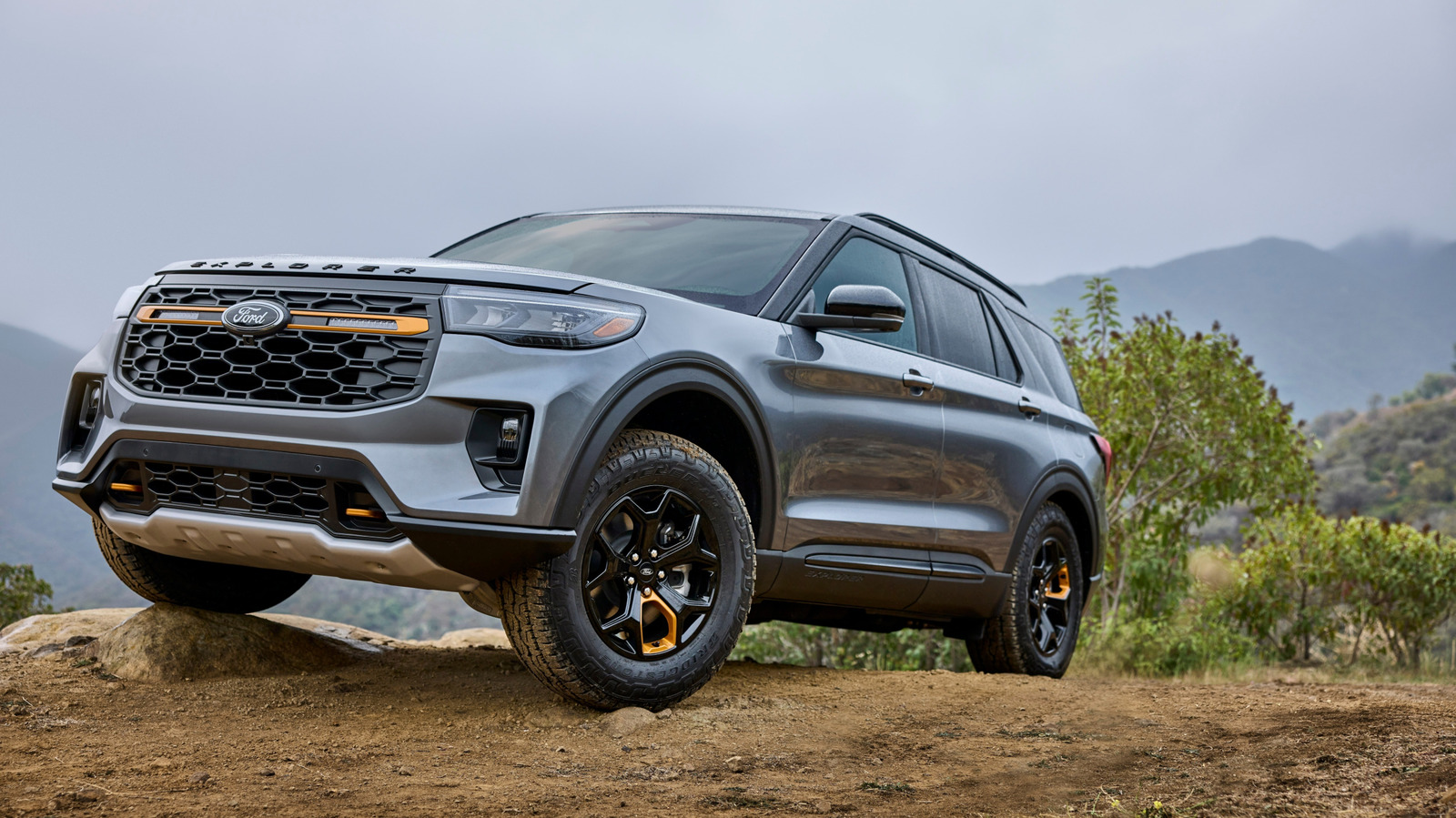
If you were putting together a list of the most important and influential vehicles of the last 40 years, the Ford Explorer would certainly be worthy of a spot in the rankings. No, the Explorer may not have been the world’s first sport utility vehicle, but it is a hugely important one, without which the original SUV boom of the 1990s may never have happened.
The Explorer has a lot of milestones under its belt, and with such a long and established history, it’s natural to wonder whether the Explorer uses the body-on-frame construction you find on truck-based SUVs, or the unibody construction common on popular crossover SUVs. The answer is both, and it depends on which generation of the Explorer you are looking at. There are lots of things to know before buying an Explorer, and a big one is that the modern Explorer, including the one on dealer lots right now, is a unibody SUV, while the earlier versions from the 1990s and 2000s were built more like trucks, with a body-on-frame platform.
In this sense, the Explorer’s lineage perfectly encapsulates the evolution of the SUV itself. In its early days, the Explorer began life essentially as a more refined, enclosed version of the Ford Ranger pickup before evolving into the popular unibody SUV it is today.
The body-on-frame era
The Explorer debuted for the 1991 model year. Like the earlier Ford Bronco II, it shared a body-on-frame platform with the Ford Ranger pickup. However, thanks to its focus on interior space and refinement, the Explorer appealed to families in a way the smaller Bronco II did not. The body-on-frame Explorer evolved through the late 2000s, becoming larger and more refined across its four generations and eventually adding options like a V8 engine.
One notable aspect of this early Explorer history is that it also spawned closely-related, badge-engineered variants known as the Mercury Mountaineer and the Mazda Navajo. The goal, of course, was to help Mercury and Mazda (who shared a partnership with Ford at the time) capitalize on the Explorer’s popularity to boost their own brands’ respective lineups.
Ford’s body-on-frame Explorer was available in both two- and four-door body styles, and later as an open-bed, four-door pickup truck version known as the Explorer Sport Trac. There was even a high-performance Saleen version of the Explorer in the late 1990s, which earned a place in history for being the world’s first factory supercharged SUV.
The modern unibody era
The biggest evolution in the Explorer’s history came in the 2011 model year, when Ford dropped the body-on-frame construction and moved the model to a unibody platform. Along with the Explorer, the unibody, front-drive-based D3-D4 platform also included models like the Ford Taurus sedan and the boxy Ford Flex wagon. It may have evolved into a softer, crossover SUV, but buyers welcomed the new Explorer with open arms; annual sales in the early 2010s were leagues ahead of previous years.
The next big change happened for the 2020 model year. The Explorer kept its unibody underpinnings, but moved to an all-new platform with a longitudinally mounted engine and rear-drive layout, which it has retained for the 2026 model year. As before, all-wheel-drive is available as an option.
Unlike older variants, the modern unibody Explorer has only been offered in one body style, but Ford has done a great job keeping the lineup interesting — and not just for mainstream family car buyers, either. Among the current Explorer lineup’s more specialized versions are the 400-hp, street-performance-oriented Explorer ST and the rugged, off-road-capable Explorer Tremor that Ford introduced for 2026. Finally, there’s also the ubiquitous Explorer Police Interceptor, which has become one of America’s most common law enforcement vehicles, following in the footsteps of the Ford Crown Victoria that came before it.