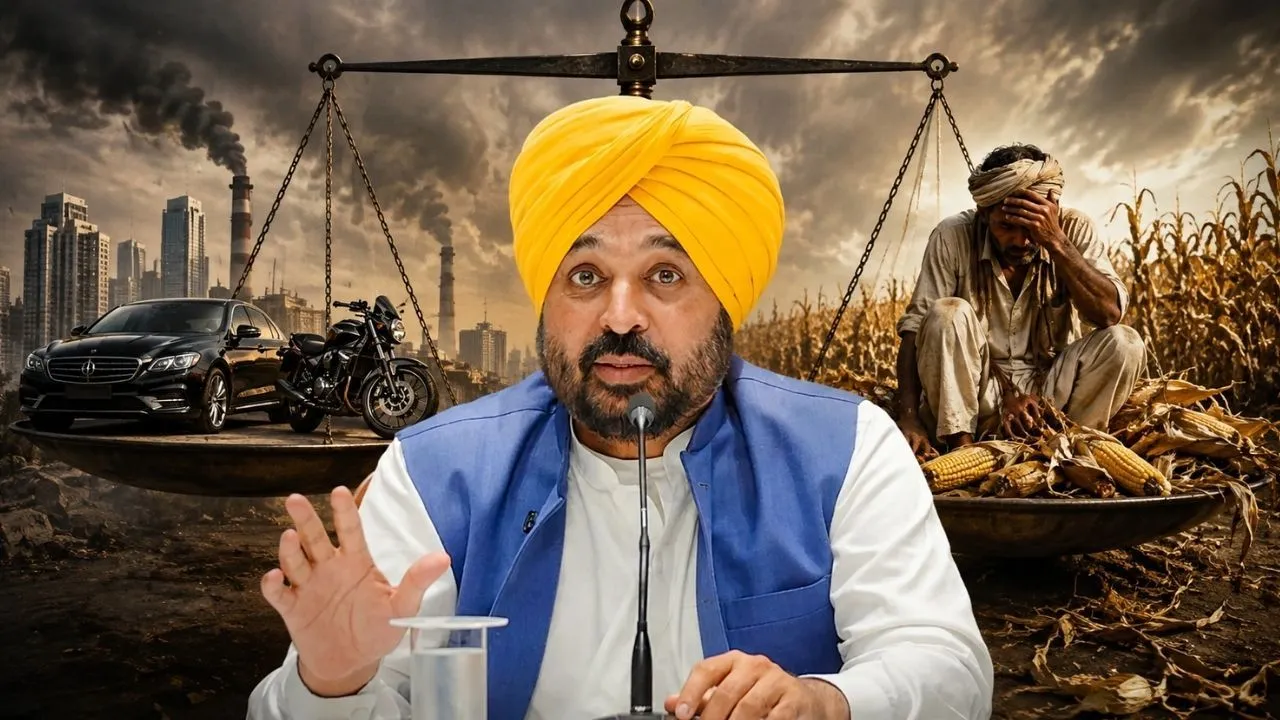
However, Punjab’s political stance has also raised another question. This question concerns the state’s farmers and rural economy. The ethanol industry in Punjab creates a large market for crops like maize and sugarcane. Could opposing the E20 program impact the state’s farmers who are transitioning away from the traditional rice-wheat crop cycle and toward alternative crops?
Farmers’ Ground Reality
The Punjab government is presenting E20 as a concern for vehicle owners and consumers. Chief Minister Bhagwant Mann and state Finance Minister Harpal Singh Cheema have questioned the central government’s policy. The government argues that mandatory E20 could impact the mileage and engine performance of older vehicles. However, the agricultural sector presents a different picture. Punjab has long struggled with the problem of excessive paddy cultivation and declining groundwater levels. Consequently, agricultural experts have advised farmers to shift to alternative, less water-intensive crops.
In this context, crops like maize become an important option for farmers. Demand from the ethanol industry has created an additional market for this crop. If distilleries and ethanol plants purchase maize, farmers have a relatively stable buyer in addition to the local market.
Maize prices may be impacted
Trade organizations and regional grain traders have also expressed concern about the decline in demand from the ethanol industry. They say that a decrease in demand from distilleries could put pressure on maize prices.
According to some trade organizations, the current price of maize is around Rs 2,100 to Rs 2,200 per quintal. They claim that if the ethanol industry’s purchases decrease, prices could drop to around Rs 1,500 per quintal.
However, the actual impact of such a price drop will depend on several other market factors. Therefore, it should be viewed as a potential risk, not a certain outcome.
Why is crop diversification important for Punjab?
Punjab’s agricultural economy has long relied on a wheat-paddy crop cycle. This model has played a vital role in the country’s food security system, but it has also faced environmental and economic pressures. The excessive water consumption of paddy cultivation poses a major challenge for Punjab. Therefore, increasing the cultivation of crops like maize has been part of the state’s crop diversification policy. If farmers do not find a market and better prices for alternative crops, they may return to the traditional wheat-paddy cycle. This is why the demand for maize generated by the ethanol industry is considered crucial for a segment of Punjab’s rural economy.
Questions Raised About AAP’s Political Opposition
The Aam Aadmi Party (AAP) is campaigning against the central government at the national level regarding E20. The party argues that mandatory ethanol blending could harm vehicle owners and consumers. AAP leaders have demanded the central government reconsider the E20 policy. Following the passage of a resolution in the Punjab Assembly, the issue has become more prominent in state politics.
However, critics question how the E20 policy, if changed, will affect farmers involved in ethanol production and the rural market. Shouldn’t discussions be held alongside consumer concerns about alternative markets and price protection for corn and sugarcane producers?
E20 Isn’t Just a Petrol Issue
The debate surrounding E20 often seems limited to vehicle mileage, engine, and fuel quality. However, it also has a significant agricultural and rural economic impact.
Ethanol production creates demand for corn and other agricultural products, in addition to sugarcane. This could create an additional market for farmers. On the other hand, questions such as the suitability of E20 for vehicle owners and its impact on older vehicles are also important.
Therefore, rather than limiting this issue solely to the question of “is E20 right or wrong,” it is important to examine how the policy impacts farmers, consumers, the automobile industry, oil companies, and the rural market.
What is the path forward in the interest of farmers and consumers?
The challenge for an agricultural state like Punjab is to guarantee market access for farmers while promoting crop diversification and, on the other hand, addressing consumers’ fuel-related concerns. If E20 poses technical or economic challenges for older vehicles, clear guidelines and transition mechanisms may be necessary. Furthermore, if demand for ethanol decreases, alternative markets and price support for corn and sugarcane producers will also need to be considered.