
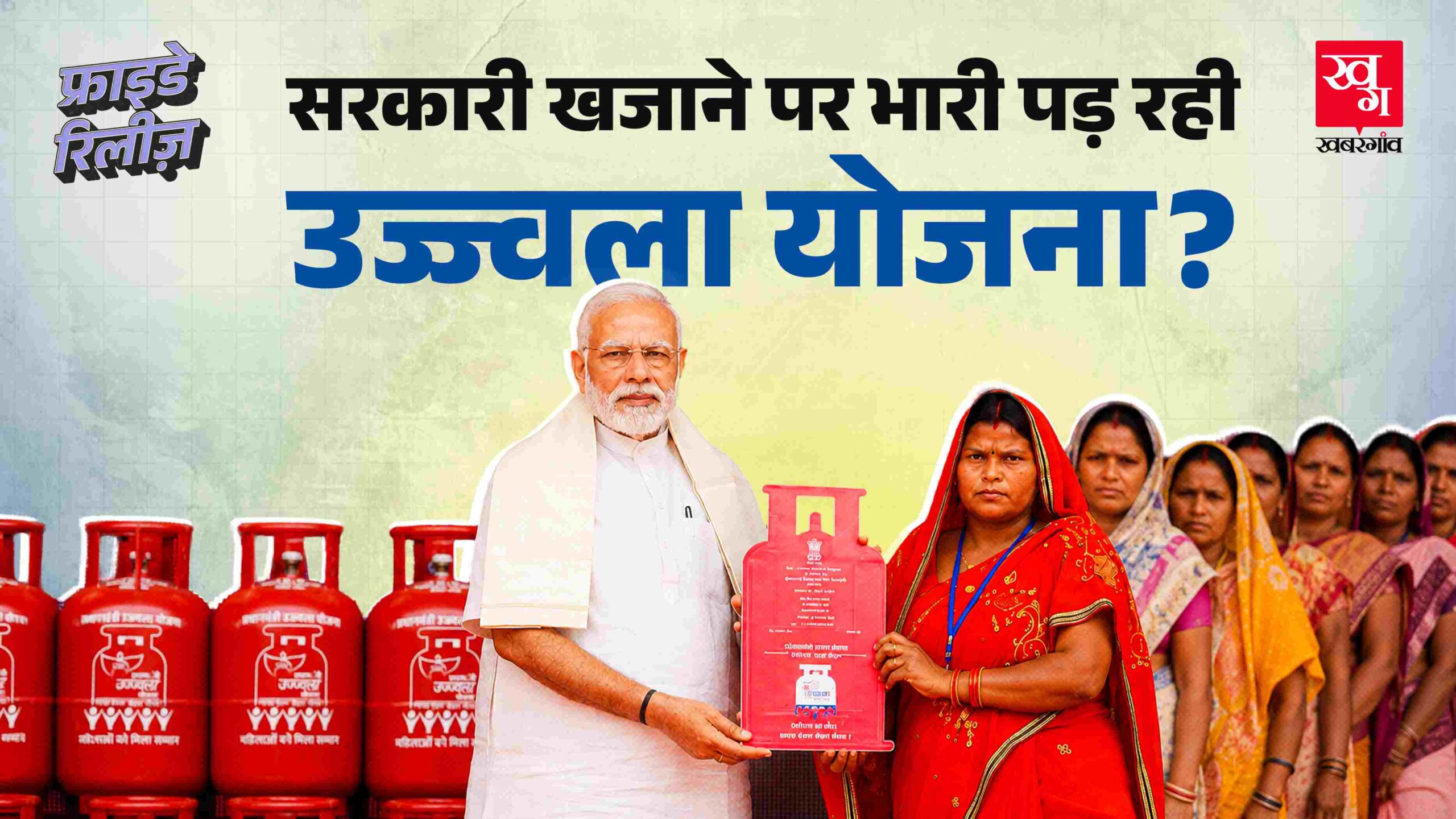
Is Ujjwala scheme heavy on the government’s pockets? Understand from the expenses incurred in 10 years

Recently, the number of subsidized LPG cylinders available under the Ujjwala scheme was reduced. In the year 2016, it was decided to give a total of 12 cylinders annually and in 10 years this number has come down to 4. Thousands of crores of rupees are being spent annually on this scheme with more than 10 crore beneficiaries. A huge amount has to be spent every year including distribution of connections, subsidy on cylinders and other expenses. Perhaps this is the reason why the number of cylinders given under the Ujjwala scheme has been reduced in the last few years and has been reduced by three times in 10 years.
At present, when the beneficiaries of Ujjwala Yojana get their gas cylinder filled, a subsidy of Rs 300 is credited to their bank account within a few days. The subsidy was started in May 2022 at the rate of Rs 200 per cylinder. It was increased to Rs 300 in October 2023. However, before August 2025, subsidy was being given on a total of 12 cylinders. Then it was increased to 9 and now in June 2026 it has been reduced to 4.
Regarding this reduction, the Petroleum Ministry says that this change has been made keeping in mind the annual average consumption of the beneficiaries of the Ujjwala scheme. According to the ministry, the cost of one cylinder is around Rs 1600 but to provide cheaper cylinders on subsidy, the government is spending around Rs 1000 per cylinder.
Also read: Ujjwala Yojana: Now instead of 9, only 4 cylinders will be available in a year at cheaper rates.
What was achieved by the plan?
If we look at the benefits to the country due to this scheme, the government claims that it has reduced carbon emissions, increased the use of clean energy and people who cook have got relief from the smoke of the stove. Government figures testify to how much gas usage has increased. The consumption of LPG which was 17696 thousand metric tons in the year 2014-15, reached 31986 metric tons in 2024-25 i.e. an increase of 81 percent in 10 years. At the same time, the number of domestic customers was 14.52 crore on April 1, 2014 and by April 1, 2025, this number will reach 32.94 crore.
How many beneficiaries were there in 10 years?
MP about this schemeRajesh Ranjan and Kaushalendra Kumar Had asked the question in the Lok Sabha in March 2026. The answer to this was given in writing by Union Petroleum and Natural Gas Minister Hardeep Singh Puri on 19 March 2026. In his reply, Hardeep Singh Puri said that till March 1, 2026, a total of 10.56 crore connections had been distributed under the Pradhan Mantri Ujjwala Yojana. Out of the total 9.54 crore connections distributed till August 1, 2025, 2.95 crore connections were given to the beneficiaries belonging to Scheduled Castes and Scheduled Tribes.
Also read: Bumper import, subsidy and heavy use, how does foreign fertilizer loosen the country’s pockets?
Then he told that the Central Government was giving subsidy of Rs 300 per cylinder on a total of 9 cylinders of 14.2 kg each. He said that due to various measures, consumption per connection has increased. The consumption which was 3.68 cylinders per beneficiary in the year 2021-22 increased to 4.80 in 2025-26. In the same reply, he also told that in the year 2024-25 alone, PMUY beneficiaries got a total of 46.22 crore cylinders filled.

Connections divided into several stages
A question related to the expenditure on this scheme MP Somendu Adhikari had asked. This was answered by Suresh Gopi, Minister of State, Ministry of Petroleum and Natural Gas, on March 12, 2026. In this reply, he said that the target of providing gas connections to 8 crore poor families under PMUY was achieved in September 2019 itself. Ujjwala 2.0 was launched in August 2021 to benefit the remaining poor families. Under this, connections were to be given to 1 crore additional families and this target was also completed in January 2022.
After this, the government set a target of distributing 60 lakh more connections and by December 2022, 1.60 crore connections were also distributed under Ujjwala 2.0. After this, the target of distributing 75 lakh more connections was set and this target was also achieved by July 2024. Then a target was set to distribute 25 lakh connections in the financial year 2025-26 also.

How much was spent on subsidy?
As stated by the government in its reply, till March 1, a total of 10.56 crore connections had been given under this scheme. In response to Somendu Adhikari’s question, the government also said that under this scheme, distribution of subsidy was started in May 2022. Initially the subsidy per cylinder was kept at Rs 200. Later it was increased to Rs 300. A subsidy of Rs 300 was planned on 9 cylinders annually in 2025-26. Now this has been increased to 4 cylinders annually.
Also read: How was Punjab’s best school decided? Understand the report of Niti Aayog
In the last five years, the government has spent a total of Rs 45432.24 crore on providing direct subsidy to the beneficiaries of the scheme. In this, the subsidy figures have been taken from May 2022 because the subsidy had started from then only. These figures are till February 2026. Apart from this subsidy, a compensation of Rs 22,000 crore was given to oil companies in the year 2022-23. Compensation of Rs 30 thousand crore has also been approved for 2025-26.

Will the government save money by reducing cylinders?
In the year 2024-25, the beneficiaries of Ujjwala scheme got a total of 46.22 crore cylinders filled. A subsidy of Rs 300 is available on one cylinder. In this way, Rs 10866 crore was spent only on subsidy in one year. However, in the same year, Rs 12700 crore was spent from the government treasury in the name of subsidy. This subsidy was on the basis of 9 cylinders annually. Now it is expected that by increasing the number of subsidized cylinders to 4, this amount will reduce and the government will save some money.
in december 2025MP VK Srikandan In response to a question, the Union Ministry of Petroleum and Natural Gas had replied that in the year 2024-25, about 86 percent of the beneficiaries were those who got at least one cylinder filled. To deal with the problem of underfilling of cylinders, the Ministry had issued a Standard Operating Procedure (SOP) in January 2025 itself. Under this, Oil Marketing Companies (OMCs) discovered that there were 11.7 lakh connection holders who never got their cylinders filled again after taking the connection.
Also read: Data related to health, crime and agriculture are many years old, how will the right policy be made?
Out of these 11.7 lakh beneficiaries identified by November 2025, 8.35 lakh got their e-KYC completed. Out of these, 5.52 lakh also got refilled again. Under this process, 21 thousand connections were also cancelled.
Is the expense becoming heavy?
If we look at the number of 10.56 crore cylinders, then the number of cylinders filled according to 9 cylinders is Rs 95.04 crore. However, only 46.22 crore cylinders were filled in 2024-25. If we look at the average, only about 4 cylinders are made per customer annually. Now the government also says that on average people are getting less cylinders filled, hence this number is being increased to 4.
If we look at the accounts of the money spent so far on this scheme, the government has so far spent at least Rs 1,14,954 crore on this scheme by distributing connections, giving subsidies and giving compensation to OMCs. Even now every year around Rs 10 to 30 thousand crores are being spent on this scheme. In such a situation, the government is gradually limiting this scheme.

Comments are closed.