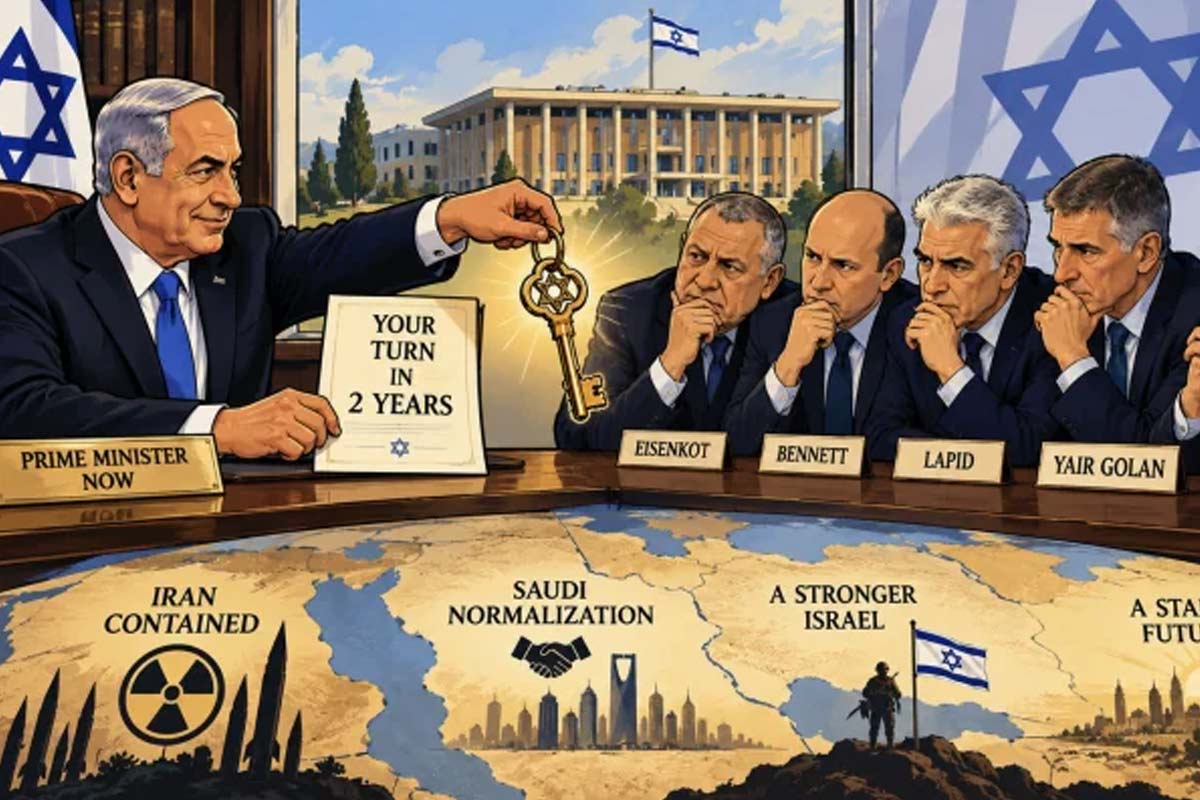
Jerusalem: The political landscape of war-torn Israel is entering a decisive phase as the newly elected 120-member Knesset (Parliament) braces up to convene on Tuesday, with Prime Minister Benjamin Netanyahu's governing bloc losing its parliamentary majority and opposition leader Gadi Eisenkot making all-out efforts to assemble an alternative coalition.
While Netanyahu is set to remain in office as the caretaker prime minister, a change in the balance of power may constrain his political authority significantly, making way for a new government.
President Isaac Herzog is scheduled to address the opening session at 4 pm local time (1930 IST), as lawmakers prepare to take their oaths. Neither Netanyahu's right-wing alliance nor Eisenkot's opposition grouping commands the 61 seats required to secure a majority in the Knesset, leaving the country facing another complex round of coalition negotiations.
Netanyahu Loses Parliamentary Majority
The polls weakened Netanyahu's political position as his bloc fell from 68 seats in the previous parliament to 53 in the new 120-member Knesset. Eisenkot's core opposition alliance has secured 48 seats, leaving both camps short of the numbers required to govern independently.
A significant feature of the new parliament is the record representation of Arab-Israeli lawmakers, whose parties have secured 19 seats. Their opposition to Netanyahu's hard-right government could prove decisive in determining whether Eisenkot can reach the parliamentary threshold.
The balance is further complicated by two ultra-Orthodox parties that collectively hold 13 seats. Their longstanding alliance with Netanyahu could become vulnerable if disagreements over military-service exemptions and other policy priorities prompt them to reconsider their political alignment.
Despite the absence of a clear majority, Netanyahu remains prime minister until a successor is sworn in. The new Knesset, however, can exercise its legislative and oversight powers even before a new coalition takes office, potentially limiting the outgoing government’s room for manoeuvre.
Eisenkot Gets 28 Days to Form Coalition Government
President Isaac Herzog formally assigned Eisenkot the initial mandate to form a government on Sunday, setting in motion a 28-day period for negotiations with prospective coalition partners. The deadline can be extended by an additional 14 days if required.
The former military chief and President of Yashar party is seeking to build a centrist alternative to Netanyahu's right-wing coalition. His challenge is to reconcile parties and lawmakers with differing ideological positions, particularly on the Palestinian question, military policy, religious exemptions and the future direction of Israel's domestic institutions.
The opposition bloc's 48 seats means it would need support from at least 13 additional lawmakers to cross the 61-seat threshold. The 19 Arab-Israeli legislators could provide the necessary numbers, either by joining the government or, more plausibly, by supporting it from outside the coalition.
However, this route faces resistance from Avigdor Lieberman, a right-wing opposition leader whose position could significantly influence the coalition arithmetic. Lieberman has ruled out relying on Arab-Israeli lawmakers to bring Eisenkot to power and has instead advocated reaching an understanding with ultra-Orthodox parties. His position presents a political contradiction, given his history of strongly criticizing ultra-Orthodox parties over their insistence on preserving exemptions from compulsory military service.
The two ultra-Orthodox parties, with a combined strength of 13 seats, could theoretically enable Eisenkot to secure a majority if they abandon their longstanding partnership with Netanyahu. The former prime minister had supported arrangements allowing exemptions for religious students, although the issue was not fully resolved through legislation.
Any coalition dependent on either Arab-Israeli or ultra-Orthodox support would nevertheless face substantial policy challenges. Arab-Israeli lawmakers are likely to oppose another major Israeli military offensive in Gaza, while ultra-Orthodox parties are expected to prioritize protections for their community’s military-service arrangements.
Eisenkot Announces Agreement on Key Knesset Positions
Ahead of the parliament's opening, Eisenkot's Yashar party announced progress in securing agreement among opposition leaders over appointments to important parliamentary positions. The opposition has proposed former senior military figure Matan Kahana for the post of Knesset speaker.
Lieberman is expected to be nominated as chair of the influential Foreign Affairs and Defense Committee, a position that carries considerable importance for parliamentary scrutiny of Israel's national security and defense policies. The proposed allocation of other parliamentary responsibilities includes Roy Folkman for the House Committee and Liran Avisar Ben-Horrin for the Finance Committee.
The speaker's election is expected to be the first major institutional confrontation between the rival political camps. The opposition's nominee will have to secure more votes than any candidate supported by Netanyahu's bloc.
The outgoing speaker, Amir Ohana of Netanyahu's Likud party, has been at the center of a procedural disagreement over when the election should take place. Opposition parties have pressed for the successor to be chosen during the opening session, while Ohana has argued that the customary timing is the day a new government is sworn in.
Parliamentary procedure allows the speaker to be elected during the opening sitting, and the appointment must take place before a new government is sworn in. The disagreement has consequently become an early test of the opposition's ability to exercise control over the Knesset's proceedings. The outcome could determine how quickly Eisenkot's bloc is able to take charge of parliamentary committees and begin implementing its legislative priorities.
Netanyahu Warns Against Restarting Iran War
Eisenkot has also sought to challenge Netanyahu's authority over decisions concerning a possible resumption of military action against Iran. He has warned military chiefs that Netanyahu does not possess a mandate to restart a war against Iran. The intervention has heightened political tensions, although it does not in itself alter the prime minister's formal control over national security and military decision-making while he remains in office.
Netanyahu continues to exercise executive authority as caretaker prime minister until a new government is formed. Eisenkot's remarks therefore represent a political challenge rather than a transfer of legal control over the armed forces.
The issue highlights the wider uncertainty surrounding Israel's security policy during the coalition transition, particularly as the country continues to navigate the consequences of the Gaza war and regional tensions.
What Happens If Eisenkot Fails to Form a Government?
Israel's coalition-formation process provides for further constitutional and parliamentary steps if the candidate initially tasked with forming a government fails to secure the required support. If Eisenkot cannot assemble a coalition within the stipulated period, Herzog will conduct another round of consultations with political parties before assigning the mandate to another member of the Knesset.
The second candidate will receive 28 days to form a government, without the possibility of an extension. Under the timetable outlined in the supplied report, that process would run until January 20, 2027.
If the second attempt also fails, a group of at least 61 lawmakers can submit a written request to the president by February 10, proposing a candidate who commands their support. The candidate would then receive a further 14 days, until February 26, to put together a government.
If all the prescribed stages end without a viable coalition, the Knesset would be dissolved and fresh elections called. The next election would have to take place no later than the last Tuesday in May 2027, unless parliament passes an earlier dissolution law. The multi-stage process means Israel could face weeks of political uncertainty before the leadership question is finally resolved.