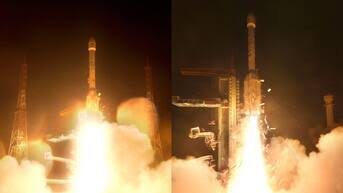
The Indian Space Research Organisation (ISRO) on Friday successfully launched the GSLV-F17 carrying the Earth observation satellite EOS-05 from the Satish Dhawan Space Centre in Sriharikota, Andhra Pradesh.
The rocket lifted off from the spaceport at 2:55 am and placed EOS-05 into its intended Sub-Geosynchronous Transfer Orbit around 18 minutes later.
“Mission Success! GSLV-F17 has accomplished its mission,” ISRO said in a post on X, confirming that the satellite had been injected into the intended orbit.
Why is the EOS-05 mission significant?
The mission marks a major milestone for India as EOS-05 is the country’s first imaging satellite designed to operate from geosynchronous orbit, around 36,000 km above Earth.
ISRO Chairman V Narayanan said the launch vehicle had successfully and precisely injected the advanced Earth observation satellite into the required orbit.
The GSLV-F17 mission was the 19th flight of the GSLV and the 107th launch from Sriharikota.
The 2,367-kg EOS-05 is also the heaviest satellite launched by the GSLV to date, according to the ISRO chairman.
EOS-05: India’s ‘Eye in the Sky’
EOS-05, described as an “Eye in the Sky”, is expected to provide high-frequency Earth imagery for a range of applications.
Its data is expected to support areas including agriculture, environmental monitoring and disaster management, among other national requirements.
Following the launch, ISRO said the satellite was healthy, its solar panel had been deployed and its systems were functioning properly.
The space agency will subsequently raise the satellite’s orbit and position it on the required geosynchronous platform.
First successful launch after January setback
The successful EOS-05 launch is also significant for ISRO following the failure of the PSLV-C62/EOS-N1 mission on January 12, 2026.
EOS-05 is intended to replace the unsuccessful EOS-03 mission, which failed during launch in August 2021.
The latest mission therefore provides another boost to India’s Earth observation programme and demonstrates the GSLV’s ability to carry heavier payloads into higher orbits.
Jitendra Singh congratulates ISRO team
Union Minister of State for the Department of Atomic Energy Jitendra Singh congratulated the ISRO team following the successful launch.
Calling it “another giant leap for India in Space”, Singh praised the space agency and said the country’s space capabilities were continuing to expand.
The successful mission adds another milestone to India’s growing space programme and strengthens the country’s capabilities in advanced Earth observation.