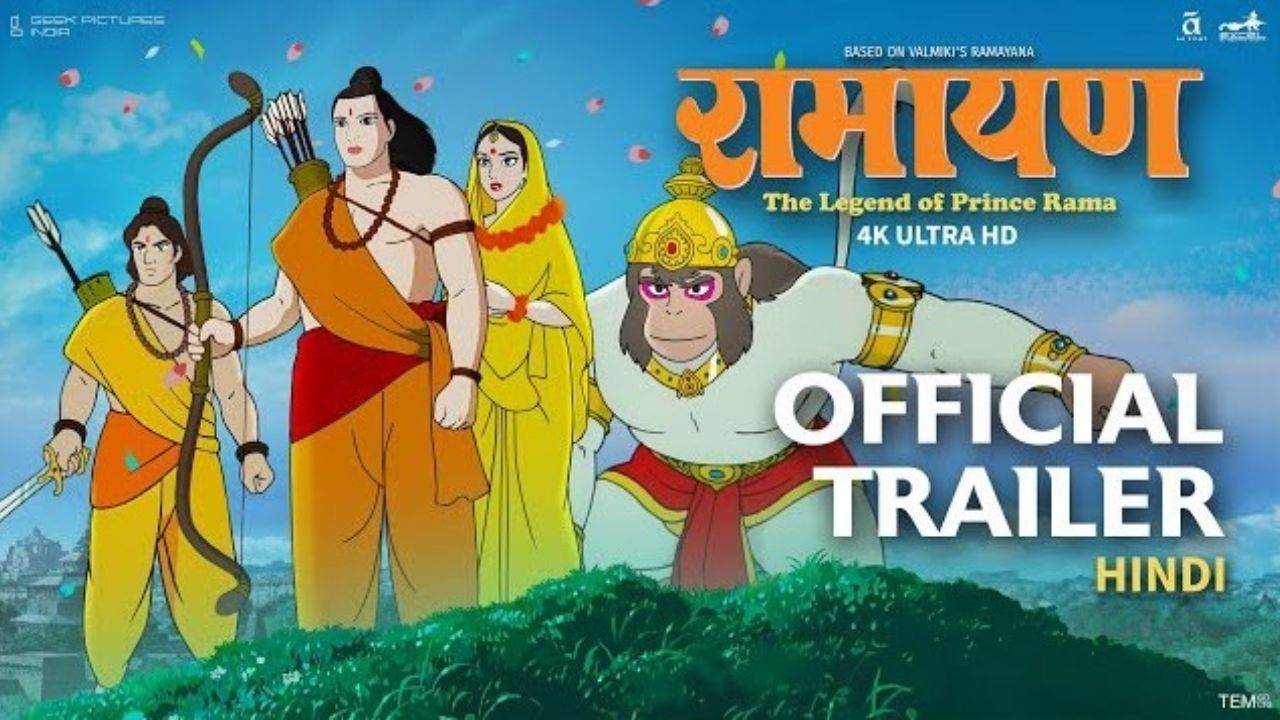
New Delhi: An ambitious collaboration between Japanese filmmakers and Indian animation artists to bring the Ramayana to the screen faced considerable resistance in India when it was first conceived. More than three decades after its completion, however, “Ramayana: The Legend of Prince Rama” has emerged as a cult favourite, finding a new generation of viewers and returning to theaters in a restored version.
Directed by Japanese filmmaker Yugo Sako and Indian animator Ram Mohan, the animated feature was completed in 1992. Despite premiering at the International Film Festival of India (IFFI) in New Delhi in January 1993, the film struggled to secure a mainstream theatrical release in the country.
Its journey from an ambitious cross-cultural filmmaking experiment to a widely appreciated cinematic adaptation reflects the sensitivities surrounding religious storytelling, the challenges of international film production and the changing reception of animation in India.
How a Japanese filmmaker became interested in the Ramayana
Sako’s fascination with the Indian epic began in 1968, when he came across a Japanese translation of the Ramayana. His interest subsequently led him to produce several documentaries on India, including one exploring archaeological locations associated with the epic.
He believed animation offered an effective medium to capture the extraordinary characters, mythological settings and larger-than-life episodes of the Ramayana. The idea was to combine India's cultural association with the epic with Japan's established expertise in animation.
For the project, Sako joined hands with Mumbai-based animator Ram Mohan, widely regarded as a pioneer of Indian animation. Although some Indian business groups initially showed interest in financing the venture, the production was eventually funded entirely in Japan.
Why the animated Ramayana encountered opposition in India
The project faced apprehensions over the prospect of a foreign filmmaker interpreting one of Hinduism’s most revered epics. There were also objections to presenting a religious narrative through animated or cartoon characters.
According to research by Rea Amit, published in the Animation Studies Journal in 2022, the Vishwa Hindu Parishad (VHP) had reportedly cautioned the Japanese Embassy in New Delhi against attempts to create a fresh interpretation of the Ramayana. The concerns followed an April 25, 1983 report in The Indian Express suggesting that Sako’s documentary work was an attempt to recreate the epic.
Ram Mohan later recalled in an interview with IIT Bombay’s D’Source that the Indian government considered the Ramayana too sensitive a subject to be represented through cartoon characters. The filmmakers reportedly spent nearly four years attempting to obtain government support for an Indo-Japanese co-production. When those efforts failed, Sako decided to take the project forward as a Japanese production.
The prevailing political atmosphere further complicated the film’s prospects. Ramanand Sagar's television adaptation of the Ramayana had become a major phenomenon after its Doordarshan debut in 1987. At the same time, the Ram Janmabhoomi movement was gaining political momentum.
The VHP organized a foundation stone ceremony in Ayodhya in 1989, followed by BJP leader LK Advani's Rath Yatra in 1990. The demolition of the Babri Masjid on December 6, 1992, the very month the animated film was completed in Tokyo, was followed by widespread communal violence.
Although the film premiered at IFFI in January 1993, its theatrical distribution remained limited. Amit’s research identifies the religious and political sensitivities of the period as possible reasons for the difficulties in securing a wider release, without establishing a direct causal connection with the Babri Masjid demolition.
A nine-year Indo-Japanese animation collaboration
The making of Ramayana: The Legend of Prince Rama was an extensive undertaking that lasted nine years and cost approximately 800 million yen. Most of the animation work was undertaken in Japan. Co-director Koichi Sasaki and animation director Kazuyuki Kobayashi supervised a large production team in Tokyo, involving around 450 Japanese personnel and more than 100,000 hand-drawn animation cells.
Mohan played an important role in shaping the film’s visual and cultural presentation. The collaboration has been described by Amit as a form of ‘reversed outsourcing’, with Indian artists contributing cultural knowledge and creative inputs while Japanese studios handled much of the animation. The absence of modern digital communication made coordination between the teams in Mumbai and Tokyo particularly demanding. Artists relied on physical sketches, drawings and frequent international travel to exchange ideas.
Indian filmmaker and production designer Nachiket Patwardhan prepared detailed visual references depicting Indian landscapes, clothing and other cultural elements for the Japanese animation team. The collaboration also involved overcoming differences in language and cultural understanding. Mohan recalled that Japanese artists initially struggled to accurately portray traditional Indian clothing. On noticing that Rama’s dhoti was being illustrated like a pair of tailored pyjamas, he demonstrated how the garment was traditionally draped.
From limited theatrical release to television popularity
Despite the scale of its production, the film did not initially find a substantial theatrical audience in India. Its popularity grew gradually through television broadcasts and home-video releases. A Hindi-dubbed version featuring Arun Govil, who had portrayed Rama in Ramanand Sagar's television series, as the voice of Rama, and Amrish Puri as Ravana, helped introduce the film to Indian households.
Doordarshan telecast the film, while Cartoon Network subsequently included it in its festive programming. In October 2002, the channel featured it as part of its Dussehra and Diwali presentation under the banner The Great Indian Epics. VCD and DVD editions further expanded its reach.
The film also encountered distribution difficulties overseas. A 2001 account published by Beliefnet reported that a Hollywood studio had expressed interest in distributing it in the United States but proposed changing Rama’s period of exile into a honeymoon with Sita. Sako and co-producer Krishna Shah declined to accept the suggested alteration.
Interestingly, the film did not immediately establish a strong theatrical presence in Japan either. The absence of a Japanese-language dubbed version was identified as one of the factors limiting its reach. After a few screenings in the late 1990s, it eventually secured an extended run at a small cinema in Yokohama beginning in September 2018.
Restored version brings the film back to Indian theatres.
The film’s fortunes changed significantly with its restored theatrical release in India. On January 24, 2025, Geek Pictures, AA Films and Excel Entertainment brought a 4K-restored version of the animated feature to 621 screens across the country. It was released in English, Hindi, Tamil and Telugu, allowing it to reach audiences across different linguistic markets.
A special screening was subsequently organized in Parliament, bringing renewed attention to the decades-old Indo-Japanese cinematic collaboration. The film’s eventual reception marks a significant turnaround for a project that once struggled to secure acceptance and distribution in the country whose epic it sought to portray. What began as an unconventional attempt by a Japanese filmmaker to interpret an Indian cultural classic has, over the years, acquired a distinct place among animated adaptations of the Ramayana.