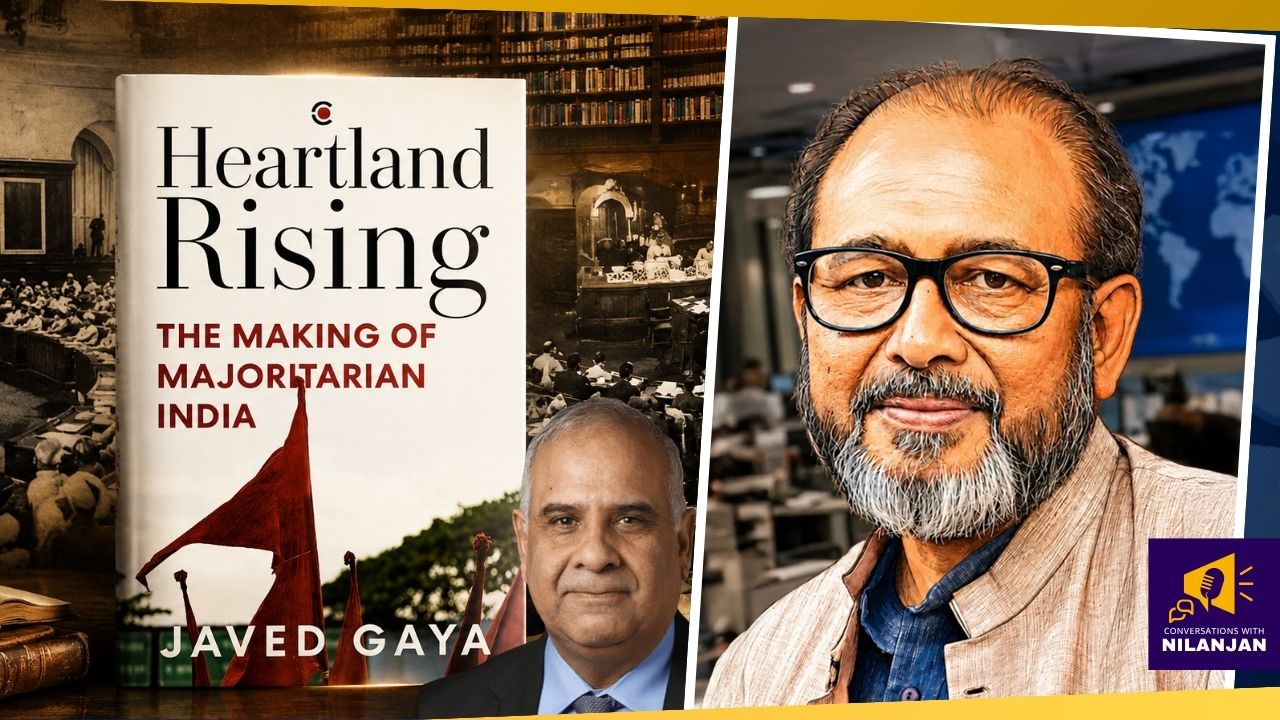
Contemporary India’s political trajectory is “very much in line with a kind of fascism” seen in Europe, says lawyer and author Javed Gaya. He is quick to add that Prime Minister Narendra Modi “didn’t come out of nowhere,” arguing that the ground for today’s majoritarian politics was laid decades before 2014.
In his new book, Heartland Rising: The Making of Majoritarian IndiaGaya traces the roots of that shift back to a founding choice the Constituent Assembly made in the 1940s — prioritising individual liberty over structural representation for minorities.
The Federal spoke to Gaya about his book’s central arguments, the politics behind the Uniform Civil Code, and what he believes needs to change.
Is it right to say that at the core of your book is the argument that the Constituent Assembly made a crucial error in the 1940s — building India’s political architecture around individual liberty, or one person, one vote, rather than ensuring meaningful structural representation for minorities within a robust federal framework?
Absolutely, I think this is the central argument. The Constituent Assembly faced a choice between liberty — a one-man, one-vote situation where everyone has access to the ballot box — and equality, the notion that people should have guaranteed representation. When we say minorities, we’re not just talking about Muslims, though they were certainly part of it. The Sikhs, the Christians, the Scheduled Tribes and Dalits, to some extent, were given certain rights too. And minorities weren’t only defined by religious identity — they could be linguistic, ethnic or regional as well.
Also read: India moving closer to a unitary state under BJP, says Christophe Jaffrelot
Ultimately, the real question was: what kind of India were we going to be? A unitary society with a homogeneous culture and a centralised system, like European states, or a more federal structure that allowed for linguistic and other differences? The Congress, and Nehru in particular, was very keen on a centralised structure, because he saw India’s problems as economic rather than cultural. Ambedkar, too, favoured a centralised system of like-minded people who could impose new social norms on the rest of the country — he didn’t have much time for rural India, which he once called “cesspools of iniquity.”
The trouble with majoritarianism is that it isn’t even good for the majority, because it creates these manufactured ‘demons’ — whether it’s Muslims here, or Trump talking about trans people elsewhere.
Then you had the Hindu. Even if you look at the ideology of the RSS, they have never been keen on federalism — they’ve always favoured a centrally imposed system. For them, there was also the centrality of Uttar Pradesh, which was culturally significant and had a high percentage of Brahmins — even though the RSS itself didn’t originate there, and only started making inroads from the 1930s, along with Bihar. Before that, it was really the Arya Samaj, in collusion with a Brahmin culture that included people like Madan Mohan Malaviya, who was part of the Hindu Mahasabha as well as the Congress — until around 1940, you could be both.
There was a strong Brahmanical tradition that wanted to impose things like Sanskrit, Hindi, and vegetarianism, and that culture has come back in a big way.
Also read: Anti-defection law now offers a roadmap to defect: Gilles Verniers | AI With Sanket
I have no problem with people choosing things for themselves. I’m nominally Muslim, and I don’t eat pork for cultural reasons — but that’s a taboo that involves only me. If someone else wants to eat pork, I have no issue with that. What’s disturbing is this idea that people should be prevented from doing things — how you dress, what you eat, who you can have relationships with. Look at the “love jihad” narrative, or the Uniform Civil Code provisions that target live-in relationships and require them to be registered — that’s really about enabling the state to keep tabs on people it considers deviant. I think it’s also about creating a culture where people snoop on their neighbours, a kind of vigilante mindset where the wrong sort of people get empowered for the wrong purposes. The village bully and the busybody effectively become arms of the state.
This idea of one person, one vote has struck me, especially now, alongside the recent debate over delimitation and southern states’ fears of becoming numerically insignificant. Suppose there had been some kind of constitutional safeguards for minorities of various kinds — how would that have changed the path we’ve followed?
Well, this is all counterfactual, since it didn’t happen. But think about the two big states that weren’t particularly communal historically — Punjab and Bengal. If you set aside the post-Partition riots, Punjab wasn’t communal. Bengal did have communal tensions from the early 1940s, but they were episodic, not constant the way they were in the United Provinces.
UP had near-constant Hindu-Muslim tension, partly because of a very high upper-caste population that resented the fact that the dominant culture — the language, the tehzeeb — was largely Muslim. They wanted to Sanskritise the state, abolish cow slaughter, introduce the Nagri script. These cultural fault lines were far sharper in UP than in Punjab or Bengal, where people shared a common language and caste was less rigid.
Also read: Netaji or Mookerjee? BJP’s ideological tightrope walk in West Bengal
When Punjab and Bengal were divided at Partition, they were reduced to smaller versions of themselves and rendered politically insignificant — post-Partition Punjab became a small Punjab, and East Bengal, now Bangladesh, was always a much bigger entity than what remained as West Bengal. This is what gave rise to the dominance of the cow belt. Before Partition, Muslims made up nearly 25 per cent of UP’s population, while the upper castes — Brahmins, Kshatriyas, Kayasthas, Banias — made up over 20 per cent. The idea was to bring the lower castes into that fold through a Sanskritisation formula, and that itself created tensions with Muslims.
These cultural motives mattered far less in Punjab and Bengal, where economics dominated politics instead. The Unionist Party in Punjab, for instance, was a landlord party, but there was a strong pro-land-reform element even in the 1940s, which helped later with things like women’s empowerment and literacy — you can still see traces of that in Bangladesh today. But instead, we elevated the cow belt. People often confuse this with the RSS and figures like Vinayak Savarkar, who were Brahmins from Maharashtra — but Maharashtra’s Brahmins weren’t as politically significant then as UP’s, where you had figures like Malaviya, Purushottam Das Tandon and Govind Ballabh Pant, who were far more central. Tandon, in fact, became Congress president after Mahatma Gandhi’s assassination, before an ideological battle with Nehru forced him to step down. The UP unit of the Congress was essentially autonomous.
Your book is both a diagnosis of what’s wrong and a warning about what worse could happen. At this point, in August 2026, what do you think can genuinely be done to restore India to the dream of the nation at independence?
One important thing that happened just last month was the resignation of the education minister. I actually argue this in my epilogue, which is a bit depressing, because my broader point is that government has certain core responsibilities — education, health, safety, pollution, law and order — that it cannot outsource to anyone else. If a government is only interested in giving out cash handouts, which increasingly seems to be the model, there’s no accountability. What was significant about that resignation is that, for once, it was a real example of accountability — and it happened because it became part of the national agenda, pushed by young people and students.
Also read: RSS at 100 stands tall but is shadowed by a fraught past and fractious present
The trouble with majoritarianism is that it isn’t even good for the majority, because it creates these manufactured “demons” — whether it’s Muslims here, or Donald Trump talking about trans people elsewhere — all sorts of distractions that let government avoid responsibility to ordinary people. Everyone ends up suffering. Look at Delhi’s air in winter — Shanghai fixed a similar problem in ten years through deliberate policy, but nobody here seems interested in taking that step. If you keep the Hindu-Muslim conversation going, all these real issues become distractions.
One of the most remarkable things said during the Cockroach Janata Party-led protest was that this is not a Hindu-Muslim issue — people said they’d had enough of that, and wanted to talk about the real issues affecting the bread and butter of young people. My generation’s major part is over — it’s the youngsters who are now calling the shots and pushing the government.