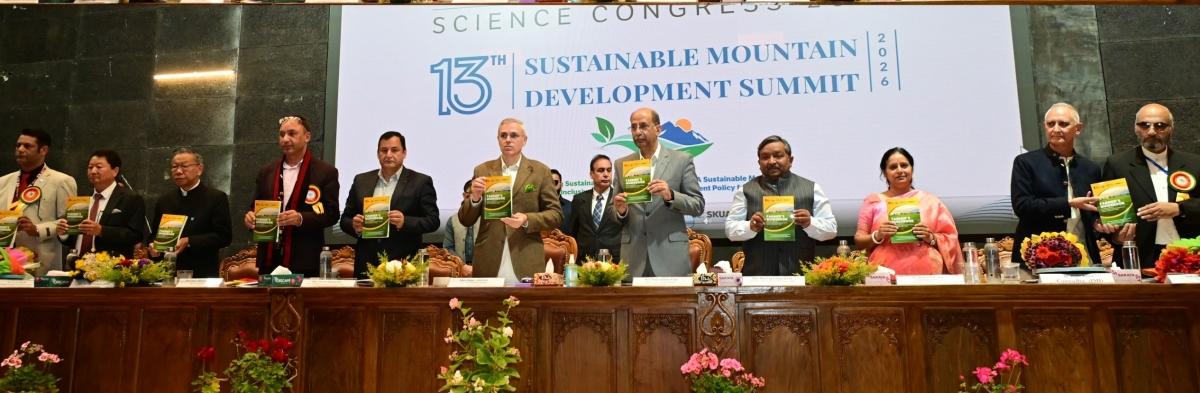
Jammu and Kashmir aims to become the first Himalayan territory to adopt a Mountain Development Policy, Chief Minister Omar Abdullah said on Monday, stressing that the policy framework must not be formulated in isolation.
He called for a practical and balanced approach to sustainable mountain development, emphasising that environmental protection, economic growth and people’s livelihoods must go hand in hand.
The Chief Minister was speaking after inaugurating the 13th Sustainable Mountain Development Summit, jointly organised by Sher-e-Kashmir University of Agricultural Sciences and Technology of Kashmir (SKUAST-Kashmir) and the Integrated Mountain Initiative, in collaboration with the Jammu and Kashmir Science, Technology and Innovation Council (JKSTIC).
Climate Change Poses Growing Challenges
Emphasising the urgent need to protect the region’s fragile mountain ecology, Omar Abdullah said climate change, erratic snowfall, water scarcity, extreme rainfall and landslides were increasingly affecting Jammu and Kashmir, making sustainable development essential for its long-term survival.
“We do not take care of our mountains, our environment as much as we should. We cannot stop global warming on our own, nor can we reverse it. The whole world will have to come together to address this challenge. But we can certainly take better care of our own environment,” he said.
Referring to changing weather patterns, the Chief Minister observed that snowfall had become increasingly erratic, with reduced snowfall and delayed winter precipitation contributing to water shortages during the spring months. He added that prolonged dry spells were often followed by intense rainfall, cloudbursts and flooding, creating fresh challenges for communities and infrastructure.
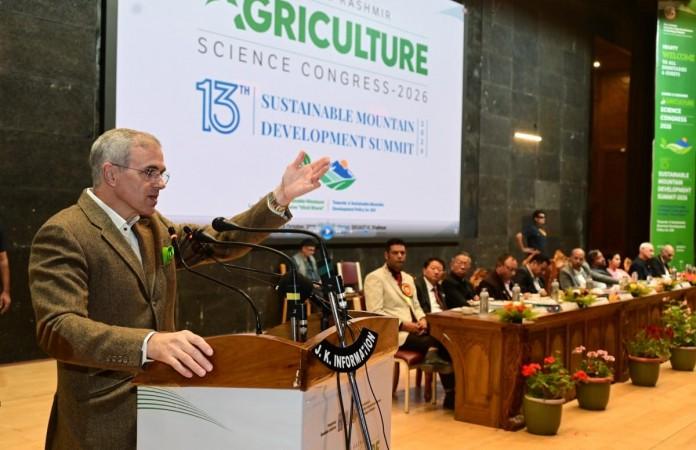
Describing these developments as the new reality, Omar Abdullah said the challenge was to determine how Jammu and Kashmir could continue to develop while adapting to growing environmental risks.
Tourism Must Grow Alongside Environmental Protection
“We have to ask ourselves: how do we sustain our livelihoods, and how do we develop? Development is essential, but it must be sustainable,” he said.
Omar cautioned against blaming tourism alone for environmental degradation, while acknowledging that growing tourist numbers placed considerable pressure on popular destinations. He stressed that environmental responsibility had to be shared by the government, residents, businesses and visitors alike.
“Tourism does put pressure on our environment, but to assume that the situation is bad only because of tourism or tourists would also be wrong. We will have to take some responsibility,” he said, urging people to avoid littering, reduce the use of single-use plastics, and conserve water and energy.
He called for a change in everyday practices, observing that people often discarded plastic wrappers and bottles in public places while expecting the government to clean up after them. While acknowledging the government’s primary responsibility for environmental management, he underlined the importance of individual efforts in protecting the natural surroundings.
New Tourist Destinations Need Sustainable Infrastructure
On tourism development, the Chief Minister said the solution was not to abruptly restrict visitors to established destinations such as Gulmarg, Pahalgam and Sonamarg, where many livelihoods depended on tourism. Instead, he advocated developing new destinations through a planned and sustainable approach, with adequate sewage treatment, wastewater management and solid waste disposal systems established from the outset.
“Some of our destinations do not have enough carrying capacity. We have to widen tourism, not to stop people from going to Gulmarg, Pahalgam or Sonamarg, but to develop new and sustainable destinations where the systems for waste disposal and sewage disposal are already ready,” he said.
Highlighting the need for environmentally sound infrastructure, Omar Abdullah said unscientific hill cutting during road construction had contributed to landslides and repeated damage to roads, particularly in remote areas of Jammu and Kashmir.
He said road construction agencies often resorted to indiscriminate cutting of mountain slopes without adequately considering slope stabilisation and appropriate cutting angles. Although such practices might reduce initial construction costs, the resulting damage during rainfall frequently necessitated repairs and reconstruction, diverting resources that could otherwise be used to build new roads.
Departments Asked to Adopt Sustainable Construction Practices
The Chief Minister said he had asked the Forest and Environment Department and the Public Works Department to work together to ensure that development projects incorporated sustainable engineering practices and reduced the risk of landslides.
“When you cut a mountain, cut it in a way in which the possibility of landslides may not be eradicated, but at least be reduced,” he said, emphasising that long-term sustainability must take precedence over short-term savings.
On urban development and housing, Omar Abdullah called for greater emphasis on energy-efficient and earthquake-resilient buildings, along with more efficient land use. With land becoming increasingly scarce in the Valley, he said, planners needed to explore vertical development wherever appropriate instead of continued horizontal expansion while ensuring compliance with seismic safety requirements.
Recalling the devastation caused by past natural disasters, including the 2014 floods and the 2005 earthquake that affected the region, he stressed the need to incorporate disaster resilience into future construction and explore cost-effective ways to retrofit existing buildings.
Glacier Retreat Highlights Need to Protect Natural Heritage
The Chief Minister also highlighted the visible retreat of glaciers in the region, recalling how the glacier near Sonamarg once extended close to the meadows. Today, he said, younger generations had to trek considerably farther to reach the receded glacier.
He said these changes underscored the responsibility of the present generation to protect the region’s natural heritage and preserve it for future generations.
“That is what we owe the future generations. Protect what we have, retrieve what we can, and ensure that we do not do any further damage, while also ensuring that livelihoods are protected,” he said.
Summit Expected to Produce Actionable Recommendations
The Chief Minister expressed hope that the three-day summit would move beyond academic discussions and produce concrete recommendations that could be translated into effective policies and practical action.
He said Jammu and Kashmir aspired to become the first Himalayan territory to have its own Mountain Development Policy and that his government was keen to take the initiative forward. However, he stressed that the policy must emerge from wider consultations and reflect the realities of the region rather than being based on idealistic assumptions.
“Those recommendations need to be grounded in reality. We need to balance the need for sustainability with the need for existence and livelihoods,” he said.
The Chief Minister thanked the delegates and participants who had travelled from different parts of the country to attend the summit and said he looked forward to its recommendations.
“I cannot emphasise this point strongly enough. Sustainable development through actionable inputs and practical steps is what I hope this summit will deliver,” he said, wishing the participants success in their deliberations.