
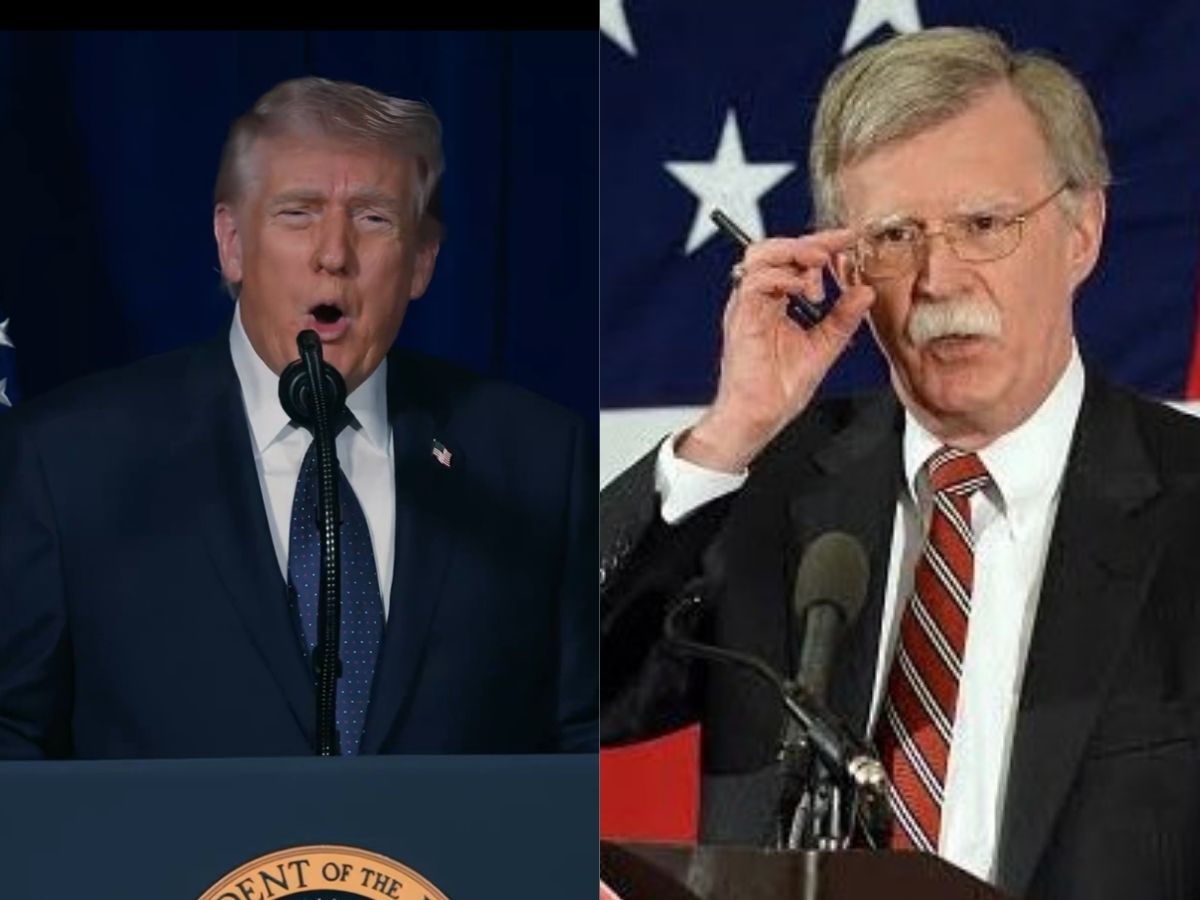

The former U.S. National Security Adviser John Bolton has criticized President Donald Trump for the recent memorandum of understanding (MoU) reached with Iran, calling the decision to reach an agreement without addressing Iran’s nuclear program “a major mistake” that went to the brink of nuclear war.
Bolton called the agreement “poor diplomacy.” It is more favorable to Iran and not to the rest of the world, and has left most of its controversial activities largely unaddressed. These activities include nuclear ambitions, ballistic missile programs, regional proxy networks and support of militant groups.
If Washington had lost valuable leverage by lifting sanctions before dealing with the nuclear issue, he admitted, “I believe that was a major mistake.”
Bolton also said: “The ceasefire with Iran was misguided. It enabled them to recover and reorganize.”
He said he felt that Iran’s potential disruption of shipping in the Strait of Hormuz made Washington accept an agreement that neglected broader strategic implications.
“The threat posed by Iran in the Strait of Hormuz to the global economy ultimately swayed Trump. He was preoccupied with his domestic political circumstances,” Bolton said.
Trump Overlooked Strategic Issues
The former official said the Trump administration focused on reopening the Strait of Hormuz and lowering global oil prices and didn’t take into account larger geopolitical issues.
It is evident from Trump’s comments that their focus was simply on opening the Strait of Hormuz to increase oil flow into international markets and reduce prices. They were not thinking of strategic implications.
Bolton claimed that several critical issues were overlooked in the agreement.
They failed to consider what this meant for Iran’s nuclear program, its continued support for international terrorism, its ability to control access through the Strait of Hormuz at will or the Iranian people still suffering under this regime. He concluded that “all these aspects currently favor Iran.”
Iran Emerges Stronger Politically
While the joint military operations between the U.S. and Israel had resulted in a huge blow to Iran’s military capabilities, Bolton maintained that Tehran had been politically more robust as a result of this agreement.
“I believe serious damage occurred” within Iran’s military-industrial complex, nuclear sites, air defenses, air force, and navy,” he said.
But he also observed that Iran exploited tension over the Strait of Hormuz crisis to extract concessions from other countries.
“Iran has not gained strength militarily but politically because it has manipulated unacceptable threats against freedom at sea. It has been using it as a tool for economic coercion against other countries.”
Bolton also raised doubts about whether Trump’s anticipated economic benefits from this agreement would come to fruition. While it was the deal to open the Strait of Hormuz to shipping through and relieve global energy markets, there are still too many questions of uncertainty for commercial shipping companies and insurance companies to fully resume operations in those waters.
“I find it quite unlikely that major shipping lines or insurance companies are prepared to deploy significant numbers of vessels back into the Gulf,” he added. And he said that “even those economic benefits envisioned from this MoU might not materialize.”
Deal Could Undermine Trump’s Credibility
The agreement, Bolton said, would undermine Trump’s credibility internationally and empower foes like China, Russia and North Korea.
Bolton said that criticisms expressed by an acronym (“TACO” for Trump Always Chickens Out) were reinforced by this deal.
“I believe that’s how it will be interpreted in Beijing and Moscow as well as Pyongyang.”
“They will recognize if they can divert Trump’s focus regardless of broader American interests. Trump will prioritize protecting his own interests first.”
Bolton predicted political consequences for Trump as a result of the deal in what he said would likely be in the not too distant future. “And I think it might be politically damaging for him.” He dismissed claims that this deal is a step toward lasting peace in West Asia. He said Iran would be able to use any respite granted by such agreements to bolster its financial resources and military capabilities.
The US-Iran peace deal, which is signed with a 14-point MoU, comes after almost four months of direct war between the countries and is a temporary ceasefire that goes on for 60 days to pacify the region while both parties work on a legally binding long-term peace treaty. It has also calmed global economic concerns by lowering oil prices and stabilizing financial markets.
Under this arrangement, Iran has reopened access through the Strait of Hormuz with a naval blockade removed and obstacles to commercial navigation cleared for free of charge and the U.S. has dismantled its own naval blockade. Tehran has also reaffirmed the commitment not to develop nuclear weapons and to freeze current nuclear activities during talks with the U.S. for its highly enriched uranium reserves for the next 60 days.
In addition, this MoU stipulates immediate waivers on U.S. sanctions that encourage Iranian crude oil exports, followed by a process of gradual lifting of primary and secondary sanctions and unfreezing billions of Iranian assets over time. It also proposes an international reconstruction scheme of no less than USD 300 billion to rebuild war-ravaged infrastructure in Iran.
Also Read: Who Is Mahrang Baloch? Prominent Baloch Activist Sentenced to Life in Pakistan
Syed Ziyauddin is a media and international relations enthusiast with a strong academic and professional foundation. He holds a Bachelor’s degree in Mass Media from Jamia Millia Islamia and a Master’s in International Relations (West Asia) from the same institution.
He has work with organizations like ANN Media, TV9 Bharatvarsh, NDTV and Centre for Discourse, Fusion, and Analysis (CDFA) his core interest includes Tech, Auto and global affairs.
Tweets @ZiyaIbnHameed
The post John Bolton Slams US-Iran Deal appeared first on NewsX.

Comments are closed.