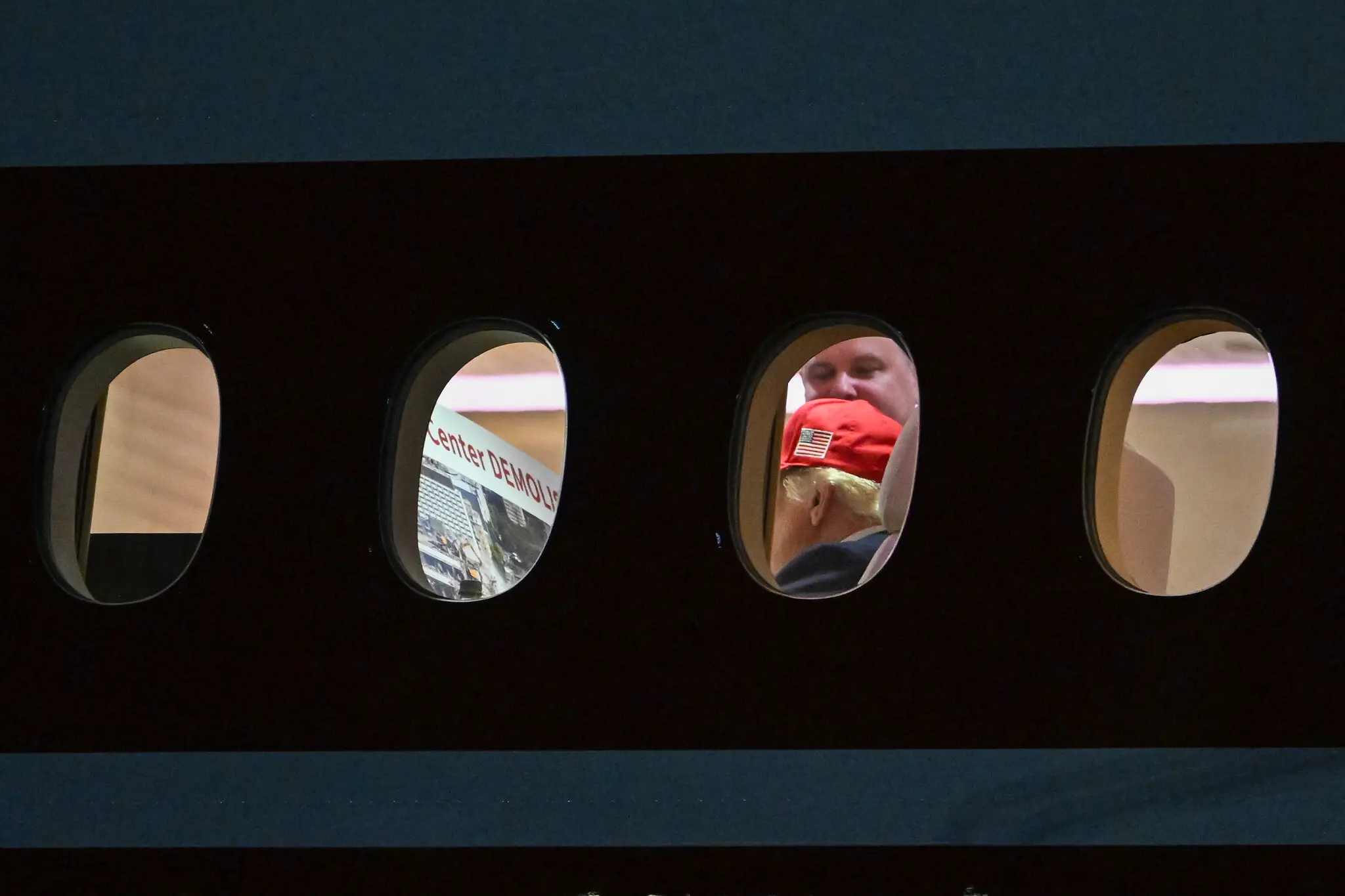
Judge Orders Kennedy Center to Give 30 Days’ Notice Before Demolition, Structural Changes/ TezzBuzz/ WASHINGTON/ J. Mansour/ A federal judge ordered the Kennedy Center to provide 30 days’ notice before making major physical changes, including any attempt to demolish the building. The order followed the performing arts center’s sudden closure over reported public-safety risks and structural deterioration. The dispute also involves President Donald Trump’s effort to place his name on the center, a proposal the judge ruled requires congressional approval. Photographs taken through Air Force One’s windows showed President Donald Trump reviewing a presentation labeled “Kennedy Center DEMOLISHED.” The White House and Kennedy Center officials have not explained the presentation or confirmed that a demolition plan has been approved.
A federal judge has ordered the institution to provide 30 days’ notice before demolishing the building or making other major physical changes.

Quick Look
- Judge Christopher Cooper required 30 days’ notice before major physical changes.
- The order explicitly covers any potential demolition of the Kennedy Center.
- The building closed suddenly Wednesday because of reported safety risks.
- Officials said the initial closure would last at least seven days.
- The Kennedy Center board separately voted to close the building indefinitely for repairs.
- Rep. Joyce Beatty challenged what she called the center’s “unlawful closing.”
- Cooper denied Beatty’s request for another hearing but clarified his existing order.
- Congress has allocated $257 million for repairs.
- Barbra Streisand criticized the center’s closure and the naming controversy.
- Lawmakers from both parties expressed opposition or concern about possible demolition.
- Photographs showed Trump examining a large presentation aboard Air Force One.
- The visible heading read “Kennedy Center DEMOLISHED.”
- Housing official Bill Pulte appeared beside Trump in the images.
- The White House has not explained the presentation.
- Kennedy Center representatives have also declined to clarify it.
- Rep. Joyce Beatty’s attorneys cited the photographs in an existing lawsuit.
- A judge denied Beatty’s request for an emergency hearing.
- The judge nevertheless required 30 days’ notice before demolition or major changes.
- Trump previously said the Kennedy Center could be torn down.
- The photographs alone do not establish that demolition has been authorized.

Deep Look
Judge requires advance notice of major Kennedy Center changes
WASHINGTON — A federal judge has ordered the Kennedy Center to provide 30 days’ notice before making any major physical changes to the performing arts complex, including demolishing the building.
U.S. District Judge Christopher Cooper issued the clarification Thursday following the center’s sudden closure and President Donald Trump’s suggestion that the aging structure could eventually be torn down.
Cooper said the order was intended to “avoid any confusion on that score given more recent events.”
The ruling does not prevent ordinary assessments or necessary safety work. It requires advance notice before officials undertake substantial physical alterations, ensuring the court and other parties have time to respond.
The order expressly applies to potential demolition and follows a series of legal disputes over the Kennedy Center’s management and name.
Officials cite ‘acute risks’ from structural deterioration
Kennedy Center Executive Director and Chief Operating Officer Matt Floca said the building was temporarily closed Wednesday because of “acute risks to public safety resulting from continued structural deterioration.”
The initial closure will last at least seven days, allowing officials to “assess existing safety risks in those portions of the main building exhibiting severe structural deterioration,” Floca said.
According to Floca, the decision followed an inspection of the roof terrace canopy and a partial ceiling collapse earlier in September. Officials could extend the closure after reviewing the building’s condition next week.
The temporary emergency closure is separate from the Kennedy Center board’s decision Tuesday to close the institution indefinitely for renovations.
That distinction has become central to the court dispute, with opponents questioning whether the stated safety concerns are being used to justify a permanent shutdown.
Trump says building could be ‘ripped down’
Trump became Kennedy Center chairman last year after his allies on the board selected him for the position.
On Wednesday, the president said his efforts to restore the deteriorating building deserved formal recognition, “because frankly, if we don’t do that, it’s going to close. It’ll end up being ripped down. It’s in very, very bad shape, very dangerous shape.”
The statement increased concern among preservation advocates, performers and lawmakers about the building’s future.
Congress has allocated $257 million for repairs. Trump has said the work would proceed only if the board could implement plans to add his name to the complex.
Cooper previously blocked the board from returning Trump’s name to the building without congressional authorization.
Joyce Beatty challenges the closure
Rep. Joyce Beatty, an Ohio Democrat and ex officio member of the Kennedy Center board, filed the legal challenge that led to Cooper’s latest clarification.
Beatty has opposed efforts to add Trump’s name to the building. She and Trump had a verbal confrontation during Tuesday’s virtual board meeting, at which members voted to close the center.
Her attorneys sought an emergency hearing to examine the board’s actions and intentions. They argued in a court filing that the temporary closure explanation should not be accepted at face value.
The board members’ “rationale that they are only temporarily closing the Kennedy Center is a plain pretext to justify shutting down the Center permanently. The facts before the Court are deeply concerning,” Beatty’s lawyers wrote.
Cooper declined to conduct the requested hearing. However, he granted the request “to make crystal clear” that the existing order prohibits demolition without 30 days’ advance notice.
Court blocks proposed Trump inscriptions
The Trump-aligned Kennedy Center board voted in August to place a lengthy inscription on the building’s exterior.
Under the proposal, the facade would have read: “The John F. Kennedy Center for the Performing Arts Restored and Renovated By President Donald J. Trump.”
A second inscription stating “Endowed by the Trump Kennedy Center Fund” would have been added if the fund raised $100 million. The board also sought to rename the plaza in front of the center in Trump’s honor.
Cooper blocked all those proposals Tuesday, ruling that they could not proceed “without Congress’s blessing.”
The judge had previously ruled in May that the center illegally added Trump’s name to the building and ordered it removed. Kennedy Center officials complied in June, although a tarp and scaffolding remained where the name had been displayed.
Cooper’s rulings maintain that changing the congressionally established institution’s name requires legislative authorization.
Photographs raise new questions about Kennedy Center’s future
Photographs showing President Donald Trump reviewing a presentation labeled “Kennedy Center DEMOLISHED” aboard Air Force One have intensified questions about whether his administration is considering tearing down the performing arts complex.
Photojournalists captured the images Wednesday night through the aircraft’s windows after it landed at Joint Base Andrews in Maryland.
The presentation appeared to include an image of a construction site beneath the demolition heading. However, the photographs did not reveal enough detail to determine whether Trump was reviewing a finalized proposal, an early concept or another type of planning document.
The White House has not provided an explanation. Roma Daravi, a Trump-aligned spokesperson for the Kennedy Center, has also not publicly clarified the presentation, according to The New York Times report.
Bill Pulte appears alongside Trump
Bill Pulte, the federal government’s top housing official and a political ally of Trump, appeared beside the president in the photographs.
Pulte also served for a period during 2026 as acting director of national intelligence. His presence added to speculation that the material represented more than a casual discussion, although no official has described his role in the presentation.
The visible photographs do not show who produced the display, when it was prepared or whether any federal agency was instructed to develop a demolition proposal.
There has also been no confirmation that Congress, preservation authorities or other agencies with potential jurisdiction were consulted.
Photos become part of Kennedy Center lawsuit
Attorneys for Democratic Rep. Joyce Beatty of Ohio incorporated the photographs into an existing lawsuit concerning the Kennedy Center’s closure and management.
Beatty is an ex officio member of the center’s board and has challenged actions taken by its Trump-aligned leadership. She objected to the institution’s sudden closure after officials cited serious safety concerns involving deteriorating portions of the building and fallen ceiling material.
Her legal team asked a federal judge to make “crystal clear” that Kennedy Center officials could not demolish the complex without advance notice.
U.S. District Judge Christopher Cooper denied Beatty’s request for an emergency hearing, allowing the center to remain closed temporarily. He nevertheless clarified that officials must provide 30 days’ notice before undertaking demolition or any other major physical alteration.
Cooper’s order specifically covers demolition and followed Trump’s public suggestion that the building could be torn down.
Closure officially attributed to safety concerns
Kennedy Center officials have said the temporary closure was necessary because of serious public-safety risks created by structural deterioration.
Executive Director and Chief Operating Officer Matt Floca said the building would remain closed for at least seven days while specialists evaluated the affected areas.
The temporary shutdown followed an inspection of the roof terrace canopy and a partial ceiling collapse earlier in September. Officials said the closure could be extended after the assessment.
The emergency action is separate from the Kennedy Center board’s vote to close the complex indefinitely for repairs. Beatty’s attorneys have questioned whether the safety explanation could be used to justify a permanent shutdown.
Trump publicly raised possibility of demolition
Hours before the Air Force One photographs were taken, Trump spoke to reporters in North Carolina about the Kennedy Center’s deterioration and the dispute over adding his name to the building.
“Because frankly, if we don’t do that, it’s going to close. It’ll end up being ripped down,” Trump said.
Those remarks differed from his public position in February, when he said, “I’m not ripping it down.”
The administration has not explained whether circumstances changed between those statements or whether Trump was describing demolition as a possible consequence rather than announcing a policy decision.
The subsequent photographs amplified the uncertainty because the heading on the displayed material appeared to present demolition as a defined concept.
Naming dispute remains central to controversy
The Kennedy Center board previously approved plans to place Trump’s name on the building and rename its plaza in his honor.
The proposed facade inscription would have credited Trump with restoring and renovating the John F. Kennedy Center for the Performing Arts. A second inscription was planned if a fundraising initiative bearing Trump’s name collected $100 million.
Cooper blocked those proposals, ruling that officials could not alter the congressionally established name without legislative approval. The judge previously ordered Trump’s name removed after determining that it had been added illegally.
Congress has allocated $257 million for Kennedy Center repairs. Trump has linked the renovation work to receiving formal recognition on the building, creating further uncertainty about how the federal funding will be used.
Previous demolition decisions shape public response
Questions about the Kennedy Center plans have also been influenced by Trump’s handling of other major construction projects.
His administration demolished the White House East Wing as part of a ballroom project after initially indicating that the new construction would not interfere with the existing structure.
Critics have also pointed to Trump’s 1980 demolition of the Bonwit Teller building in Manhattan. Decorative limestone features that he had previously indicated might be preserved were destroyed during construction of Trump Tower.
Those earlier episodes do not prove that the Kennedy Center will be demolished, but they have contributed to concern among lawmakers, artists and preservation advocates seeking firm assurances about the building’s future.
What remains unknown
The photographs establish that Trump reviewed material carrying an explicit demolition heading. They do not establish that a final plan exists or that demolition has been approved.
Officials have not disclosed:
- Who prepared the presentation.
- Whether it contained an architectural or engineering proposal.
- Why Pulte was participating in the discussion.
- Whether demolition costs or replacement plans have been evaluated.
- Whether Congress or preservation agencies have been consulted.
- Whether the material represented an active proposal or one option among several.
For now, any major physical changes are subject to Cooper’s 30-day notice requirement, giving Beatty’s attorneys and other interested parties time to respond if the administration formally moves toward demolition.
Barbra Streisand criticizes the dispute
Barbra Streisand, who received a Kennedy Center Honor in 2008, questioned the decision to close the institution and described the controversy surrounding its management as “galling and painful to witness.”
Addressing Trump’s efforts to add his name, Streisand said in a statement to The Associated Press: “You can easily imagine my indignation at seeing this revered institution become the subject of such a bitter struggle over one man’s name and unchecked ego.”
Streisand said her inclusion in the 31st class of Kennedy Center Honorees represented more than professional recognition.
She described it as “for me, and for so many artists, that honor represented something larger than a career recognition. It represented a belief in the importance of art to the life of a democracy.”
Lawmakers respond to demolition possibility
Lawmakers from both parties called the controversy a distraction and expressed hope that demolition would not occur.
Senate Majority Leader John Thune, a South Dakota Republican, questioned whether the building would actually be torn down.
“I’d be very, very surprised if that actually happened,” Thune said.
Asked whether Congress would attempt to prevent demolition, he responded, “I hope we won’t get to that point.”
Democratic Sen. Ruben Gallego of Arizona accused Trump of “being selfish and is mad that they’re not putting his name on it.”
Gallego said the president did not appear to understand “how many people love and value both the memories of the Kennedy family as well as obviously of what the Kennedy Center means to this country.”
He predicted a “massive backlash” if Trump attempted to demolish the building.
Republican Sen. Thom Tillis of North Carolina characterized the controversy as a “false crisis” and said, “worrying about what (the building) is named is kind of silly.”
The Kennedy Center must now provide the required notice before undertaking demolition or other major structural changes while litigation over the building’s management and identity continues.
More on US News