
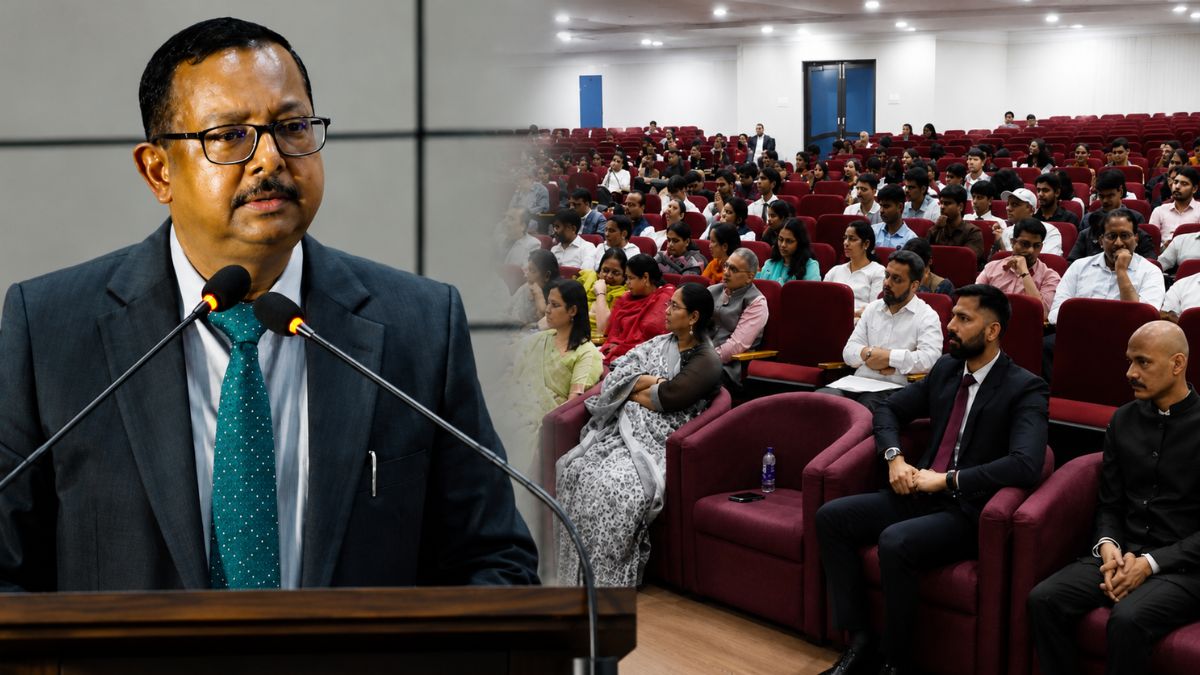
‘Eating chicken on the banks of Ganga is not a crime’, Supreme Court judge raised questions on freedom of expression, expressed deep concern over what?

Supreme Court Justice Ujjal Bhuiyan on Saturday made many important comments regarding democracy, freedom of expression and judicial system. Addressing the fourth Justice GP Singh Memorial Lecture organized at the National Law Institute University (NLIU), Bhopal, he said that in India, there is a growing tendency to convert even normal activities into criminal cases, which is a matter of concern for democracy.
in your address Justice Bhuiyan He mentioned the case in which 14 Muslim youth were arrested for eating chicken biryani on a boat in the Ganga river to break the fast during Ramzan. He said that eating chicken biryani is not a crime nor is there any law that prohibits eating chicken above the river Ganga. Despite this, those youths were arrested and had to stay in jail for about three months. According to him, this example shows how even normal activities are being criminalized.
‘Debate and disagreement are the soul of democracy’
- Justice Bhuiyan said that in India, the public space for expressing different opinions and protesting peacefully is continuously shrinking. He said that the Constitution gives citizens the right to express their views and demonstrate peacefully.
- The real strength of democracy lies in debate and disagreement, but unfortunately today many normal activities are also being turned into criminal cases.
- The Supreme Court judge said that courts grant bail in many cases, but there is a lot of delay in getting relief. Not only this, many times such conditions are imposed while granting bail which can affect the freedom of expression of the citizens.
- He raised the question that if while granting bail to a person, he is barred from attending public meetings, posting on social media or leaving the country, then are the courts not indirectly discouraging people from expressing their dissent?
Bombay High Court’s comment on Gaza protest was also mentioned
- Justice Bhuyan also referred to the decision of the Bombay High Court in July 2025 in which the petition filed by CPI (M) seeking permission to hold a demonstration against the alleged massacre in Gaza at Azad Maidan in Mumbai was rejected.
- In that order, the court had said that there are already many problems in the country and people should first pay attention to the issues of their country.
- Responding to this comment, Justice Bhuyan said that he found it ‘quite surprising’ that a judge raised the question as to why Indian citizens want to protest against incidents happening abroad.
‘Judiciary not above criticism’
- In his speech, Justice Bhuiyan said that the judiciary is by no means beyond criticism. He appealed to law students, lawyers and common people to critically analyze judicial decisions.
- Justice Bhuiyan Said that criticizing a decision is not criticism of the judge, rather it strengthens the justice system.
- Referring to several recent Supreme Court decisions, including the Economically Weaker Section (EWS) reservation, he asked the students not to blindly accept every decision, but to review it from a legal and constitutional point of view.
‘Praise alone will not strengthen the system’
Justice Bhuiyan said that if everyone just keeps praising judges and never asks questions, then how will the justice system improve? According to him, serious debate and criticism on judicial decisions is very important in a healthy democracy.
‘Public trust is most important’
- Justice Bhuiyan said that the legitimacy and relevance of the judiciary depends on what the public thinks about it. Therefore, judges should introspect from time to time.
- He said that 75 years after the formation of the Republic of India, it is most important how the citizens view the Supreme Court and the entire judiciary. Improvement in institutions is possible only through introspection and public discussion.
Such questions have been raised before also
This is not the first time that Justice Ujjal Bhuyan has expressed concern over the issue of freedom of expression and dissent. Earlier, in a program of the Supreme Court Bar Association in Bengaluru, he had said that to become a developed India, the ability to accept different ideas will have to be increased. Referring to the increasing use of UAPA and low conviction rate, he had said that keeping people in jail for a long time without a timely trial cannot be the identity of a developed democracy.

Comments are closed.