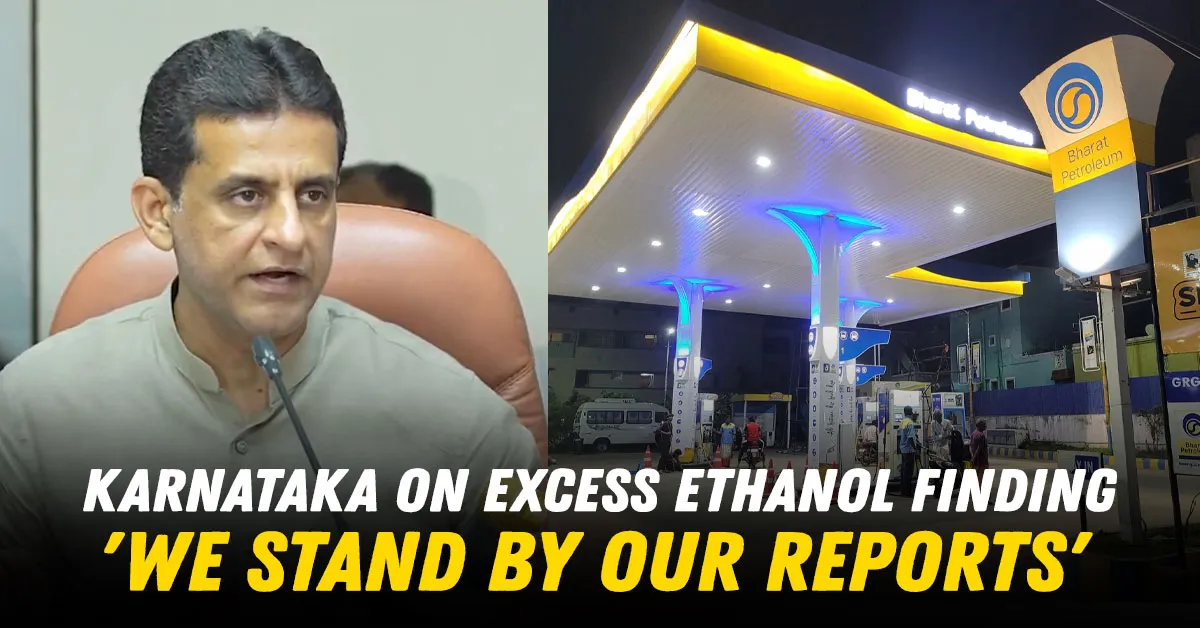
The Karnataka government has stated that it stands firmly by the report it had previously released, showing excess ethanol content in fuel samples collected from within the state. The state has publicly questioned the credibility of oil companies’ own testing methods and accused them of having a conflict of interest in the matter. The state’s Food, Civil Supplies, Consumer Affairs and Legal Metrology Minister Rizwan Arshad maintained that high ethanol blends can damage a lot of vehicles plying on our roads and urged the Centre to step in and ensure that independent testing is accepted.
In a press conference held on Monday (November 9), the Karnataka government reiterated that excess ethanol blending is based on independent testing conducted by an NABL-accredited third-party laboratory. It has questioned why oil marketing companies are unwilling to accept these results. Oil companies mostly rely on their own in-house testing to establish that the petrol supplied meets the required standards.
The Minister has also raised concerns about the use of basic water-based hydrometer kits by oil companies to check quality. It argues that independent laboratory testing should be given due importance. This particularly matters in this case as the results have direct impact on the vehicle health and in the larger picture, on the consumer’s wallet.
Arshad further pointed out that only around 6,200 vehicles registered on the VAHAN portal are capable of operating on higher ethanol blends. Most other vehicles can only support blends of up to E20 (20% ethanol and 80% petrol).
The government wants the Centre to intervene and direct oil marketing companies to accept independent third-party testing. It has called for greateer transparency and accountability in the ethanol-blending program.
The controversy began after Karnataka Food, Civil Supplies, Consumer Affairs and Legal Metrology Minister Rizwan Arshad presented test results showing that petrol samples collected from multiple outlets in the state had ethanol content above the recommended 20% limit.
According to the state’s findings, the highest ethanol content was recorded at 31.2% in a sample from an Indian Oil Corporation (IOCL) outlet. Sampling was done from bunks in Bengaluru, Kolar, Chikkaballapura, Bengaluru Rural, Ramanagara, Mangaluru and Tumakuru. These were then tested at a laboratory accredited by the National Accreditation Board for Testing and Calibration Laboratories (NABL).
The state highlighted the possible financial impact on ordinary motorists due to the excess blending. The Minister called for action against oil marketing companies found supplying petrol with ethanol content above the prescribed limit.
Minister Rizwan Arshad has alleged that the oil companies’ position in the case, raises a conflict-of-interest concern. His argument is that companies responsible for supplying the fuel should not be the only ones whose testing methods are accepted when the fuel quality is being questioned. He also said that state-run, unannounced inspections are essential to prevent consumer fraud and ensure fuel quality.
Indian Oil Corporation, Bharat Petroleum Corporation and Hindustan Petroleum Corporation- three of India’s major publis sector oil companies, have jointly rejected Karnataka’s findings. In a statement, they said the reported results were not established through testing that followed the prescribed statutory and technical procedures. The companies argued that the E20 petrol supplied across India complies with IS 17021, the Bureau of Indian Standards specification for ethanol-blended motor gasoline.
The three also questioned the sampling process followed in this case. According to these companies, sampling and testing must follow the Motor Spirit and High Speed Diesel Order 2005, along with the Marketing Discipline Guidelines (MDG) 2024.
According to these guidelines, six one-litre samples need to be collected from a petrol outlet. Two must be handed over to the dealer against acknowledgement, while two others must be retained by the oil company or the department. The remaining two must be sent to a laboratory specified under Schedule III of the Control Order or notified in the Official Gazette. The companies also said that the sample labels must carry joint signatures and the test results must be communicated to both the dealer and the oil marketing company (OMC).
The OMCs also alleged that the sampling was done without the participation of their representatives. They allegedly did not receive the corresponding retention samples, complete details of the petrol bunks or the lab reports. The companies said they had requested these through the State Level Coordinator to independently verify the findings.
Karnataka’s finding of up to 31.2% ethanol content fuel itself is shocking. Responding to a question about them, Union Heavy Industries Minister H.D. Kumaraswamy hinted that discussions are ongoing within the government, on increasing ethanol blending in petrol to around 30%.
However, in October, Hardeep Singh Puri, the Union Petroleum and Natural Gas Minister, had stated that the government currently has no plans to raise ethanol blending in petrol beyond the 20% threshold. Karnataka’s findings and the Heavy Industries Minister’s statement contradict this assurance, and add to the citizens’ confusion. It is high time that the central government steps in and throws clarity on the actual direction.