

At a time when women’s reservation in legislatures, be it at the Centre or states, has dominated debates, the story of E Sindhu, a local self-government leader in Kerala, continues to inspire many, even as India prepares to welcome yet another Local Self-Governance Day on Friday (April 24).
What makes her journey bright is not just her stepping away from a steady legal practice to make a successful foray into serving the public at the grassroots level and serving as the president of two award-winning panchayats in the southern state’s Malappuram district, but her utilising women’s reservation in the pursuit of an administrative role.
Also read: Beyond empowerment, India needs women leaders for its own good
Sindhu, who first served as the president of Maranchery gram panchayat from 2012 to 2019 despite facing resistance from a section of her own Communist Party of India (Marxist), and that of Perumbadappa block panchayat since 2020, concedes that the women’s quota did facilitate her goal.
‘Women’s reservation made me who I’m’
“Without an iota of doubt, women’s reservation made me who I am today. I first contested in 1995 and lost narrowly. Later, I became panchayat president (Maranchery) under reservation, and then again from a general seat (Perumpadappu). However, the experience I had when I became president under women’s reservation was different from that I had when I became president from a general seat,” Sindhu told The Federal.
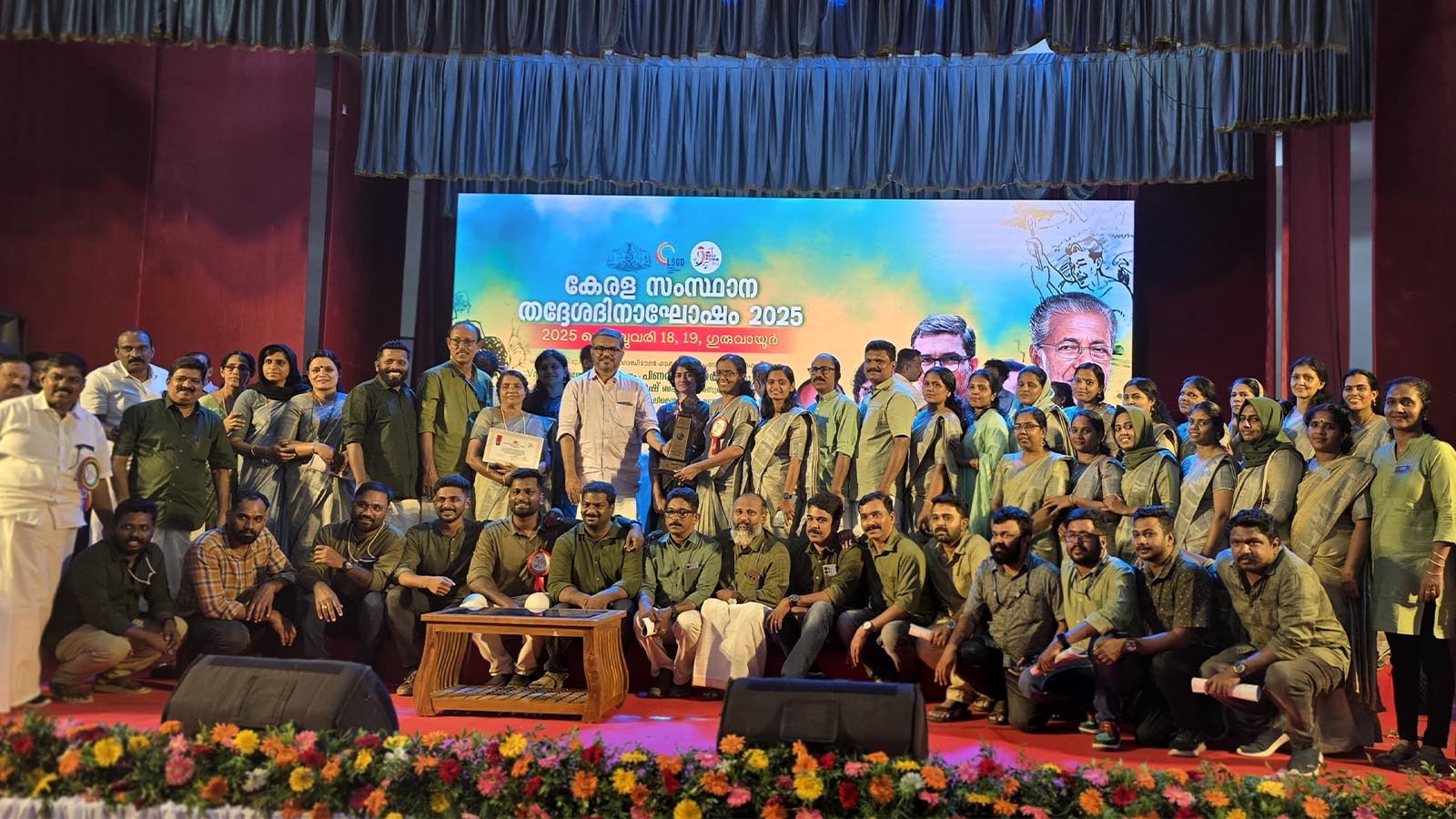
E Sindhu receives the Swaraj Trophy, which the Kerala government confers the best self-government institutions, from the states chief minister, Pinarayi VIjayan, in 2021.
“After becoming president from the general seat, I had to go through many challenges. But, among the public, I had strong support from a large majority. People recognised and appreciated our work,” she added.
However, inside the party, it has been far from smooth. When a woman stands from a general seat, many don’t look at it positively, she told this website, particularly from those who themselves are keen to contest from such seats.
Kerala made use of women’s quota in local bodies
Sindhu was among the thousands of women who entered local governance after the reservation for women in local bodies was raised from 33 per cent to 50 per cent in 2010.
Kerala was not among those states that took the step early; it was around the eighth or ninth in the country to implement it. But once the change set in, the state saw a massive participation of women in local administration, which resulted in a decisive change in its grassroots political landscape.
Dr KPN Amrutha, assistant director of the Thrissur-based Kerala Institute of Local Administration, which trains members of local self-governments, said Kerala’s uniqueness lies in the fact that it doesn’t just make up the numbers of women in reserved administrative roles just for the sake of it.
Also read: Namita Thapar slams trolls over Namaz reel: ‘People speak up for Women’s Bill, not for women’
“Their presence is more structured within governance. For instance, if the president is a woman, the vice president is typically a man, and vice versa. If there are four standing committee chairpersons, at least two of them are women. In district panchayats, if there are multiple committee heads, a significant number of them are women. This kind of balance is ensured not just in membership but in positions of power within the administrative structure,” she said.
According to Amrutha, this has brought a visible change.
“When women serve as standing committee chairpersons in sectors such as health, education, and welfare, there is a noticeable shift. Projects are actively sought out and designed with a focus on women’s development and specific needs. From panchayats to gram sabhas, there is now a tendency to identify and push for such targeted initiatives. That, in itself, is a very positive development,” she added.
This change hasn’t come in a day. Although Kerala had the socio-political ingredients, such as literacy, reform movements, and a long history of decentralisation, the 50 per cent reservation for women implemented in 2010 altered something more fundamental. It moved a large number of women from the private space of the household into visible positions of power.
Today, representation in panchayats, district bodies and corporations has crossed the mandated quota, roughly between 53 and 54 per cent. The numbers matter, but the story is not just about them. It is about who speaks, who decides, and how governance ensures the last-mile delivery.
Women play significant administrative roles today
While women no longer remain occasional participants across various institutions of local governance but confidently serve in top posts, including president, chairperson, or standing committee leads, handling key businesses such as budget, negotiations, managing political pressures and responding to crisis situations, women representatives are also seen as more approachable and less transactional and more willing to engage with residents directly.
Also read: Nari Shakti: A convoluted stratagem to preserve male dominance
Women’s growing clout has given governance a different texture, and it has brought local issues such as health, sanitation, neighbourhood infrastructure and welfare delivery more to the centre of discussions and events, such as ward sabhas have been seeing more participation. The training that aspiring women receive in such a work environment and with role models such as Sindhu, one would not be surprised if Kerala produces more like her in the near future.
Mobilisation and empowerment
“When we function as women representatives, we are able to enter homes we normally wouldn’t have access to. Even in families aligned with our opponents, we could go in as elected members. We could move from the front verandah to the kitchen, speak to people, and build a connection inside every household,” Majida A M, who served as a councillor in Ponnani municipality from 2010 to 2015, told The Federal.
“That changed something important. Women began to feel they could directly call us when an issue came up. Earlier, only men interacted with councillors. Women had almost no direct link. With our presence in governance, that began to shift,” she added.
Amid all the highs, there are also lows. Proxy politics still prevails in pockets where male relatives informally control decision-making. Also, bureaucratic resistance can slow down first-time representatives who are unfamiliar with procedural complexities. The burden of balancing public office with domestic responsibilities also remains unevenly distributed. Moreover, while women’s presence has increased, the depth of their influence could vary widely across regions and tiers.
Is change reflecting at higher echelons?
The question now is not whether the reservation has changed the landscape. It surely did. What deserves attention is what is next, especially when the shift has not carried into higher levels of power.
In the Kerala Assembly, women’s representation has historically remained low, rarely crossing 10 per cent since 1957, and stands at around eight per cent in the current House.
Also read: Why BJP’s ‘women insult’ pitch may not work in Bengal: ‘Not primary concern’ | AI With Sanket
The gap becomes even more visible when extended to Parliament, where representation remains limited.
Leaders such as Sindhu rarely become automatic choices for Assembly or Parliament seats, despite having a strong track record in local governance.
This is where the reservation often becomes the key opening. A woman leader from the CPI (M) points to how internal calculations often work against such candidates, particularly in electorally sensitive constituencies such as Ponnani.
“Someone like Sindhu, with her track record as president at both the village and block panchayat levels, should have been a natural choice. But the reality is, she wasn’t even in the initial discussions or among the probables. A big reason was the perception around the constituency’s sizeable Muslim vote base. There was this assumption that a woman candidate wouldn’t be able to consolidate those votes. Had it been a reserved constituency, she could have easily been in the Assembly two terms ago,” said the woman leader.
Also read: Speculation over Modi address after women’s quota hits Lok Sabha hurdle | Capital Beat
The disconnect between Kerala’s social progress and women’s higher presence in legislative power chambers continues to be stark, posing questions over the success of a ‘bottom-up’ democratic model.

Comments are closed.