
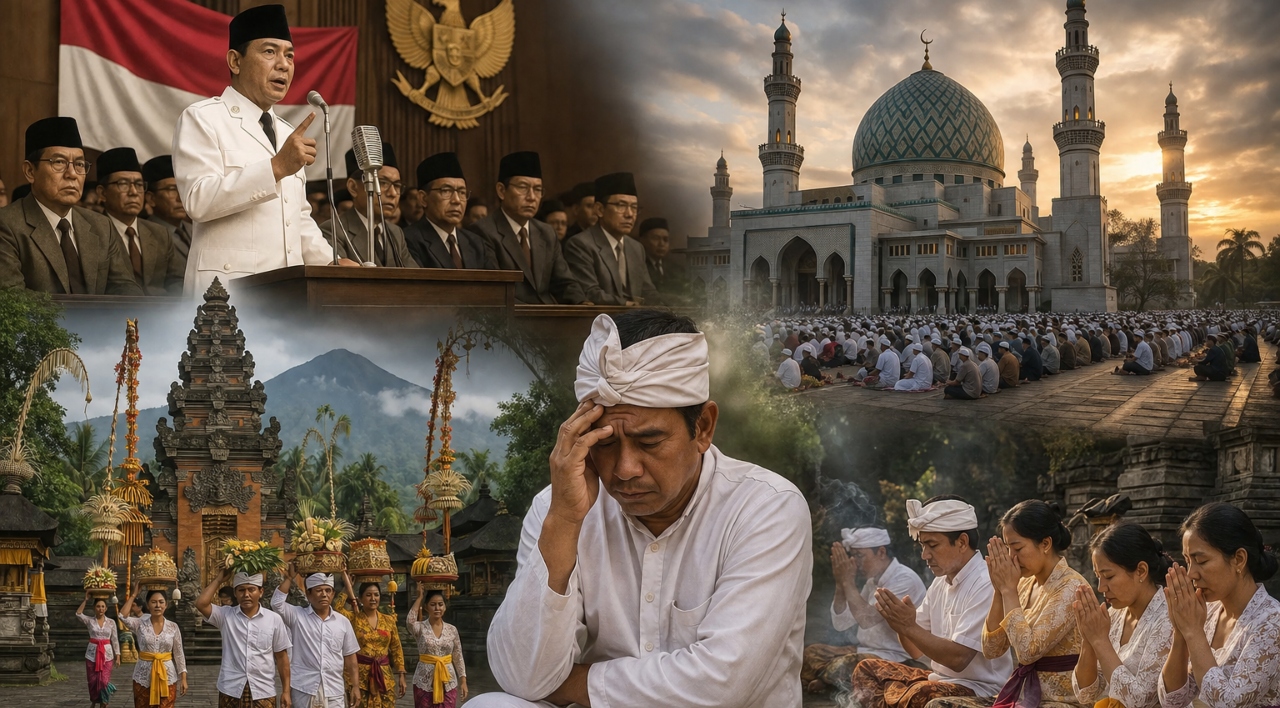
When the condition of ‘One God’ surrounded the Hindus of Indonesia, what is ‘Ketuhanan Yang Maha Esa’ and how was the identity saved?

PM Narendra Modi’s visit to Jakarta and worship at the historic Prambanan temple has once again brought the shared cultural relations between India and Indonesia into discussion. But there came a time in Indonesia when the country’s national principle “Ketuhanan Yang Maha Esa” (belief in one Supreme God) raised a big question of identity before the Hindus there. After all, what is this principle, why did it pose a challenge to Hindus and how was its solution found?
What is ‘Ketuhanan Yang Maha Esa’?
Ketuhanan Yang Maha Esa is the first principle of Pancasila, the national philosophy of Indonesia. It means “belief in one supreme God”. It was made the national ideological basis at the time of Indonesia’s independence in 1945. Its objective was not to promote any one religion, but to ensure that every citizen of the country has faith in some supreme divine power.
Why did the challenge arise before Hindus?
The Religion of Java – According to Clifford Geertz, Hindus in Indonesia, especially in Bali, worship many gods and goddesses. At first glance, this tradition was inconsistent with the constitutional concept of “one Supreme God”. For this reason, the question arose in the early years whether Hinduism meets this constitutional criterion.
Confusion also arose at some administrative levels regarding the official recognition of Hinduism. Although, it would not be correct to say that all Hindus were forced to become Muslims, but a crisis of religious recognition and constitutional acceptance did arise.
How was Hindu philosophy and ‘One God’ reconciled?
The solution to this challenge was found by Hindu scholars of Indonesia and Parisada Hindu Dharma Indonesia. He made it clear that Hinduism basically does not believe in multiple theisms, but believes in one ultimate truth (Brahma). Brahma itself appears in the form of various gods and goddesses. On this basis, “Sang Hyang Widhi Wasa” was presented as the supreme supreme power in Hinduism. This was not a new god, but a local expression of Brahma.
What did Hindus have to change?
Indonesian Hindus did not abandon their worship methods or their gods and goddesses. He simply presented his religious interpretation in a new form that all the gods are different manifestations of the same Supreme Being. After this, Hinduism got a place among the officially recognized religions of Indonesia and Hindus remained with their religious identity.
The dispute started with the Constitution in 1945, the solution was found in the 1960s.
The Religion of Java – According to Clifford Geertz, the controversy regarding “Ketuhanan Yang Maha Esa” in Indonesia began with the country’s independence. On June 1, 1945, President Sukarno proposed Pancasila as the ideological basis of the nation, which was included in the Constitution on August 18, 1945.
The first principle of Panchsheel was “Ketuhanaan Yang Maha Esa”, i.e. “belief in one Supreme God”. After the implementation of the Constitution, the government made it clear that Indonesia would not be a nation of any one religion, but every citizen would have to have faith in a supreme divine power. From here the question arose in front of the Hindu community whether the Hindu religion which worships many gods and goddesses would be able to live up to this constitutional test.
In the 1950s and 1960s, there was a long discussion on this issue between the government and Hindu organizations. This dispute was more about constitutional recognition and administrative acceptance than religious freedom. Ultimately Hindu scholars presented a philosophical interpretation of their religion, after which the government gave official recognition to Hinduism and the controversy ended.
What was the basis of ‘Ketuhanan Yang Maha Esa’?
The basic objective of this principle was not to promote any particular religion, but to establish a nation which would be religious, but would not become a state of any one religion. At the time of independence, Indonesia had a Muslim majority population along with Christian, Hindu, Buddhist and other communities. In such a situation, the founding leaders neither adopted the model of an Islamic nation nor a completely Western-style secular state. He chose a middle path, in which the state should respect all religions, but the citizens should have faith in some supreme divine power.
Under this thinking, “Ketuhanan Yang Maha Esa” was made the first and most important principle of Panchsheel. Its objective was to establish national unity, religious co-existence and balance between different communities. This is why even today the Constitution of Indonesia gives equal status to all recognized religions, provided they accept the concept of belief in a supreme divine power.
How did Hindus find the solution?
Hindu leaders of Indonesia found a solution to this challenge on the basis of the basic principles of Hindu philosophy. He explained to the government that Hindu religion definitely worships many gods and goddesses, but its basic philosophy believes in one ultimate truth or Brahma.
The famous mantra of Rig Veda “Ekam Sad Vipra Bahuda Vadanti” (Truth is one, the wise call it by many names) also expresses the same idea. On this philosophical basis, Hindu organizations accepted “Sang Hyang Widhi Wasa” as the local expression of the Supreme Being. This was not a new god, but an Indonesian interpretation of Brahma.
After this the government accepted that Hindu religion also believes in one supreme God and its gods and goddesses are different forms of the same supreme power. After this interpretation, Hinduism received official recognition and Hindus throughout Indonesia, including Bali, were successful in maintaining their identity without changing their religious traditions.
Why is this issue in discussion again due to PM’s visit?
During Prime Minister Narendra Modi’s visit to Indonesia, the worship at Prambanan temple and the emphasis of both the countries on the common cultural heritage of India and Indonesia again brought this historical incident into discussion. Both countries also reiterated their commitment to further strengthen temple conservation, cultural cooperation and shared civilizational ties.

Comments are closed.