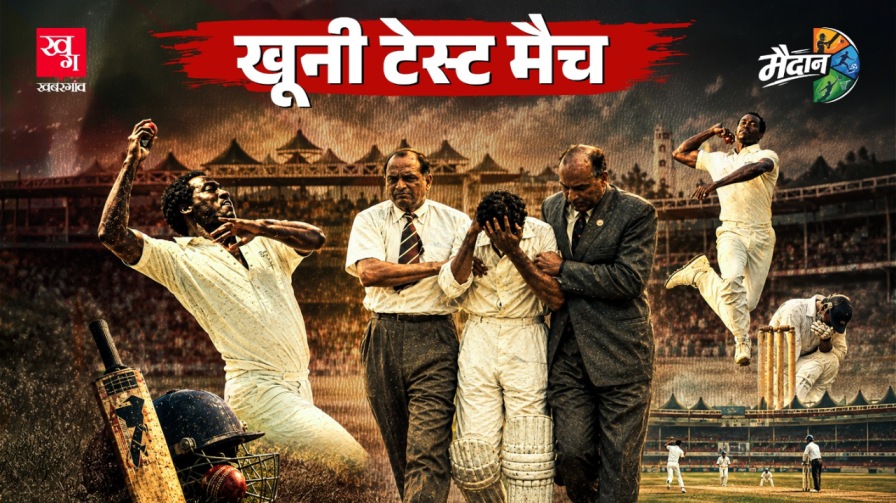
Cricket is called a gentleman's game but in its 148 years of history, there have been some matches which have caused a lot of damage to the image of this game. One such match was played between India and West Indies in 1976 at Sabina Park in Kingston. This was the last and decisive match of the series. In this match, West Indies captain Clive Lloyd adopted such a dangerous strategy that even today it is remembered as the bloody Kingston Test.
The Indian team, captained by Bishan Singh Bedi, surprised the West Indies by chasing the target of 403 runs in the third match of the series played in Port of Spain. This was the most successful chase in the history of Test cricket at that time. After this defeat, there was tremendous pressure on the West Indies team and captain Lloyd. Lloyd's captaincy was in danger. There were rumors that he could be removed from the captaincy of West Indies. In such a situation, he decided to enter Kingston with four fast bowlers Michael Holding, Wayne Daniel, Bernard Julien and Vanburn Holder.
Gavaskar-Gaikwad stuck on dangerous pitch
The pitch of Sabina Park in Kingston has always been helpful to fast bowlers but this time the pitch was harder than before. There were so many cracks on the pitch that a coin could easily go inside. Lloyd won the toss and asked India to bat first. The opening pair of Sunil Gavaskar and Anshuman Gaikwad came to the crease. Both of them did not let India suffer any loss till lunch on a difficult pitch.
Aditya Bhushan writes in Gaikwad's biography 'Guts Amidst Bloodbath', 'The pitch at Sabina Park was so hard that walking on it wearing spike shoes felt like walking on a cement surface. Despite this, Indian openers Sunil Gavaskar and Anshuman Gaikwad took the score to 60 without getting out till lunch.
West Indies showered bouncers after the break
After lunch, West Indies changed their strategy and started bowling holding round the wicket. Daniel, Julian and Holder also started targeting the bodies of the Indian batsmen. There was a continuous barrage of bouncers on the bouncy pitch of Sabina Park. Beamer balls also started being thrown. Daniel kept pretending that the ball was slipping from his hands.
On West Indies' body-targeting bowling, Gavaskar wrote in his autobiography 'Sunny Days', 'Lloyd, fearing that he might be removed from the captaincy, although he had been declared captain for the tour of England, attacked us with fast bowlers but we took the score to 98 runs without losing any wicket. Lloyd was feeling very disappointed. So he did not stop Holding from hitting a flurry of bouncers. It seemed that he had thought that if you could not get him out, then you would injure him and take him out of the field.
In that era, batsmen did not wear helmets. There was only a cap on the head. No grill to protect the face, no protection to protect the ears. This was the reason why every bouncer seemed to be waiting for some accident.
Gavaskar got angry
Gavaskar was so disappointed with the dangerous bowling of the Caribbean pacers that he threw his bat on the ground in anger. Gaikwad approached him to calm him down. Gavaskar said, 'I don't want to die from this bowling. I want to return home safely so that I can see my newborn son Rohan.
Holding was bowling at such a pace that many of his balls were passing over the batsman as well as wicketkeeper Derek Murray. The spectators present at Sabina Park would support their bowlers on every bouncer. They wanted to avenge the defeat at Port of Spain at any cost. Gavaskar writes in his autobiography that he did not clap on even one of our shots.
Gavaskar was clean bowled out on Holding's ball after scoring 66 runs. By the end of the first day's play, India had scored 175 runs at the loss of 1 wicket. Gaikwad scored 58, while Mohinder Amarnath returned unbeaten after scoring 25 runs. West Indies bowled only 65 overs in the first day's play.
'…the ball would have taken away Amarnath's head'
At the beginning of the second day, a ball from Holder hit Amarnath's ankle joint. Shortly after this, he was out on a deadly bouncer from Holding. Gaikwad recalls, 'Holder was bowling at almost the same pace as Holding… Amarnath could add only 14 runs to his score. He was out while defending on a ball which, if he had not played, would have taken his head off.
Holding bowled a sharp short ball to Gundappa Vishwanath, who came to the crease after Amarnath was injured. While trying to defend this ball, Vishwanath not only broke his finger but also got caught.
Meanwhile, Gaikwad had also got injured. Aditya Bhushan writes, 'Due to pain in the ribs, it was difficult for Gaikwad to move his legs even a little. The faster he hit the ball, the more determination he would get ready to play the next ball like a brave boxer. Despite the pain, he took his score to 81 but he knew that the way the West Indies bowlers were bowling, he was going to get a ball that would blow his mind.
Gaikwad's injury shakes the Indian dressing room
This happened within a few moments, which made the entire field silent for a few seconds. A fast-paced ball from Holding hit Gaikwad near his ear. Gaikwad fell on the ground. Gaikwad recalls that injury, 'I don't know where my glasses flew. I felt like there was an earthquake in my head. Bells were ringing in it. Immediately Lloyd, (Vivian) Richards and Murray came running towards them.
Gaikwad was bleeding from his ears. He had to retire hurt and return from the field. This is how that 81-run innings played in adverse conditions ended. Gaikwad lay down as soon as he went to the dressing room but had to be immediately taken to the hospital. When Gaikwad reached the hospital, team manager Pauly Umrigar was already present there, who had come to get Vishwanath's hand plastered. Umrigar was very worried about Gaikwad. Similarly, 14 years ago, his team member Nari Contractor was hit on the head by a ball and she regained full consciousness after 6 days and after that she could never play cricket.
Brijesh Patel also got badly injured
While Gaikwad was in the hospital, Brijesh Patel also got badly injured. Holder's rising ball hit his lips. He also had to retire hurt. Captain Bishan Singh Bedi was monitoring the condition of his players from the dressing room. He was forced to declare the innings at 306/6 as India had no batsmen left to play. In response, West Indies scored 391 runs and took a lead of only 85 runs.
That bold decision of Bishan Singh Bedi
In the second innings, 3 Indian batsmen Gaikwad, Vishwanath and Brijesh Patel were not in a position to bat. Gavaskar also walked out after scoring just 2 runs. Amarnath avoided the defeat of India's innings by scoring 60 runs but as soon as he was out, Bedi took a decision which probably not every captain can take. Actually, India's score in the second innings was 97/5. Team India had a lead of only 12 runs but now there was no batsman left to play. In such a situation, Bedi declared the innings. Bedi knew that if batting continued, a serious accident could happen.
West Indies got the target of only 13 runs, which they achieved without any loss. Bedi later clearly said that the lives of the players were more important than any victory. Even today, this bold decision of Bedi is praised.
Holding admitted the truth
West Indies players also now believe that their team adopted dangerous bowling tactics. Many years later, Holding wrote in his autobiography 'No Holding Back', 'Many people said that the pitch was the reason for the injuries to the Indian players but the truth was that we bowled more short balls than necessary. I was not comfortable with the way we were asked to bowl, but if your captain asks you to do so, there is nothing you can do about it.
For several days after being hit by Holding's ball, Gaikwad kept hearing strange sounds in his ears. His left eardrum was completely ruptured. He had his ears operated twice but suffered hearing loss from his left ear throughout his life.