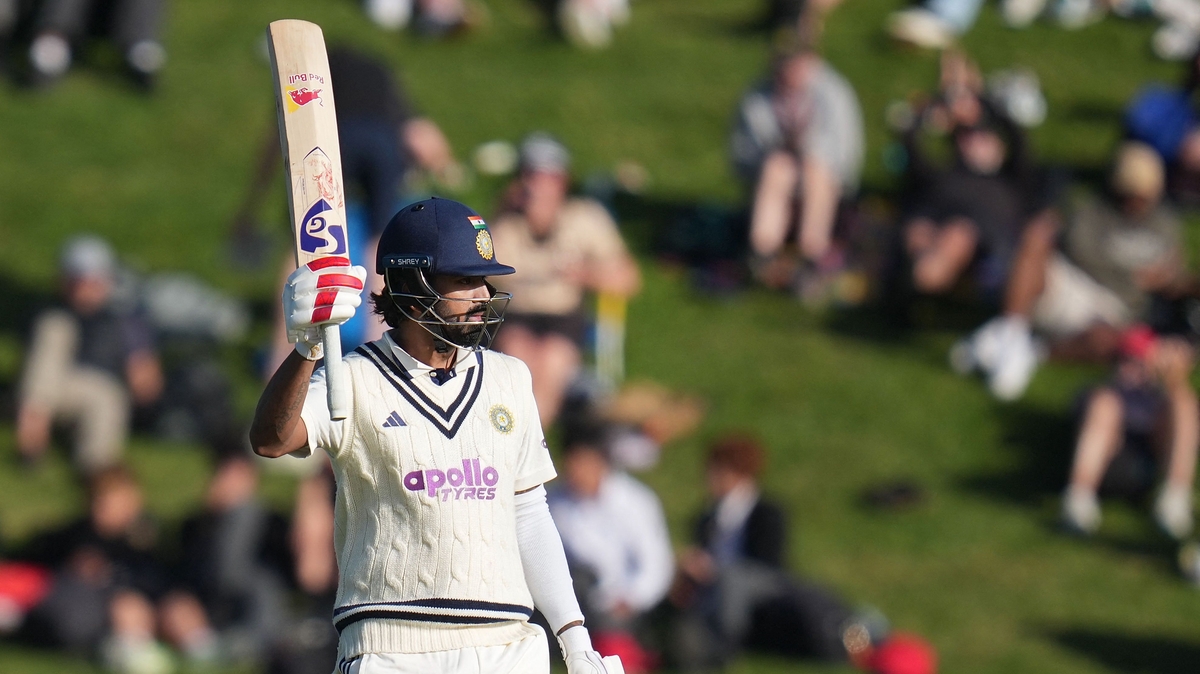
Wellington: Devdutt Padikkal continued his golden run in the international arena with another half-century, in the company of seasoned campaigner KL Rahul, who inched towards a well-deserved century as India comfortably reached 239 for one at lunch on the third day of the opening Test against New Zealand here on Saturday.
Padikkal, who scored back-to-back hundreds in the last away series in Sri Lanka, was unbeaten on 53 off 118 balls with seven crisp boundaries, while Rahul blended solid defensive technique with occasional aggressive strokes to remain unconquered on 93 off 197 balls.
Towards the end of the session, Rahul showed classical footwork against a flighted delivery from off-spinner Glenn Phillips to hit a six over long-on, the first of the Indian innings. In Phillips's next over, Rahul punched him through the covers to enter the 90s. In all, Rahul hit eight fours and a maximum.
The two Bengaluru men added 109 runs for the unbroken second-wicket partnership but, more importantly, showed no signs of trouble on a track that has remained good for batting since the opening day of the Test. This is only the third time in a Test match in New Zealand that a visiting team has managed to stitch together century stands for the first two wickets.
Starting the day at 159 for one, Rahul was the first to get off the mark with a signature cover drive off Nathan Smith.
Padikkal showed tight technique for the first 20-odd balls before a square cut off Matt Henry got him off the mark.
Once the scoreboard started ticking, there was no looking back for the duo. Padikkal, the younger of the two, was slightly more aggressive in his stroke play as he tried to play cut shots on the rise, standing on his toes to deal with any width on offer.
Just like Yashasvi Jaiswal on the second day, Padikkal also used the pace of deliveries from the Black Caps pacers to dab the ball through the vacant third-man region and collect a few boundaries.