
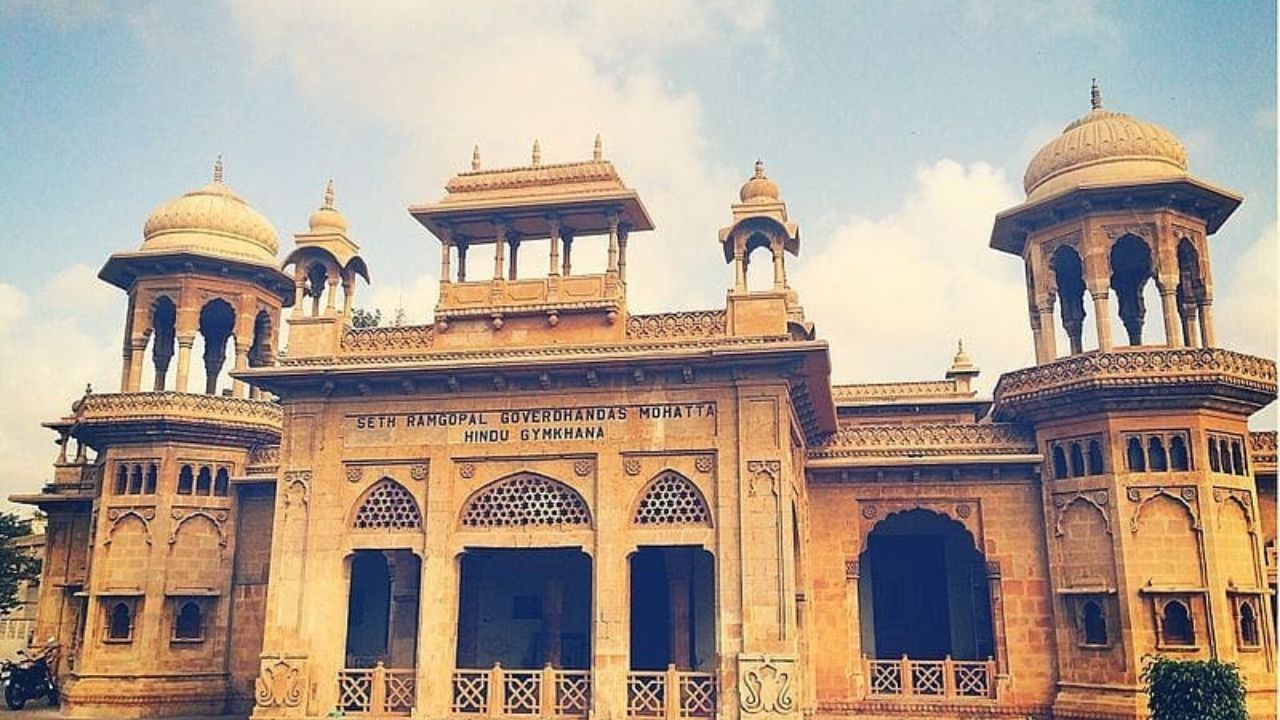
Palace-like design, where royal functions were once held, how much do you know about the Hindu Gymkhana of Pakistan?

In India, after the recent controversy regarding Delhi Gymkhana Club, the word “Gymkhana” has again come into discussion. As soon as people hear the name of Gymkhana, the picture of big buildings of the old British era, lush green lawns and clubs of exclusive people comes to their mind. During the time of British India, gymkhanas were not just places for sports, rather they were considered meeting centers for rich and influential people of the society.
These clubs had a special identity in cities like Mumbai, Madras, Lahore and Karachi. But do you know that there is also a Hindu Gymkhana in Karachi, Pakistan, which was built in 1925. Today, this building, apart from being a historical heritage in Pakistan, also remains a part of legal and cultural controversy.
What is a gymkhana?
The word “Gymkhana” is believed to have originated from India. It is said that it is derived from the Hindi-Urdu word “Gend-Khana”, which means a place of play or entertainment. This word started being used in English around 1854. During the British era, gymkhanas became such clubs where officials, businessmen and rich people used to gather for sports, horse riding, tennis, billiards, food and social events.
How was Hindu Gymkhana built in Karachi?
instagram-@mad.mughal.memes
When Hindu Gymkhana was built in 1925, Pakistan had not yet been formed. Karachi was a part of British India at that time and Hindu traders had great influence there. The Hindu community was considered very strong in trade, shipping, banking and real estate. Hindu traders of Karachi thought that there should be a big social and entertainment center for their community also. With this thought in mind, “Seth Ramgopal Govardhandas Mohatta Hindu Gymkhana” was created.
Who built the gymkhana?
This project was led by famous business man and social worker Seth Ramgopal Govardhan Das Mohatta. In 1921, the British government had given about 47 thousand square yards of land on a 100-year lease. After this construction started and this magnificent building was ready in 1925.
What does Karachi’s gymkhana look like?
instagram-@abdullarafayyy
Hindu Gymkhana of Karachi is famous all over the world for its beautiful design. It was designed by the famous architect Aga Ahmed Hussain, who is counted among the early Muslim architects of the subcontinent.
- It was one of the first public buildings in Karachi to be built in the Mughal-Revival or Indo-Saracenic style. Its design was inspired by the tomb of Itmad-ud-Daula in Agra, which is also said to be an early form of the Taj Mahal.
- The building had octagonal towers, jharokas, umbrellas and Mughal-Rajasthani style carvings. The design of its roof is inspired by Fatehpur Sikri.
- Stones from different places were used to build this building. Jodhpur stone was used for carving, Gijri stone for parts of the domes and Bijapur stone from South India for thick walls.
- For this reason this building looked more like a palace than a sports club. Even today it is counted among the most beautiful old buildings of Karachi.
What changed after partition?
- India-Pakistan was partitioned in 1947 and most of the Hindu families of Karachi went to India. After this the Hindu Gymkhana became vacant. The Government of Pakistan declared it as “evacuee property”.
- In the 1960s, the Hindu community tried to take back the building, but the case weakened after the Indo-Pak war of 1965.
- Gradually the condition of the building started deteriorating. Its large land started being used for various government works. Some parts were given to police stations, government offices and educational institutions.
- It is said that almost 90 percent of this property spread over 47 thousand square yards has been destroyed and now only about 4500 square yards of land is left.
How did this historical building survive?
instagram-@abdullarafayyy
- By the 1970s and 1980s, the Hindu Gymkhana had become dilapidated and was on the verge of demolition. But the Heritage Foundation of Pakistan and many historians tried to save it. Later this building was declared a protected historical heritage under the Sindh Cultural Heritage Act 1994.
- For some time, a plan was made to make it a museum and cultural center, but later it started being used in a different way.
How did the center of art and theater become?
In 2005, former President of Pakistan Pervez Musharraf gave this building to the National Academy of Performing Arts i.e. NAPA on a 30-year lease. After this this place became a major center of theatre, music and art in Pakistan. NAPA, associated with famous actor Zia Mohiuddin, started training artists here. Today this building has become an important identity of the cultural world of Pakistan.
Why is there controversy regarding the building?
- Karachi’s Hindu community and several heritage conservation groups want the building to be returned to the Hindu community as it is part of their historical identity.
- Many legal petitions have been filed in this matter since 2014. The Supreme Court of Pakistan has also heard this matter several times.
- In 2021, the court had also ordered the removal of some new constructions built in the complex. However, NAPA says that this place is very important for the art and culture of Karachi and they will not move from here without finding another good place.

Comments are closed.