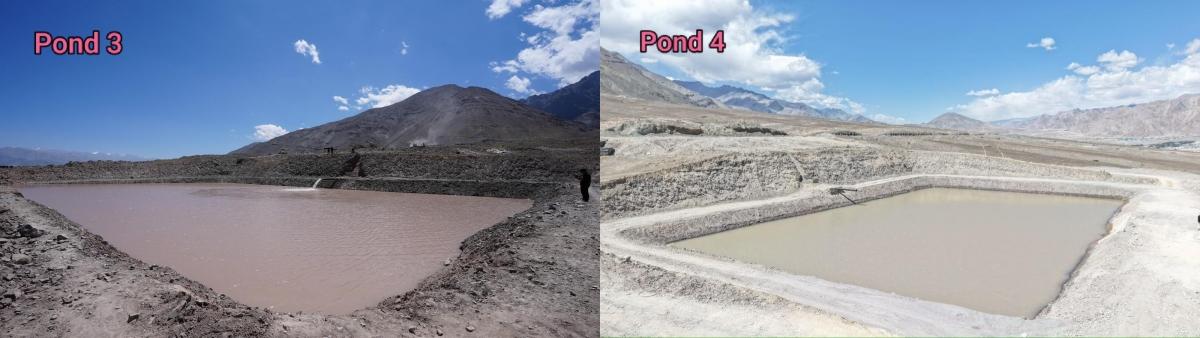
Three days after launching an ambitious ecological restoration project to revive the shrinking Tso Kar Lake by channelising glacier meltwater from the remote Rupsho Kharnak stream in Changthang, the Union Territory of Ladakh has achieved another milestone by filling four ponds with glacier meltwater to address water scarcity in the cold desert.
Each pond, measuring 60m × 40m × 2m, is designed to store approximately 60 lakh litres of glacier meltwater. Together, the four ponds can store nearly 24 million litres of precious water, preventing it from going to waste and creating a new command area of nearly 1,000 acres.
“With immense delight and satisfaction, I share that all four large ponds, constructed under Project Him Sarovar at Spituk Farka in Leh, have now been filled with glacier meltwater in a record time of just five months,” Lieutenant Governor of Ladakh Vinai Kumar Saxena posted on his social media handle.
Work on the construction of the four large ponds began on April 10, 2026, and concluded with the recharge and operationalisation of the fourth pond on September 9.
The first pond was inaugurated and filled on June 21, the second on July 19, the third on August 24, and the fourth and final pond on September 9.
Importantly, these ponds are being directly replenished by glacier meltwater from the Stok Glacier stream, whose seasonal flows have been diverted into the Igoo-Phey Canal, which feeds the reservoirs.

This diversion ensures that huge volumes of water that were earlier going to waste are now conserved for irrigation, ecological restoration, and long-term water security.
“This achievement reflects our administration’s unwavering commitment to environmental resilience, agricultural revival, and sustainable water security in Ladakh’s cold desert,” the Lieutenant Governor further stated.
Mega Project Launched to Revive Shrinking Tso Kar Lake
Two days ago, Lieutenant Governor Vinai Kumar Saxena launched a larger project to channelise another glacier stream, Rupsho Kharnak in Changthang, to revive and rejuvenate the shrinking Tso Kar Lake at an altitude of nearly 15,000 feet.
The project envisages channelising an average of 132 cusecs, or around 320 million litres, of untapped glacier water per day from the Rupsho Kharnak stream to Tso Kar Lake, which has reportedly shrunk by almost 70% over the last decade.

Incidentally, the entire volume of this untapped water currently flows into the Sindhu River. Tso Kar, one of the most iconic glacial lakes in Ladakh, was originally spread over nearly 11,000 acres but has now been reduced to just around 3,200 acres.
Consequently, the lake, once a thriving habitat for migratory birds and the famed Black-necked Crane, is also rapidly shrinking, with only a small number of birds now arriving at the site.
By fully utilising this volume of water, it is expected that Tso Kar Lake will be restored to its original extent within a period of one year.
First Attempt of Its Kind in India
The project has been described as the first attempt of its kind and magnitude in India to revive a shrinking high-altitude lake under such harsh climatic conditions. Temperatures in the region generally remain below 10 degrees Celsius during summer, while in winter they can fall to minus 20 to 30 degrees Celsius.
Glad to share a mammoth exercise we have undertaken to revive the majestic glacial lake – Tso Kar in Ladakh, using the pioneering glacier water integration, making it the first-of-its-kind high-altitude ecological restoration project in India.
Utilizing natural gravity flow and… pic.twitter.com/6TSQHSIF4X
— LG Ladakh (@lg_ladakh) September 13, 2026
The pioneering water-management initiative was conceived by Lieutenant Governor Saxena during his first visit to Tso Kar Lake on August 10. During the visit, local villagers informed him that the majestic lake was rapidly shrinking and that its avian population had also declined drastically.
The ambitious project focuses on recharging Tso Kar Lake by channelising untapped glacier meltwater from the Rupsho Kharnak stream, situated nearly 11 km from the lake at an altitude of around 18,000 feet. The peak discharge from the stream during summer is estimated at around 132 cusecs, or 320 million litres per day.

The plan utilises three natural depressions located along the downward flow of the stream from the glacier towards the lake.
The glacial runoff from the Rupsho Kharnak stream is being channelised into the first depression, which is spread over 270 acres.
From the first depression, the water will be transferred to the second depression, spread over 24 acres, and subsequently channelised into the third depression, which covers 10 acres.
In each of the three depressions, a check dam with three RCC pipes will be constructed at the outlet to augment the water level and regulate the downstream flow.
Finally, water from the third depression will be regulated to flow directly into Tso Kar Lake, located just 400 metres from the third depression.
The water will be diverted through gravity flow using simple, low-cost earthworks, without the construction of concrete channels.