
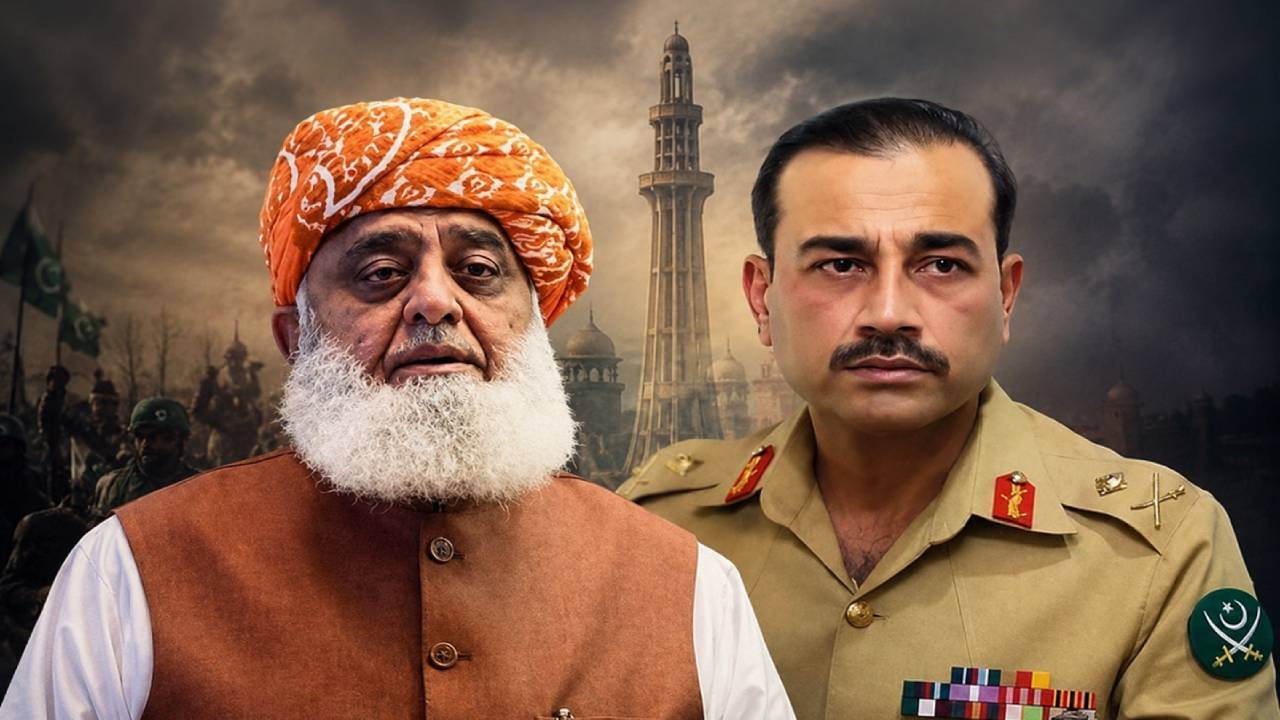

In Pakistan, the discussion has once again intensified regarding the relations between the army, religious organizations and fundamentalist networks. According to intelligence sources, Pakistan Ulema Council Chairman Maulana Tahir Mahmood Ashrafi met Hafiz Talha Saeed, son of UN-banned terrorist Hafiz Saeed, at Markaz Quba in Lahore. It is being told that Lashkar-e-Taiba (LeT) leaders also participated in this meeting.
Sources claim that the purpose of the meeting was to decide the future strategy after criticizing the security policies and governance of Army Chief General Asim Munir through Pakistan’s prominent Islamic leader Maulana Fazlur Rehman. It was believed that Pakistan was planning to remove Maulana Fazlur Rehman forever. However, after this meeting everything seems to be changing.
What was discussed in the meeting?
According to the report, in the meeting, instead of adopting a policy of direct confrontation, emphasis was laid on adopting a soft approach against Fazlur Rehman. Intelligence sources say that people associated with Lashkar-e-Taiba asked religious leaders to mention the positive aspects of Fazlur Rehman’s political career, but also warned him to avoid making statements against state institutions, especially the army.
Sources claim that this development is an indication that Pakistan’s military establishment is using traditional political methods as well as fundamentalist religious networks to control political opposition. The proof of this is Lashkar-e-Taiba’s participation in the meeting. It is clear that Pakistan is going to use Lashkar to suppress the voice of Maulana Fazlur Rehman.
What is the dispute between Maulana Fazlur Rehman and Asim Munir?
The conflict between Maulana Fazlur Rehman and Pakistan Army Chief (Field Marshal) Asim Munir is continuously deepening. The root of this controversy includes many issues like the increasing role of the army in politics, deteriorating security system in Balochistan and Khyber Pakhtunkhwa and statements made regarding the martyrs of the Kargil war.
Recently, Fazlur Rehman directly targeted Asim Munir and said that if the army wants to play an active role in the country’s politics and take the responsibility of running the government, then it should leave the uniform and contest elections under the democratic process. He said that only then it will be clear who has the real support of the public and how many votes the uniformed leadership gets.
Who is Maulana Fazlur Rehman?
Maulana Fazlur Rehman is counted among the most influential Islamic leaders of Pakistan. He was born on 19 June 1953 in Abdul Khel of Dera Ismail Khan. His father Mufti Mahmood was the founder of Jamiat Ulema-e-Islam (JUI) and the Chief Minister of the then North-West Frontier Province, now called Khyber Pakhtunkhwa.
Fazlur Rehman received his early religious education in local madrassas and later studied in several leading Islamic educational institutions, including Darul Uloom Haqqania in Akora Khattak. After the death of his father in 1980, he took command of Jamiat Ulema-e-Islam at an early age.
When Fazlur Rehman opposed military rule..
In the mid-1980s, Jamiat Ulema-e-Islam divided into two factions. One faction was known as JUI-F under the leadership of Fazlur Rehman and the other as JUI-S under the leadership of Sami-ul-Haq. This division occurred due to different political stances towards the then military ruler General Zia-ul-Haq. Fazlur Rehman’s group joined the ‘Movement for the Restoration of Democracy (MRD)’ opposing military rule and during this time he was also arrested.
When did you win the election for the first time?
In the year 1988, he was elected to the National Assembly of Pakistan for the first time from Dera Ismail Khan. After this he became a member of Parliament several times. In the 2024 general elections, his party JUI-F won 11 seats and he was elected MP from Balochistan’s new seat NA-265. His party’s strongest base is the Pashtun-dominated areas of Khyber Pakhtunkhwa and Balochistan, where it has a wide network of madrassas and religious institutions.
Are you a supporter of Taliban?
Fazlur Rehman is considered a long-time supporter of the Afghan Taliban. His party JUI-F has provided ideological support to the Taliban since the 1990s and many Taliban leaders have received education in JUI-affiliated madrassas. He opposed then President Pervez Musharraf’s policy of supporting the US invasion of Afghanistan in 2001 and led anti-US and pro-Taliban rallies in Pakistan.
After the return of Taliban to Afghanistan in 2021, he several times demanded the international community to recognize the Islamic Emirate of Afghanistan. According to media reports, he has met many senior leaders including supreme Taliban leader Hibatullah Akhundzada and has also been appealing to Pakistan to strengthen relations with Kabul.
Although relations between Pakistan and Afghanistan are extremely tense at the moment, Fazlur Rehman has been continuously advocating dialogue and diplomatic solution between the two countries.
Do you want to bring complete Sharia in Pakistan?
Fazlur Rehman has been a supporter of the widespread implementation of Sharia law in Pakistan. When his party was part of the government of Khyber Pakhtunkhwa between 2004 and 2007, it supported the Hasba Bill aimed at implementing Islamic moral rules.
However, later the Supreme Court of Pakistan declared this bill unconstitutional. Along with this, Fazlur Rehman has also been saying that the path of armed struggle to implement Sharia is against the principles of Islam and it promotes fundamentalism and violence.
Do you criticize Pakistani Army?
In December last year, he had also criticized the military action taken by Pakistan inside Afghanistan against terrorist organizations like Tehreek-e-Taliban Pakistan (TTP). In such a situation, the alleged meeting of Tahir Mahmood Ashrafi and Hafiz Talha Saeed is being considered important in the context of Pakistan’s internal politics and army strategy. However, there has been no official response from the Pakistan government or the concerned parties on these claims.

Comments are closed.