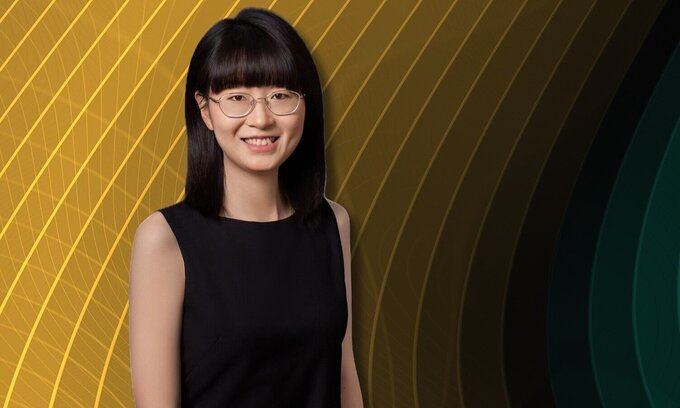
The Association of Asia Pacific Physical Societies (AAPPS) and the Asia Pacific Center for Theoretical Physics (APCTP) presented the award on Nov. 11 in Pohang, South Korea, to three young physicists chosen from 50 candidates across the region.
The prize is named after Chen Ning Yang, the Chinese-born theoretical physicist who shared the 1957 Nobel Prize in physics and was a major influence on modern physics.
Zhang, of the Chinese Academy of Sciences’ Institute of Theoretical Physics, was honored for outstanding contributions to theoretical condensed matter physics, from building a catalog of topological electronic materials to discovering topological and chiral phonons, vibrations of a crystal lattice that carry topological properties and angular momentum.
MIT Technology Review named Zhang in its 2025 Innovators Under 35 Asia Pacific list, and in 2024 she won a silver medal at the Young Scientist Award of the AAPPS Division of Condensed Matter Physics.
|
Chinese physicist Zhang Tiantian. Photo by AAPPS, with design by My Hanh |
Zhang, who once planned to become a high school physics teacher, spoke with Associate Professor Nguyen Hong Quang, Vice President and Secretary General of the Vietnam Physical Society, about her path into physics, how she does research and her advice for young scientists.
What brought you to physics, and what has kept you in the field?
Before university, I didn’t really know what I was most passionate about. I chose to study physics at a teacher-training university, initially intending to become a high school physics teacher.
But the further I went in my studies, the more I realized I especially enjoyed quantum mechanics and solid-state physics. I was increasingly drawn to the fundamental principles behind these subjects and to how they help us understand the material world. That interest kept growing and eventually led me to pursue graduate studies in condensed matter theory and computational materials science.
Looking back on your student years, did you do anything differently from your peers? Is there anything you wish you had started earlier?
I don’t think I did anything particularly different from my friends. If there is one thing I wish I had done earlier, it would be exploring more disciplines and research fields. I think that would have helped me realize sooner what I liked and make wiser choices about my career.
Can you explain your award-winning work so that a second-year university student could understand it? Why does it matter?
Before our work, research on topological materials largely followed a “study whatever material you find” approach. Researchers usually identified a promising material first and only then examined its topological properties.
This process took a lot of time and slowed research considerably. It also created the impression that topological materials were quite rare in nature.
To solve this, we built an efficient, fully automated computational workflow to systematically screen all experimentally synthesized nonmagnetic materials in existing materials databases. Surprisingly, we found that about 24% of these materials are topological.
Why does this matter? First, the work offers an efficient way to identify topological materials, overcoming a major bottleneck in discovering them. Second, it significantly expands the pool of candidate materials for further research.
Most importantly, it changes how we understand topological materials: rather than being rare exceptions, they are actually quite common in nature. This opens up exciting opportunities to explore new topological phenomena and their potential applications.
Topology is not easy for young physicists. How did you get started in a field that is hot but very difficult?
Honestly, I always believed in where this line of research would lead. Much of that confidence came from having an excellent supervisor and wonderful collaborators, whose expertise, encouragement and support were invaluable throughout my research.
Whenever we ran into difficulties, we discussed them openly, exchanged ideas and found solutions together. This experience taught me that having the right people alongside you is very important when pursuing big research goals.
You mentioned pursuing big research goals. How do you choose a problem big enough to matter but small enough to solve?
I think the key is to stay connected with researchers who have different expertise. I often talk about research with experimentalists, computational scientists and theorists, sharing ideas and learning about the difficulties they face in their work.
Such conversations often reveal interesting and important problems that would otherwise go unnoticed. Then I look for questions that are both scientifically meaningful and within my expertise to solve.
I think this is a good way to balance ambition and feasibility: start with a big question, but find a concrete, manageable problem that allows you to make progress.
 |
|
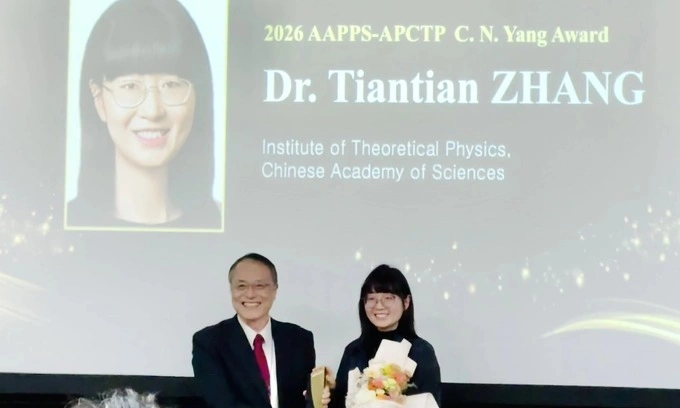
Misao Sasaki (L), president of the Asia Pacific Center for Theoretical Physics, presents the 2026 AAPPS-APCTP C.N. Yang Award to Zhang Tiantian in Pohang, South Korea, on Nov. 11, 2026. Photo courtesy of Nguyen Hong Quang |
Of the steps from doctoral student to postdoctoral researcher to running your own group, which was the hardest?
I think building my own research group has been the hardest step. Besides doing research, I now have many other responsibilities, such as mentoring students, applying for research funding and managing the group. The work requires skills I didn’t necessarily need as a doctoral student or postdoc.
Still, I feel very lucky to have had wonderful mentors and collaborators throughout my academic journey. Their guidance and support made the challenges of my doctoral and postdoctoral years much easier to overcome.
I’m grateful for those experiences, and I see the challenges of running a group as an important part of becoming an independent researcher.
How does international cooperation in the region, such as through APCTP or AAPPS, help young researchers?
International cooperation has broadened my scientific horizons. Through exchanges with researchers from many countries and backgrounds, I have been exposed to different approaches and research ideas.
Cooperation also creates opportunities to find shared research interests and establish new collaborations. I believe exchanging ideas across borders is essential to scientific progress, and organizations such as APCTP and AAPPS are valuable platforms for building such connections.
Vietnam is a developing country, with limited equipment and funding for scientific research compared with developed countries. In such an environment, where should talented students start?
I would encourage them to start with theoretical research, because it generally requires less specialized equipment and funding than experimental research. It’s a good way to develop scientific ideas and understand a research problem deeply when resources are relatively limited.
However, if they are more passionate about experimental research, I wouldn’t advise them to give up that passion. Instead, I’d encourage them to seek collaboration with researchers who have the necessary facilities and expertise.
I believe limited resources should not limit anyone’s curiosity or scientific ambition. Finding the right collaborators can make a huge difference.
For young scientists who choose to study and work abroad, how can they make the most of international research opportunities while staying connected with the scientific community at home?
I think this really depends on each person’s interests and career goals. Each choice has its own advantages, and I don’t think there is one right choice for everyone.
Studying abroad offers valuable opportunities to experience different academic environments and broaden one’s horizons, while staying at home also offers many good opportunities to build a successful research career.
If they decide to go abroad, I’d encourage them to keep active academic ties with home. For example, they could keep a few collaborative research projects with colleagues at home and return regularly for scientific conferences and to meet researchers.
That way, they benefit from international experience while keeping close ties with the research community at home.
 |
|
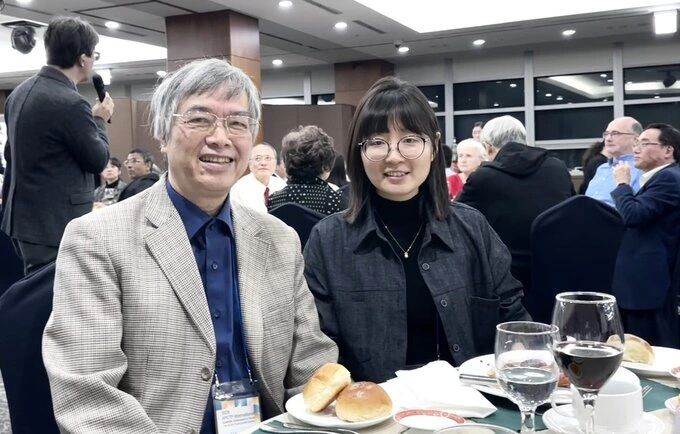
Associate Professor Nguyen Hong Quang (L), Vice President and Secretary General of the Vietnam Physical Society, with Chinese physicist Zhang Tiantian at the gala dinner after the 2026 AAPPS-APCTP Chen-Ning Yang Award ceremony in Pohang, South Korea, Nov. 11, 2026. Photo by TGCC |
Your research involves theory and computation, fields that are changing a lot with the development of AI. At which stages of research can AI help physicists, and what remains the irreplaceable role of humans?
I think AI is becoming a very powerful tool in physics research, especially in condensed matter theory and computational materials science. AI can help us process large volumes of data, automate computational tasks, search for new candidate materials and speed up theoretical analysis.
These capabilities can significantly improve research efficiency and drive scientific progress. However, I believe physical intuition, critical thinking and scientific creativity remain essential. AI should be seen as a tool that supports researchers, not a replacement for their scientific judgment.
As a successful young female physicist, have you faced any particular challenges in your research career? What would you say to female students and young women scientists in Vietnam who are pursuing physics?
In China, it is quite common for women scientists to do physics research, especially among the younger generation, as more and more women choose careers in physics and scientific research. Personally, I haven’t faced any particular challenges that I would put down to being a woman.
In fact, China also has many policies to encourage women to take part in science, including some priority in applications for research funding.
My message to female students and young women scientists in Vietnam is quite simple: physics is just one of many possible career paths. If you really love it and enjoy exploring scientific questions, why not give it a try?
Don’t let stereotypes or preconceptions discourage you from pursuing what you love. Follow your interests and give yourself the chance to discover what you can do!
|
Topology is a branch of mathematics that studies properties that do not change when an object is stretched, bent or continuously deformed, as long as it is not torn and no holes are added. A doughnut and a mug with a handle are topologically equivalent because each has one hole running through it and one can be deformed into the other. A sticky rice cake and an egg, neither of which has a hole, are likewise equivalent. What matters is not an object’s shape or size but its topological properties. In physics, the concept is used to study the quantum structure of materials. In topological materials, the energy states of electrons carry special topological properties, which can create conducting states on a material’s surface or edges that keep working even when it has defects or is disturbed. Because these conducting surfaces and edges are robust and scatter little, research on topological materials promises electronic and spintronic devices that use less energy, quantum computers more resistant to noise and more efficient thermoelectric materials. |