
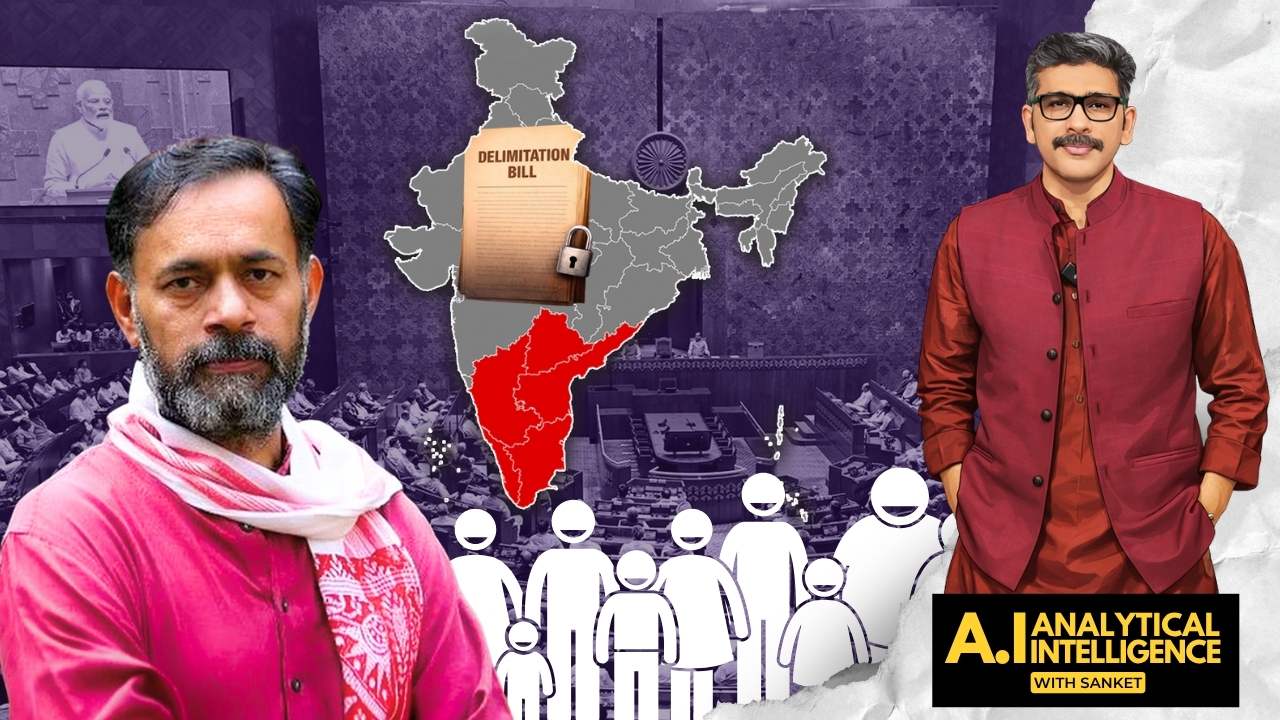

Political analyst Yogendra Yadav has raised sharp concerns that the Centre’s proposed constitutional amendment is “not about women’s reservation” but about altering the balance of Parliament through delimitation.
The proposal to expand Lok Sabha seats to 850 has triggered debate over representation and federal equity. The Federal spoke to Yadav about the implications of the move and the concerns it raises.
Is this a backdoor delimitation exercise?
I would say this is a delimitation exercise from the front door. What is hidden about it? I have been saying for some time that all this talk of women’s empowerment is actually a Trojan horse. What the government wants is to rush through a delimitation exercise before the 2029 Lok Sabha election because it feels insecure and believes that without such changes it may not return to power.
Also read | Is BJP electoral juggernaut deciding the shape of women’s quota, delimitation bills?
This is not about women’s reservation. Women’s reservation is a very minor aspect of it. If the government was serious, it could have passed a one-line constitutional amendment and implemented it by 2029. You don’t need a census or delimitation for that.
What is the core objective of the amendment then?
It is about delimitation, and more than that, about changing the character and balance of India’s Parliament. The government has been assuring that every state’s seats will increase proportionately by about 50%.
But this constitutional amendment says nothing of that kind. All those assurances are not reflected in the bill. In fact, it provides for the opposite.
Why do you say the assurances are not credible?
The bill clearly states that seat reallocation will be based on population as per a census decided by the government through law. The accompanying delimitation proposal says it will use the latest available census data — which would mean 2011.
The states that lose are those where the BJP is relatively uncertain. The states that gain — like Uttar Pradesh, Bihar, Madhya Pradesh, Rajasthan, Gujarat — are where the BJP is stronger
So, where is this talk of proportional increase coming from? It is simply not in the law. Parliamentary delimitation will happen based on what is written in the Constitution, not on statements made by ministers.
How would this affect states like Tamil Nadu and Kerala?
When Parliament increases from 543 to 850 seats, every state will see an increase in absolute numbers. But the real question is whether their share rises or falls.
Take Tamil Nadu. If there were a proportional increase, its seats should go from 39 to about 61. But it would get only around 50. So, while it appears to gain seats, it actually loses representation.
Similarly, Kerala should go from 20 to about 31 seats but would get only around 23. So, it effectively loses eight seats in terms of share.
And Andhra Pradesh, Odisha, Telangana, West Bengal, Karnataka, and Punjab also lose share.
Do you see a political pattern in these changes?
Yes. The states that lose are those where the BJP is relatively uncertain. The states that gain — like Uttar Pradesh, Bihar, Madhya Pradesh, Rajasthan, Gujarat — are where the BJP is stronger.
So, this is not about women’s reservation. This is about political advantage. It is an insurance policy for the BJP.
Is the shift linked to using newer census data instead of 1971?
Yes, but I would avoid framing it as punishment for population growth. The real issue is that the amendment removes the earlier constitutional protection tied to the 1971 census.
It replaces it with a provision that allows Parliament to decide which census to use. That effectively removes the Opposition’s veto and gives the government power to decide — whether it is 2011 or even a future census like 2027.
This creates uncertainty and opens the door to greater imbalance.
Why do you see this as a larger national concern?
For me, this is not about which party wins in 2029. It is about India’s unity over the next 50 to 100 years.
If changes in representation create a sense of alienation in parts of India, it becomes a threat to national unity.
Also read | Women’s reservation a smokescreen for delimitation, warns activist Anjali Bhardwaj
We already have overlapping cleavages — regional (North vs South), linguistic (Hindi vs non-Hindi), and economic (richer vs poorer states). When these overlap, they become dangerous.
We should not introduce another cleavage that deepens this divide.
What alternative approach would you suggest?
I am saying not only is the manner problematic, the intent itself is questionable. The government is once again delaying women’s reservation by linking it to delimitation and census.
In 2023, Parliament unanimously passed the women’s reservation bill. But the government inserted conditions — that it would only be implemented after the next census and delimitation.
Why do you need a census to reserve one-third seats for women? Just amend Article 334 and remove that condition. That’s a one-line change.
If the government is serious, it should do that. Otherwise, women’s reservation is being used as a shield for another objective.
The content above has been transcribed from video using a fine-tuned AI model. To ensure accuracy, quality, and editorial integrity, we employ a Human-In-The-Loop (HITL) process. While AI assists in creating the initial draft, our experienced editorial team carefully reviews, edits, and refines the content before publication. At The Federal, we combine the efficiency of AI with the expertise of human editors to deliver reliable and insightful journalism.

Comments are closed.