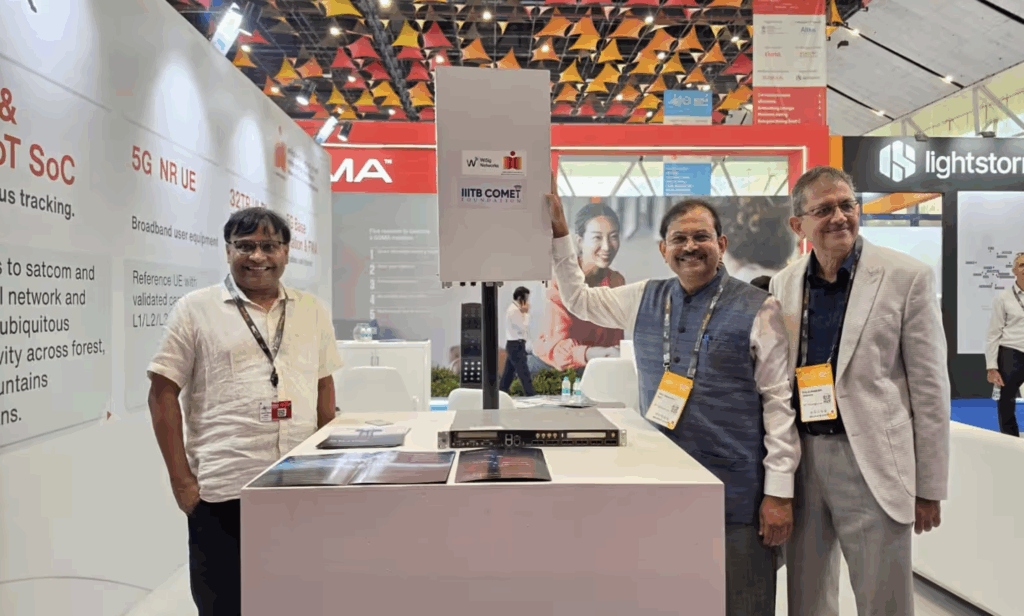
India’s efforts to develop indigenous 5G telecommunications equipment have taken another step forward, with Hyderabad-based deep-tech company WiSig Networks opening commercial orders for its Made-in-India 5G radio. The company expects bulk supplies to begin in 2027, marking an important transition from academic research and technology development to commercial deployment.
The technology was developed through research led by Professor Kiran Kuchi of IIT Hyderabad, with support from the IIITB COMET Foundation in Bengaluru. The research received funding under the Department of Science and Technology’s National Mission on Interdisciplinary Cyber-Physical Systems (NM-ICPS).
The development is significant for India’s ambition to reduce dependence on imported telecom equipment and strengthen domestic capabilities in advanced wireless communication.
How Does the Indigenous 5G Radio Work?
The 5G radio uses multiple antennas to transmit and receive several signals simultaneously. This technology, known as Multiple Input Multiple Output (MIMO), helps mobile networks improve capacity, performance and coverage.
By handling multiple data streams at the same time, the system can support increasing mobile data consumption and the growing number of connected devices.
The technology also has applications in 5G-Advanced networks, which are designed to improve network performance and support more demanding communication requirements.
From IIT Hyderabad Research to Commercial Orders
The technology originated from research at IIT Hyderabad and was subsequently licensed to WiSig Networks, a deep-tech company founded at the institute.
WiSig first showcased the 5G radio at the Mobile World Congress in Barcelona in March 2026. It subsequently opened commercial orders at the India Mobile Congress in New Delhi in October 2026.
The opening of commercial orders represents a significant milestone, although large-scale deliveries have not yet started.
The company expects bulk supplies to begin in 2027. The scale of commercial adoption will depend on industry requirements and the progress of supply agreements.
Role of IIITB COMET Foundation and Government Funding
The IIITB COMET Foundation played an important role in supporting the research and technology development process.
Established at IIIT-Bangalore under the NM-ICPS programme, the foundation supports research in advanced communication systems and indigenous technology development.
Professor Debabrata Das, chairman of the foundation’s governing body and director of IIIT-Bangalore, said the development demonstrated how academic research could progress towards commercial products.
Sridhar Pillalamarri, CEO of IIITB COMET Foundation, also highlighted the importance of research support, technology transfer and industry participation in bringing domestic innovations to market.
Why Indigenous 5G Equipment Matters for India
India’s telecom industry has traditionally depended on international vendors for several critical network components. Developing domestic alternatives could help reduce import dependence and strengthen the country’s position in the global telecommunications equipment market.
Indigenous 5G radios could also create opportunities for Indian technology companies to participate in the development of next-generation networks.
However, commercial success will depend on factors such as product performance, compatibility with telecom operators’ existing infrastructure, manufacturing capacity and large-scale deployment requirements.
The expected 2027 bulk supply timeline will therefore be an important test of India’s ability to convert domestic research into commercially competitive telecom equipment.
Summary
WiSig Networks has opened commercial orders for its Made-in-India 5G radio, developed through research led by IIT Hyderabad Professor Kiran Kuchi with support from IIITB COMET Foundation. The technology uses multiple antennas to improve network capacity, performance and coverage. After being showcased at international and domestic telecom events in 2026, bulk supplies are expected to begin in 2027.
Image Source