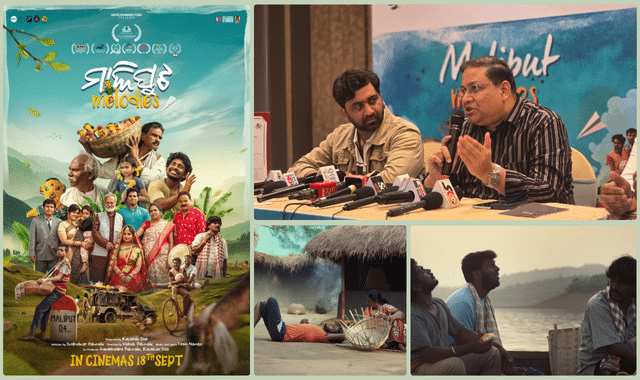
It is often said that cinema tells stories. *Maliput Melodies* does something rarer. It makes you feel as if you have lived one.
Shot over more than two years in the hills and hamlets around Jeypore, the Odia anthology does not treat rural Koraput as an exotic backdrop for commercial polish. It treats the region as a living character: landscapes that breathe, homes that carry memory, village roads that lead into other people’s dreams. Festivals, food, work, music and everyday talk are not decoration. They *are* the narrative.
That is why the film now sits at a remarkable intersection. It was the only Odia feature selected for the Indian Panorama — Feature Films section at the 56th International Film Festival of India in Goa. Since then it has travelled through festivals in India, Spain, Australia and the United States. Its first single, *LagaJoy*, is already out. The film arrives in theatres across Odisha on 18 September 2026.
A village invented so a real one could be seen
Writer Sudhakar Patnaik set the film in Maliput, a fictional village inspired by Koraput and the spirit of Deomali. Director and cinematographer Vishal Patnaik, who hails from the region, approaches that world from the inside. The idea began as a web series and grew into a feature of four interlinked stories: *Kanaphula* (earrings), *Rangamati*, *Baidakaria* and *Subha Bibhaghara*. Together they hold friendship, migration, music, marriage, disappointment and the fear of change.
The official IFFI framing called it a celebration of rural Odisha through touching stories of hope, struggle and resilience. Patnaik’s camera gives those ordinary hours a cinematic scale without manufacturing spectacle. A face held a few seconds too long. A musician waiting for an invitation that may not come. Two brothers at a fork in the road. A family preparing a wedding. In this film, those images carry the weight of a monologue.
Producer Kaushik Das of Kaustav Dreamworks has described a shoot in remote villages with limited amenities, local language, local food and local weather. The budget was modest. The patience was not. Production stretched over two and a half years. Most of the cast came from nearby communities; a smaller share arrived from theatre. Many first-time actors were coached through the process. The result is an unpolished honesty that is hard to fake. The characters do not appear to be performing rural life. They appear to be living it.
Patnaik has said a large share of the faces on screen were people he already knew — uncles, aunts, in-laws, neighbours — and that roles were found so the village itself would not be left outside the frame. Supporting players matter here for a specific reason. They create the feeling that Maliput existed before the camera arrived and will continue after it leaves.
If Vishal gives the film its eyes, Tosh Nanda gives it a pulse
The word *melodies* in the title is not ornamental. Music director Tosh Nanda, who also wrote the lyrics, built a score from Koraput’s folk traditions, Odissi colour and contemporary feeling. He has spoken of trying to shape a musical signature for southern Odisha — a sound that has rarely been articulated on screen with this much care. Six songs sit inside the film not as interval decoration but as atmosphere, memory and identity.
In *Maliput Melodies*, the soundtrack does not compete with the story. It deepens it. Rhythms seem to rise from the community rather than being pasted over it. That is why audiences can leave the hall feeling they have heard the region, not only seen it.
Cinema Express compared the film’s village to Odisha’s own *Malgudi Days*: a small, invented place that somehow represents many real ones. The comparison holds because the film refuses the usual bargain of regional cinema. It does not become less Odia in order to travel. It travels because it stays rooted.
A local film that refused to stay local
The festival map tells the rest of the story. After IFFI, *Maliput Melodies* was selected at the Chennai International Film Festival, the Khajuraho International Film Festival, the Madrid Film Awards and the National Indian Film Festival of Australia. It featured at the Habitat Film Festival in New Delhi, was nominated at the Jaipur International Film Festival, and won the Bronze Award for Best Feature Film — Fiction at the SCA International Film Festival in Los Angeles. For an Odia-language film shot within a short radius of Jeypore, that journey is unusual.
Patnaik put the ambition simply after the IFFI selection: tell stories rooted in the soil, yet universally relatable. Authenticity, he argued, has its own power. The fictional village may belong to Koraput. Its emotions do not. Family, ambition, tradition, migration, love, community and the anxiety of change are not provincial themes. They are human ones, spoken here in the cadence of southern Odisha.
That may be the film’s largest achievement. Not merely that it tells an Odia story, but that it proves an Odia story can travel without being translated out of itself.
When *Maliput Melodies* reaches theatres on 18 September, viewers will not be asked to admire rural Odisha from a polite distance. They will be asked to walk its roads. The people, the landscapes and the songs have already been waiting.