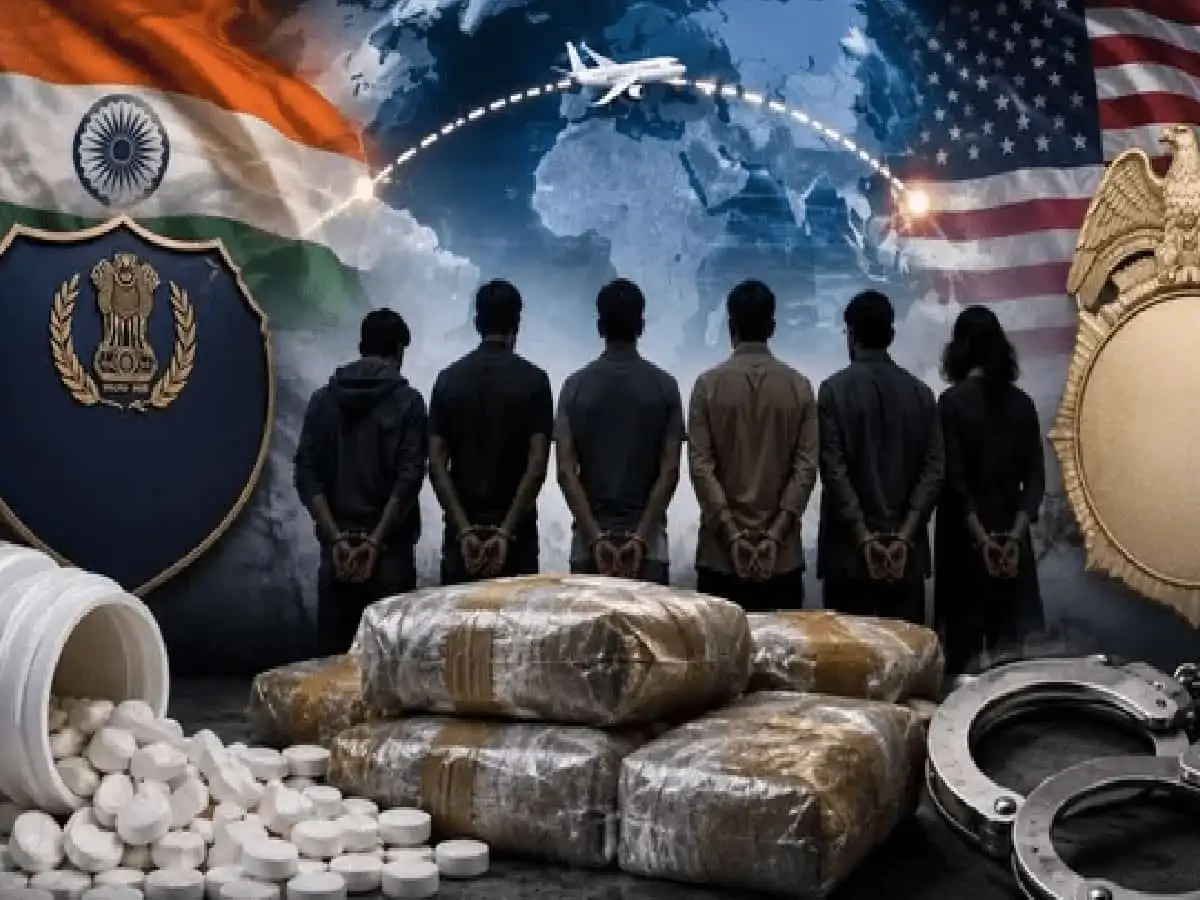
A joint transnational counter-narcotics operation conducted by India’s Narcotics Control Bureau (NCB) and the United States Drug Enforcement Administration (DEA) has exposed a disturbing new face of organized drug trafficking—one operated not by conventional street syndicates, but by educated young professionals holding MBA, BTech, and science degrees. Codenamed ‘Operation Monsoon Thunder’, the coordinated enforcement drive resulted in the arrest of six individuals across four Indian cities—Lucknow, Hyderabad, New Delhi, and Kolkata—during synchronized raids carried out between November 4 and November 13, 2026. According to official disclosures from the NCB, the busted syndicate specialized in procuring and dispatching controlled psychotropic and opioid medications—including Alprazolam (Xanax), Tramadol, Diazepam (Valium), Ativan, and Ambien—from India to consumers across the United States. Digital forensics seized during the raids revealed that between June 2022 and November 2026, the network shipped roughly 3,000 parcels containing nearly 5 lakh (500,000) tablets, while maintaining an active database of more than 59,000 American customers that has now been handed over to US federal investigators. Union Home Minister Amit Shah praised the NCB and DEA for dismantling the cross-border module, calling the operation a testament to bilateral resolve against narcotics. For parents, educators, university students, and law-enforcement watchers across northern India—especially in Lucknow, where two of the arrested accused resided and operated legitimate-looking commercial fronts, as well as neighboring Uttar Pradesh hubs like Unnao, Kanpur, Prayagraj, and Varanasi—the revelations serve as a stark warning about how digital literacy and technical degrees can be diverted toward transnational crime.
Investigators reviewing the backgrounds of those apprehended under Operation Monsoon Thunder noted an unusual concentration of higher education and commercial familiarity—including a prior US deportee who resumed trafficking after returning to India:
| Accused Name & Age | City / State | Educational Qualification & Background | Investigative Findings in Operation Monsoon Thunder |
| T. Hands (27) | Telangana (Hyderabad module) | B.Tech in Computer Science; was pursuing a Master’s degree in the US | Deported from the United States in January 2024 for involvement in trafficking banned narcotics; allegedly rejoined cross-border supply operations upon returning to India. |
| T. D. Jaiswal (30) | Lucknow, Uttar Pradesh | MBA degree holder; active in pharmacy and clothing businesses | Suspected of leveraging pharmaceutical supply knowledge and commercial channels to source and route controlled tablets. |
| Aarti Soni (32) | Lucknow, Uttar Pradesh | Degree in Mathematics | Arrested in connection with operational coordination and record-keeping within the Lucknow module. |
| A. Muttalib (28) | Kolkata, West Bengal | Engineering graduate | Allegedly handled technical and logistics coordination from the eastern India leg of the syndicate. |
| Two Additional Associates | New Delhi / Multi-city network | Part of the six-member Indian module arrested Nov 4–13, 2026 | Linked to parcel dispatch, drop-shipping logistics, and financial layering across domestic and international channels. |
Rather than relying on traditional physical smuggling routes, the network operated like an illicit e-commerce enterprise tailored for overseas buyers. According to NCB investigators, orders from US buyers were solicited and confirmed over encrypted and everyday messaging platforms—specifically Telegram, WhatsApp, and Skype—while order ledgers were systematically tracked using Google Sheets.
Once orders were logged, consignments were routed through international postal channels and domestic/overseas drop-shipping networks to mask their origin—with the US DEA intercepting two live parcels during the joint investigation. To obscure money trails across jurisdictions, proceeds were collected through a layered mix of UPI transfers, domestic bank accounts, cryptocurrency wallets, and hawala channels.
Congratulating both agencies on November 21, Union Home Minister Amit Shah reiterated the government’s zero-tolerance stance that neither a gram of narcotics should enter India nor leave its borders for other nations, while US Ambassador to India Sergio Gor hailed the operation as a model of US–India law-enforcement partnership in action.
With intelligence covering over 59,000 US buyers shared with the DEA and financial forensics underway in India to attach illicit assets and identify upstream pharmaceutical suppliers and overseas masterminds, Operation Monsoon Thunder underscores how modern cyber-forensics and international cooperation are closing the net on tech-savvy drug networks.