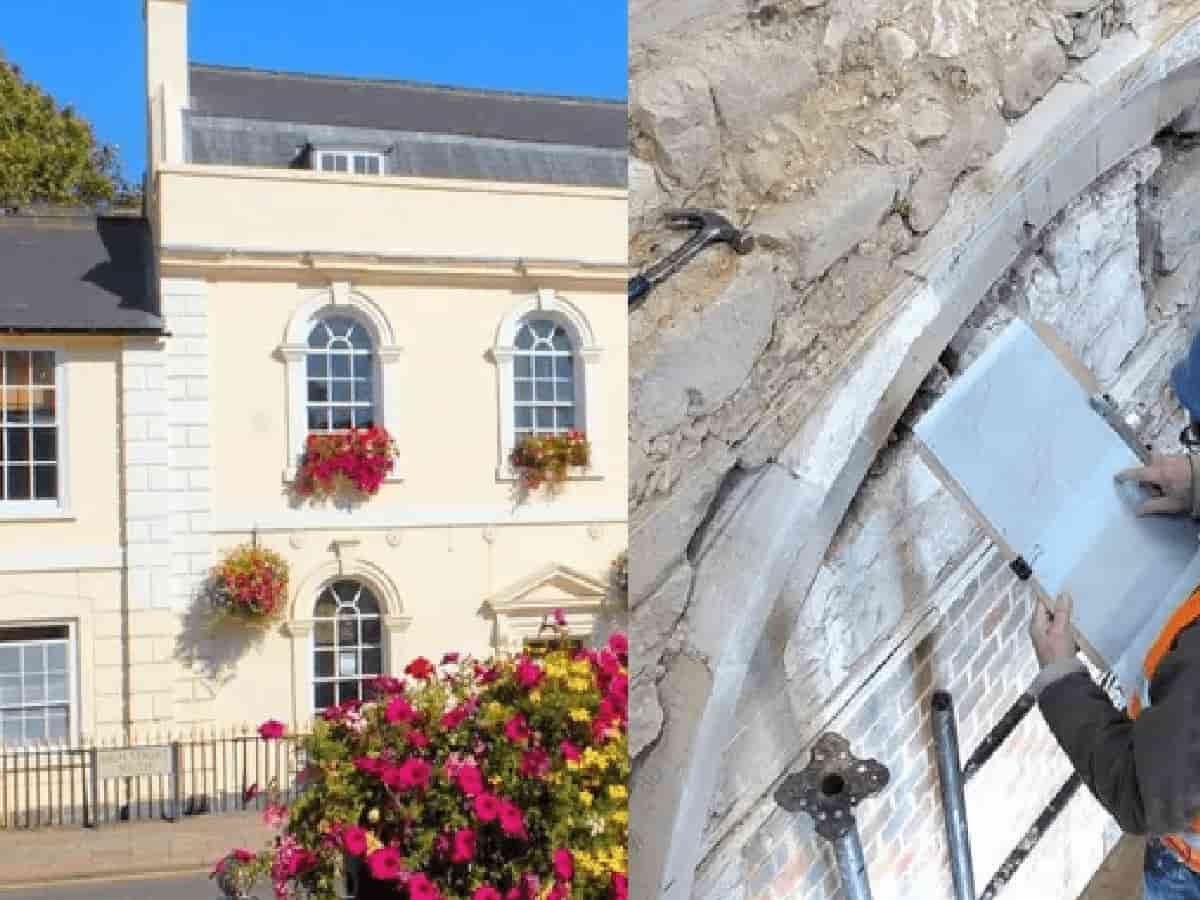
An ambitious and meticulous conservation project at Dunstable’s Grade II listed Priory House in England has blown the lid off eight centuries of hidden architectural secrets. Funded by a substantial £1,142,730 grant from The National Lottery Heritage Fund alongside £684,312 from Historic England, the multi-year restoration has brought to light nationally important wall paintings, ancient medieval entryways, and mysterious protective carvings designed to ward off malevolent forces.
Scientific Testing Confirms 13th-Century Origins Along Watling Street
Spearheaded by specialist teams from HB Archaeology & Conservation Ltd alongside structural engineers and preservation contractors since 2022, the restoration work has fundamentally rewritten the property’s historical timeline. Advanced scientific analysis of organic material retrieved from the building’s stone basement has definitively established its construction to the early or mid-13th century. Radiocarbon dating performed on ancient twigs found resting atop the vaulting cones placed the samples squarely between 1217 and 1269 AD.
Historians note that this ancient cellar originally formed an integral part of the sprawling Dunstable Priory complex, functioning primarily as a welcoming guest house for weary travelers and religious pilgrims journeying along the historic Roman road of Watling Street. During preliminary archaeological clearances, experts also mapped out the property’s primeval layout, unearthing a forgotten doorway that once bridged the main High Street directly with the inner Priory grounds, alongside the original central heating hearth for the chambers above. Following King Henry VIII’s Dissolution of the Monasteries in 1540, the structure was secularized and transformed into a high-status private residence.
Five Layers of Historic Wall Art Span the Tudor and Jacobean Eras
Perhaps the most visually stunning discovery occurred when conservationists peeled away layers of later plasterboard and paneling on the first floor. Dr. Andrea Kirkham, an esteemed wall painting and historic stone conservation expert, identified five distinct decorative design layers stacked upon a single wall.
The surviving artworks showcase a fascinating evolution of interior design, transitioning from 16th-century Tudor aesthetics to intricate 17th-century Jacobean patterns that reflect how successive generations continuously remodeled their living spaces. Specialist conservator Claudia Fiochetti worked under tight deadlines to stabilize the fragile pigments and protect them from environmental degradation. Further excavation of the interior layers revealed fragments of late 18th-century hand-printed wallpaper and fabric wall hangings, while attic spaces yielded discarded woven straw plaiting—tangible proof of the building’s 19th-century industrial chapter when it operated as a bustling workshop for the Munt & Brown straw-hat manufacturing company.
Apotropaic ‘Witch Marks’ Discovered on Ancient Timber Beams
Adding an eerie and fascinating layer of folklore to the property, the restoration team documented numerous apotropaic markings—widely referred to as “witch marks”—carefully carved into aged wooden support beams and stone surfaces. These ritualistic symbols feature intertwined geometric rings alongside soot marks left by burning candles.
In medieval and early modern British society, residents carved such protective symbols near vulnerable access points like chimneys, doors, and windows to shield their households from witchcraft, fires, and evil spirits. Representatives for the Dunstable Town Council, who serve as the building’s current custodians, admitted their astonishment, noting that the structure held far more secrets than anyone previously imagined. Although complex engineering hurdles have slightly extended the renovation timeline, historical elements recovered during the digs are being carefully integrated into new educational exhibits. Priory House is slated to complete its structural overhaul and reopen its doors to the public as a vibrant community heritage and tourist information center in early 2027.