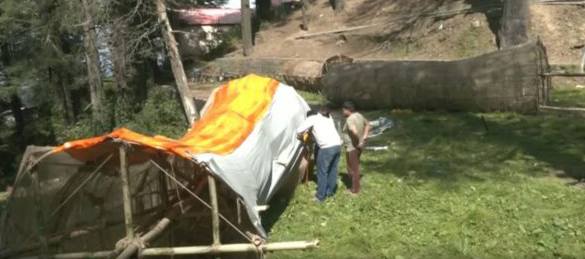
A Muslim family from Meerut, Uttar Pradesh, continues a decades-old tradition of crafting effigies of Ravana, Kumbhkaran and Meghnad for the Dussehra celebrations at Shimla’s Jakhu temple, advancing a message of communal harmony ahead of the festival on October 20.
In Shimla, Chief Minister Sukhwinder Singh Sukhu is scheduled to burn the effigy of Ravana at the historic Jakhu temple during the Dussehra festival, which will be celebrated across India on October 20. Himachal Pradesh will also observe the International Dussehra festival in Kullu, where Governor Kavinder Gupta will inaugurate the event.
The family, now in its third generation of artists, has been traveling to Shimla annually to prepare the effigies. Mohammad Sohil, a young family member, stated that their involvement spans approximately 20 years at Jakhu, while the broader family tradition of making Dussehra effigies is close to 70 years old.
“We have been coming here for the past 20 years. Earlier, our elders used to come, and now we have continued the tradition. We live in the temple and eat here. We have never faced any problems. Everyone treats us with love and respect,” Sohil said.
Despite occasional interruptions, including during the COVID-19 pandemic, the family has maintained its participation in Shimla’s Dussehra festivities. Sohil emphasized the importance of brotherhood, stating, “Some people try to spread the idea that someone is Hindu and someone else is Muslim, but that is wrong. We should maintain brotherhood among ourselves. There is no problem here, and everyone lives together with love.”
The artists are currently preparing the effigies at Jakhu temple, with Chief Minister Sukhu expected to attend the effigy burning on October 20. Sohil noted that the team had spent three days at the site and anticipated completing the work within two more days.
Beyond Jakhu, the family’s work extends to other locations in Shimla district, including Sankat Mochan temple, Shoghi, Sunni and Junga, where effigies are also crafted for Dussehra. Sohil said, “Our team generally consists of 20 to 22 people. Some members are currently away making effigies at other places. The main structures have been prepared, and the cloth and other finishing work will now be completed. The final touches will be given before the festival.”
The temple committee invites the artists and provides them with food and accommodation during their stay. Sohil expressed the family’s commitment to continuing the tradition as long as they receive invitations. “We have no problems staying here. The temple committee takes care of our food and other needs. We will celebrate Dussehra here before returning home, and whenever we are invited in the future, we will certainly come,” he said.
Stressing mutual respect among communities, Sohil said, “When Hindu people come to our festivals, we also participate in theirs. Every community has its own festivals, and we should maintain brotherhood and mutual respect.” He appealed against divisions based on religious differences, stating, “My message is that there is no question of someone being Hindu or Muslim when it comes to humanity. Humanity is the greatest thing. We should live together in unity and not fight with one another. What is the benefit of fighting? We should pray to the Almighty that everyone stays together.”
Another artist, Abdul Azim, reasserted the family’s dedication to the tradition of making Dussehra effigies in Shimla.
The artists expressed satisfaction in contributing to a festival rooted in Hindu religious tradition, viewing their role as an expression of shared cultural life rather than religious division.
As preparations for Dussehra accelerate across Himachal Pradesh, including the International Dussehra festival in Kullu, the artists also intend to address environmental concerns by reducing firecracker use and modifying the effigies’ clothing this year to lessen pollution.
For the Meerut family, participating in Shimla’s annual Dussehra celebrations signifies more than the craft of effigy-making; it represents a longstanding tradition of intercommunity cooperation and a testament to the power of humanity and mutual respect to bridge religious boundaries.