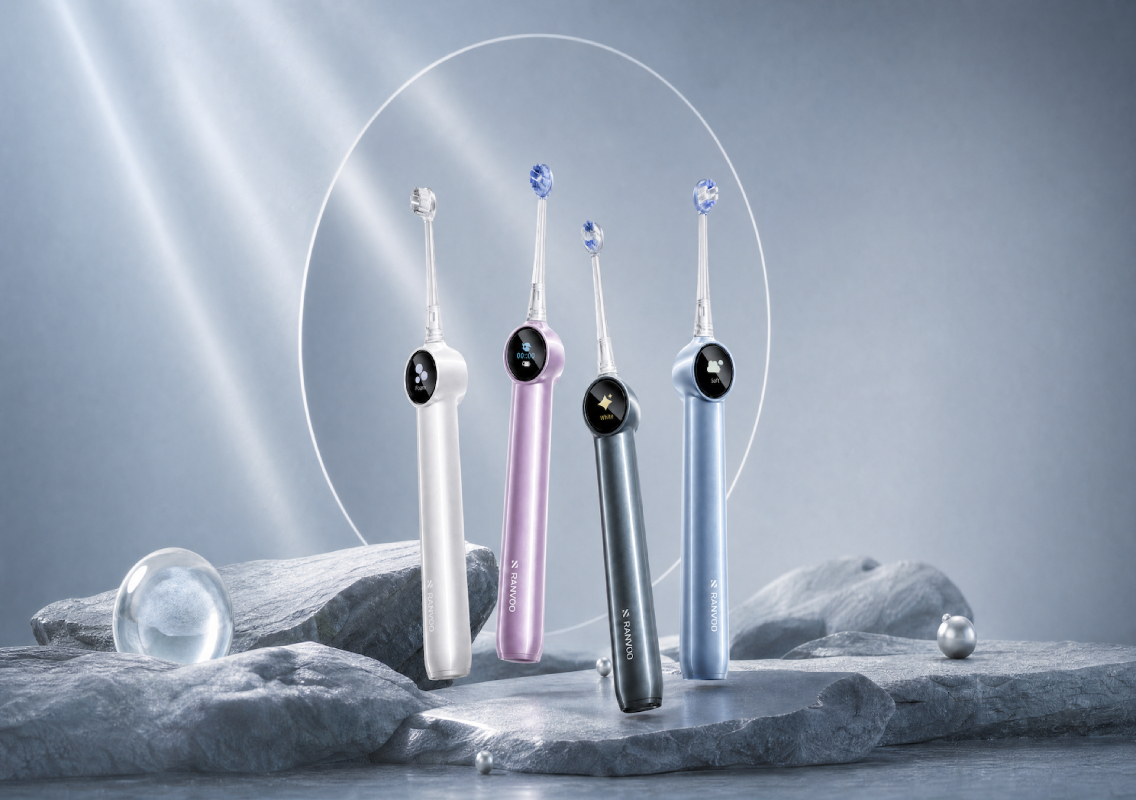
Can a toothbrush use shark-inspired physics and microscopic bubble explosions to clean your teeth? We looked at the science behind RANVOO’s AirJet X5 — and it’s genuinely fascinating.
Most of us don’t think much about our toothbrushes. The basic idea hasn’t changed in living memory: bristles scrub, friction cleans, rinse and repeat.
But here’s a fact worth pausing over: more than 80% of cavities begin in the narrow gaps between teeth — the interdental spaces where bristles are physically too wide to enter. No toothbrush in the world, no matter how expensive or fast, can push a solid bristle into a gap smaller than itself. The bristle-based model of cleaning, essentially unchanged since 1938, has a fundamental geometric blind spot.
RANVOO, a company that has accumulated 20 international patents around a technology called AirJet 2.0, decided the answer wasn’t to make better bristles. It was to stop relying on bristles entirely for the most important cleaning task.
The Core Technology: Three Stages of Fluid Cleaning
The AirJet X5 replaces mechanical friction with fluid dynamics in three stages, each grounded in well-established physics.
Stage 1 — Boosted Bubble Chamber. Inside the handle, a precision-machined cavity uses the Venturi effect to aerate the water-toothpaste mixture into a dense stream of microbubbles — each just tens of microns across, small enough to slip between teeth. At its peak setting, the system generates one liter of bubble-infused fluid per minute. This is not the coarse foam that forms when an ordinary brush agitates toothpaste. It’s an engineered cleaning medium.
Stage 2 — Coanda Effect Brush Head. Getting the bubbles where they need to go requires more than just spraying. RANVOO’s brush heads are shaped using computational fluid dynamics to exploit the Coanda effect: a principle where a fluid jet naturally sticks to and follows a curved surface. When the bubble stream touches a tooth, it hugs the contour and flows downward into the gaps — no aiming, no special technique. Physics handles the navigation.
Stage 3 — Acoustic Cavitation. This is where the technology truly differentiates itself. When microbubbles enter the confined space between teeth and contact plaque biofilm, they collapse asymmetrically. Each implosion produces a microscopic high-velocity liquid jet — a microjet — aimed directly at the tooth surface. The shear force physically breaks apart the sticky matrix that binds plaque bacteria to enamel.
This is the same principle used in industrial ultrasonic cleaning tanks, where cavitation bubbles strip contaminants from precision components. RANVOO’s achievement was calibrating the energy precisely for the delicate oral environment.
Why Sharks Matter Here
In perhaps the most unexpected detail in the AirJet engineering story, the brush head’s oscillation pattern was modeled on the swimming mechanics of great white sharks.
When a shark sweeps its tail, it creates a reverse Kármán vortex street — a train of counter-rotating water vortices that generate forward thrust rather than drag. It’s one of nature’s most efficient propulsion systems. RANVOO tuned the coupling between the brush head’s vibration frequency and oscillation angle to produce a similar effect in the mouth: each micro-movement becomes a directional fluid pulse that actively drives bubbles into interdental spaces, rather than merely swishing them around.
The “shark physics” detail sounds like marketing, but the fluid-dynamic modeling behind it is genuine and patent-protected.
Gentle by Design
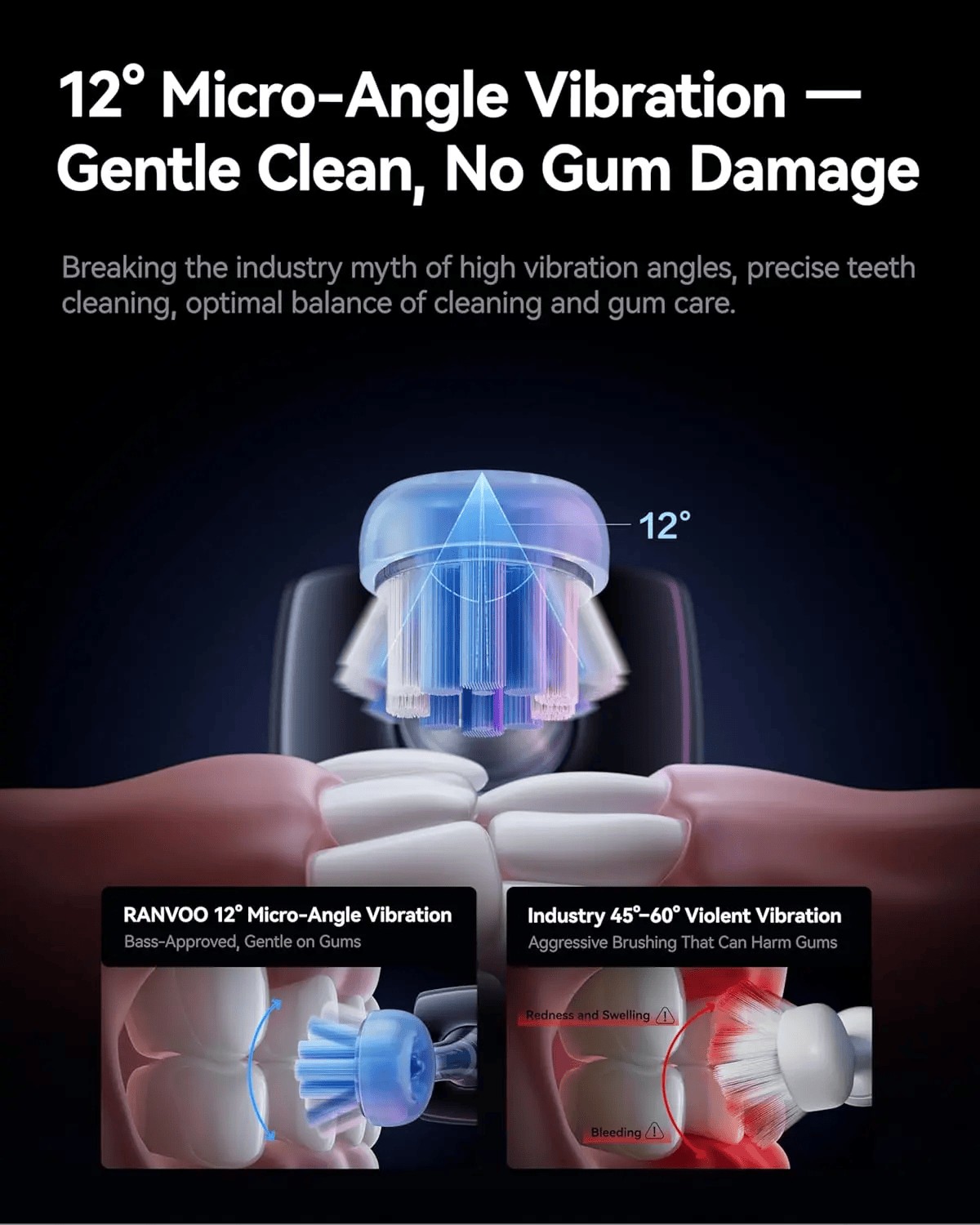
A counterintuitive number on the spec sheet: the AirJet X5’s maximum vibration speed is 21,600 strokes per minute. Premium electric toothbrushes routinely advertise 31,000 to 62,000 strokes per minute. Why would a next-generation device run slower?
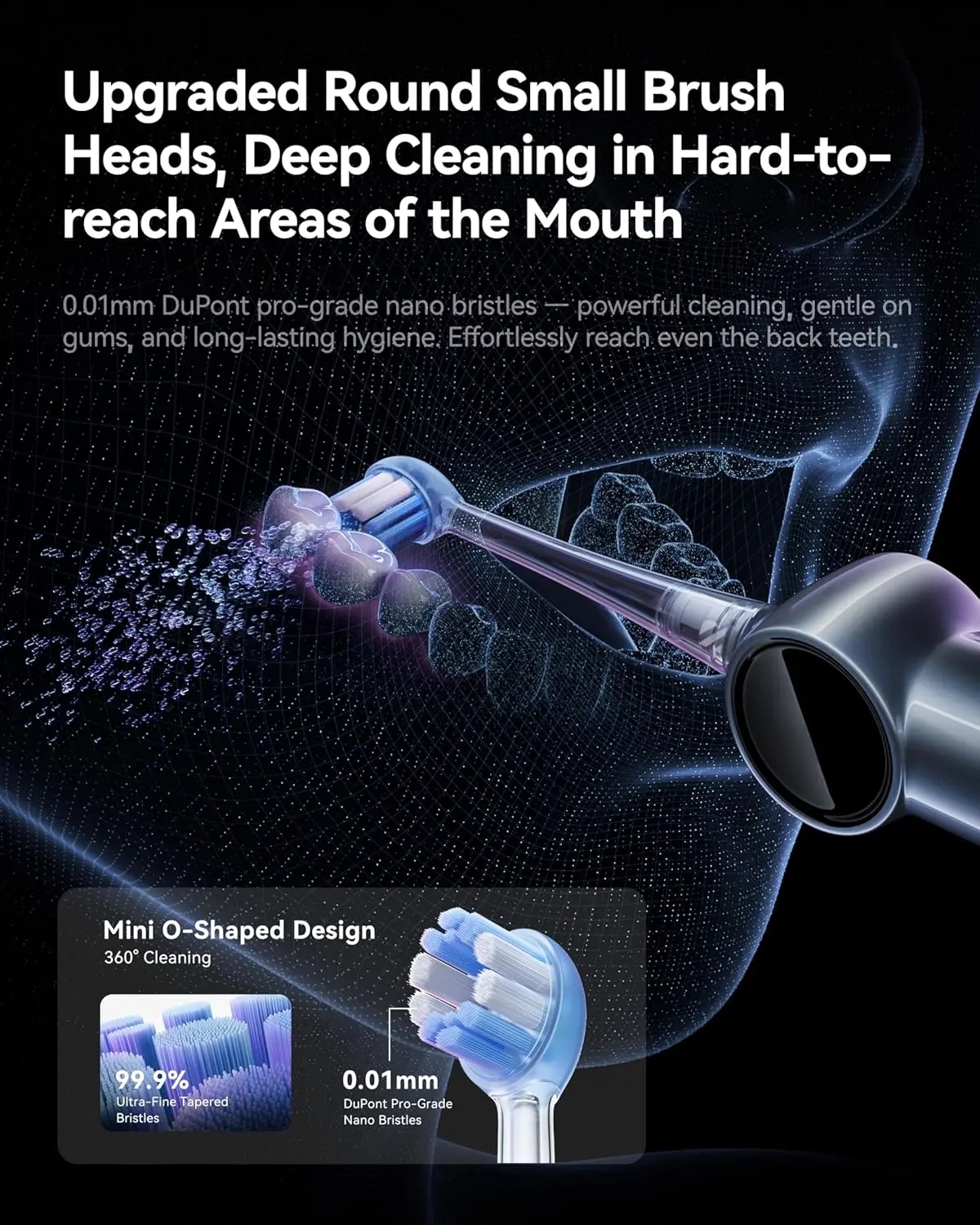
Because it doesn’t need high speed. The bristles are responsible only for surface polishing, a much less demanding task. This allowed engineers to deliberately cap the motor frequency at gum-safe levels, pairing it with a narrow 12° oscillation arc, 0.01mm bristle tips polished to a 99.99% end-rounding rate, and a soft rubber backing that absorbs stray vibration.
The clinical result: 97% plaque removal and Grade 1 cleaning efficiency — the highest classification in standardized dental testing — achieved at lower mechanical intensity than most premium competitors.
Built for Real Bathrooms
The AirJet X5 is IPX7 waterproof, carries a Grade 0 anti-mold certification via silicon carbide coating, and includes a magnetic wall mount that charges wirelessly while storing the brush vertically so moisture drains and air circulates — eliminating the biofilm-prone charging puck familiar to electric brush owners. A 1,600 mAh battery delivers up to 39 days per charge. Operating noise stays below 65 decibels.