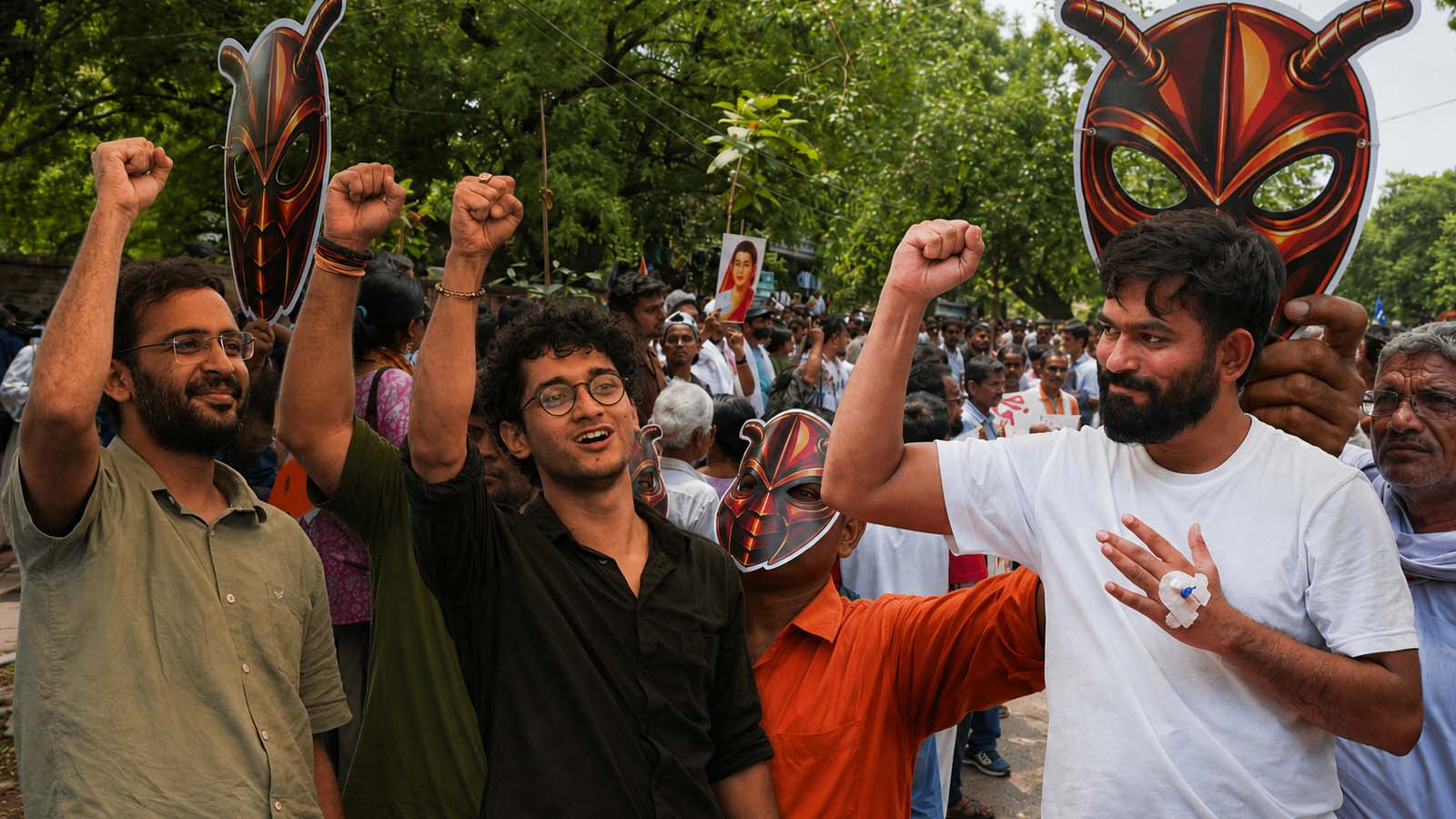
India’s youth-led protest movement, driven largely by Gen Z, has emerged as a powerful voice against alleged irregularities in national examinations and widespread unemployment and underemployment. Its demands include education reform and greater government accountability.
The movement has now been joined by Opposition parties and civil society activists in calling for the resignation of Chief Election Commissioner Gyanesh Kumar over alleged SIR irregularities.
Several of the movement’s leading faces have become well known in recent months for pressing those in power to answer for their decisions. Here are the voices that speak out.
Abhijeet Dipke
Abhijeet Dipke is the founder and national convener of the Cockroach Janta Party (CJP), which emerged in 2026 as a satirical response to a controversial remark by Chief Justice of India Surya Kant and later evolved into a broader campaign that brought together professionals from journalism, public policy, law, and engineering.
Dipke, from Sambhaji Nagar (Aurangabad), Maharashtra, was born in 1995 into a middle-class Marathi-speaking family. He attended a Marathi-medium school before completing his higher secondary education in English. He studied journalism and mass communication in Pune and subsequently earned a master’s degree in public relations from Boston University in the United States.
Also Read: CJP’s Dipke demands CEC Gyanesh Kumar’s resignation, warns of countrywide protests
Before launching CJP, Dipke worked with the Aam Aadmi Party, handling social media strategy and election campaigns. His political communication experience helped him turn an online satirical response into a youth mobilisation campaign.
The movement expanded its demands to include better government schools under its School Thik Karo campaign, accountability over examination irregularities, and action on unemployment. Dipke has become the movement’s most recognisable face, using street protests and social media to challenge the government on issues affecting students and young people.
Neha Bora
Neha Bora is a research scholar at Jawaharlal Nehru University (JNU) and the national president of the All India Students’ Association (AISA), a Left-wing student organisation associated with the Communist Party of India (Marxist-Leninist) Liberation. Originally from Uttarakhand, she completed her undergraduate studies at the University of Delhi before pursuing a master’s degree in Performance Studies at Dr BR Ambedkar University, Delhi. She subsequently joined JNU’s School of Arts and Aesthetics for doctoral research in Theatre and Performance Studies.
Her involvement in activism developed alongside her academic interests, including theatre and campaigns on social issues.
Also Read: Neha Bora exclusive |’BJP is the largest source of content for youth now’
In 2026, Bora became a prominent face of student-led protests over alleged examination irregularities, paper leaks, and demands for greater accountability in public institutions. She drew national attention by participating in a 23-day hunger strike at Delhi’s Jantar Mantar alongside fellow activists and education reformer Sonam Wangchuk. She has also participated in protests concerning students’ rights, recruitment examinations, and electoral issues.
Saurav Das
Saurav Das is a journalist and public-interest activist who became one of CJP’s principal spokespersons and later its co-convener. A Delhi resident, he holds a bachelor’s degree in journalism and mass communication from Amity University, where he studied between 2016 and 2019. Before joining the movement, Das worked as an investigative journalist, reporting on legal, judicial, governance, and social issues. His work has appeared in publications including The Caravan, The Hindu, The Wire, Article 14, Al Jazeera, and New Lines Magazine.
He has also used the Right to Information mechanism and legal avenues to pursue questions of public accountability, including issues surrounding information access during the COVID-19 pandemic. Das co-founded Climate Action Front, an initiative concerned with climate governance and environmental policy, and participated in anti-pollution protests in Delhi. At CJP, he has played a key role in communicating the movement’s demands to the media and framing its campaign around transparency, education, and accountability.
Ashutosh Ranka
Ashutosh Ranka, a native of Jaipur, Rajasthan, is an engineer turned public-policy professional who has emerged as a key strategist and co-convener of the CJP. He holds a BTech degree in Materials Science and Engineering from the Indian Institute of Technology (IIT) Kanpur, where he also served as president of the Students’ Gymkhana. After graduating, he worked with global consulting firm McKinsey & Company in Mumbai and London before pursuing a master’s degree in public administration at the London School of Economics. He subsequently worked with Gavi, the Vaccine Alliance, bringing experience in governance and international policy to his public engagements.
Also Read: CJP protests: Mass detentions, arrests, plea filed in SC | What happened so far in Delhi
Unlike Dipke’s focus on mobilisation and Das’s emphasis on journalism and communications, Ranka has been associated with policy formulation and developing the movement’s demands into concrete proposals. He has spoken on education reform, examination irregularities, environmental concerns, and youth-related issues. His professional background gives CJP a leadership perspective grounded in public administration, institutional functioning, and policy research.
Ratna Singh
Ratna Singh is a lawyer from Lucknow, Uttar Pradesh and heads the Cockroach Janta Party’s legal affairs function. She holds an LLB degree from Guru Gobind Singh Indraprastha University in Delhi and is part of the organisation’s core leadership team. Her legal training gives CJP expertise in constitutional questions, civil liberties, legal accountability, and protesters’ rights. She joined the movement’s spokesperson team in June 2026 and was subsequently assigned responsibility for legal affairs when the organisation announced its leadership structure in August. Ratna’s role is particularly relevant to a movement that has used public demonstrations and institutional challenges to press its demands.
Aishe Ghosh is a student activist from Durgapur, West Bengal, who rose to national prominence after being elected president of the Jawaharlal Nehru University Students’ Union (JNUSU) in 2019 as a candidate of the Students’ Federation of India (SFI), the student wing of the Communist Party of India (Marxist). She completed her undergraduate degree in political science at Delhi University’s Daulat Ram College before pursuing postgraduate studies in international relations at JNU, where she subsequently enrolled for MPhil and doctoral research. Ghosh grew up in a family exposed to Left politics and trade union activism; her father was associated with the Centre for Indian Trade Unions (CITU).
Also Read: Meet Aishe, the JNUSU president who led from the front
She became involved in student politics during her undergraduate years and later emerged as a prominent figure in campaigns over university fees, education policy, and students’ rights. Her national profile expanded dramatically in January 2020, when she was injured during the violence at JNU on January 5. Photographs of her with head injuries became widely circulated, and she continued to participate in protests following the attack. Ghosh later took up a leadership role in SFI, serving as its secretary, and remained an influential voice in left-wing student politics.
Ajinkya Shinde
Ajinkya Shinde, 35, is a technology graduate from Latur, Maharashtra and has emerged as an important organisational figure in the CJP. He holds a BTech degree from Dr Babasaheb Ambedkar Technological University in Lonere, Raigad district, Maharashtra. In August 2026, Dipke appointed him national organisation in-charge, giving him responsibility for coordinating the movement’s activities and expanding its reach beyond its principal leadership.
Shinde was also involved in organising CJP’s Mumbai agitation and has been associated with its School Thik Karo campaign, which seeks improvements in government-school infrastructure across India. His organisational role became particularly visible on October 10, when Dipke designated him to lead a planned protest at Delhi’s Jantar Mantar after police detained Dipke, Das, and Ranka. Shinde’s rise reflects CJP’s efforts to develop a broader organisational network capable of sustaining demonstrations and campaigns even when its best-known leaders are unavailable.