The conversation about message queues in backend engineering almost always starts at the wrong point. Teams reach for a message broker when they want to do something asynchronously (send an email in the background, process an upload after the response, notify another service that something happened), and the first question they ask is which tool to use. That is the second question. The first question is what communication pattern the system actually needs, because the answer to that question determines everything about which tools are appropriate, what guarantees they provide, and what failure modes they introduce.
Messaging systems play a foundational role in solving the challenges of distributed system architecture. They allow services to exchange information asynchronously, decouple processing flows, and facilitate event propagation across system boundaries. The production consequence of treating message queues as an implementation detail is a system that handles the happy path correctly and handles every failure mode badly: messages dropped when consumers are slow, cascading failures when a dependency goes down, duplicate processing when a consumer retries without idempotency, and no visibility into any of it.
What a Message Queue Actually Does
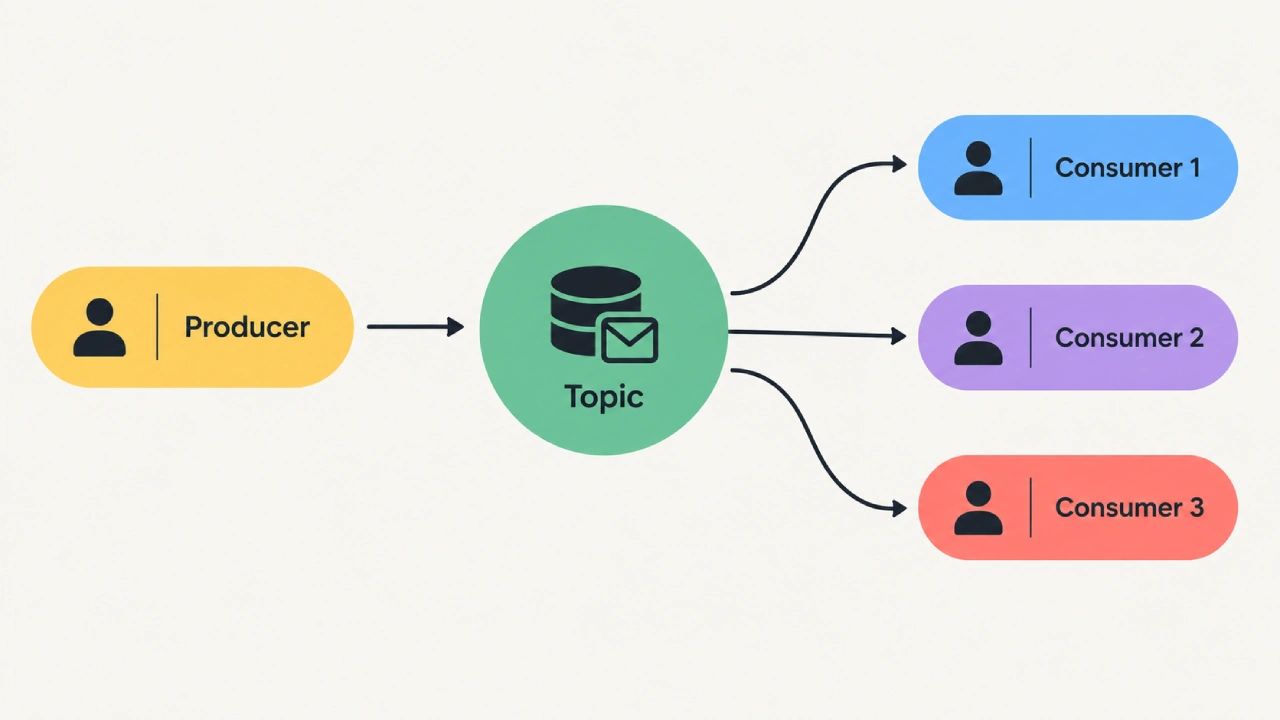
At its simplest, a message queue sits between a producer (the service that creates a message) and a consumer (the service that processes it). The producer writes a message to the queue and returns immediately, without waiting for the consumer to process it. The consumer reads from the queue at its own pace, processes the message, and acknowledges successful processing. If the consumer fails before acknowledging, the queue redelivers the message.
The producer and consumer are completely decoupled; they do not know about each other. This decoupling is the core value proposition: a producer that writes to a queue does not need the consumer to be running, healthy, or fast. If the consumer is slow, messages accumulate in the queue. If the consumer crashes, messages wait in the queue and are redelivered when a new consumer starts.
Asterfolio/Unsplash
This decoupling changes the failure model of a distributed system fundamentally. In a directly coupled system where Service A calls Service B synchronously to notify it of an event, Service B’s failure causes Service A’s operation to fail. The failure propagates upstream. In a queue-based system, Service A writes to the queue, and the write succeeds as long as the queue is healthy; Service B’s failure is isolated. The message waits until Service B recovers, then processes normally. The failure does not cascade.
The advantages that message queues deliver in practice:
- Services do not need to know each other’s availability
- Queues handle increasing message volume by buffering it
- Message persistence ensures no data loss even during consumer failures
- Asynchronous processing improves responsiveness and avoids blocking the request thread on slow downstream operations.
RabbitMQ: The Message Broker Built for Task Queues
RabbitMQ is a traditional message broker built around the AMQP protocol. It was designed for message routing, getting a specific message to the right consumer. Its primitives are exchanges, which receive messages; bindings, which route them; and queues, which hold them for consumers. RabbitMQ excels at task distribution with strict delivery control: per-message TTL, priority tiers, dead-lettering with requeue rules, and competing consumers across heterogeneous workers. This is its home turf, and it is still the best at it in 2026.
The operational characteristics of RabbitMQ that make it the right choice for task queue use cases are predictable: a message goes to one consumer (unless configured otherwise), the broker actively pushes messages to consumers, delivery acknowledgement is fine-grained and per-message, and complex routing logic (fan-out to multiple queues, topic-based routing, priority queuing) is handled at the broker layer through exchanges and bindings.
RabbitMQ excels at complex routing, priority queues, and request-reply patterns with sub-10ms latencies. Durable queues and exchanges provide message persistence, and dead-letter queues handle failed message processing with configurable retry mechanisms. The flexibility of the exchange-binding-queue model makes RabbitMQ suitable for both small-scale and enterprise-grade applications.

The use cases where RabbitMQ is the clearest choice are:
- Background job processing, where tasks are distributed across a pool of workers
- Request-reply patterns, where a consumer needs to return a result to the producer using a correlation ID and reply queue
- Priority queues, where high-urgency messages must be processed before lower-priority ones
- Per-message routing, where different message types must reach different consumer groups based on content.
Kafka: The Event Stream Built for Replay and Fan-Out
Apache Kafka was originally developed by LinkedIn and is built around a distributed commit log paradigm optimised for high throughput. Where RabbitMQ routes messages to individual consumers, Kafka appends events to a partitioned, replicated log and lets multiple consumer groups read from it independently; each group maintains its own offset into the stream. A message published to Kafka is not consumed and removed; it is retained for a configurable period, and any consumer group can replay from any offset.
This architectural difference (broker-push versus consumer-pull, delete-on-consume versus retain-for-replay) is what makes Kafka right for a completely different set of use cases than RabbitMQ. The properties that Kafka’s log model delivers are: multiple independent consumer groups reading the same event stream without interfering with each other, the ability to replay historical events when a new consumer is added, or an existing consumer needs to reprocess, and throughput at a scale that traditional message brokers cannot match.
Event streaming and analytics (clickstreams, audit logs, event sourcing, feeding multiple downstream systems) is clearly Kafka’s domain. Nothing else on this list does replay and multi-consumer fan-out with retention properly. A payment event that needs to be consumed by a fraud detection service, an accounting service, a notification service, and an analytics pipeline simultaneously, with each service processing at its own pace and with the ability to replay from the beginning if the analytics pipeline is rebuilt, is a Kafka use case. A background job that sends one email per user signup is a RabbitMQ or SQS use case.
The operational cost of Kafka is real and worth stating honestly: Kafka clusters require more operational expertise to run than RabbitMQ, the schema management and consumer offset coordination add development complexity, and the minimum viable Kafka deployment is heavier than the equivalent RabbitMQ setup. “We might need Kafka later” is not a reason to choose Kafka now, since migrating a job queue is a week of work; running Kafka you did not need is a permanent operational tax. For small teams with simple pub/sub requirements, managed cloud alternatives (AWS SQS, Google Cloud Pub/Sub, AWS EventBridge) provide the operational simplicity of a managed service with the durability guarantees that Kafka provides, at the cost of Kafka’s replay capability.
At-Least-Once Delivery and the Idempotency Requirement
RabbitMQ, Kafka, and SQS all guarantee at-least-once delivery: a message will be delivered to a consumer at least once, but may be delivered more than once under specific failure conditions. When a consumer processes a message and then crashes before sending the acknowledgement, the broker redelivers the message to another consumer. Consumer idempotency is the only correct architectural response to this reality.
An idempotent consumer produces the same outcome whether it processes a message once or ten times. For a consumer that sends an email, this means checking whether the email has already been sent (using a database record keyed on the message’s unique identifier) before sending it, and returning successfully without sending again if it has. For a consumer that processes a payment, this means passing the payment provider an idempotency key generated from the message content, so that the provider deduplicates the charge even if the request arrives multiple times.

The implementation pattern that makes idempotency reliable across message types is the idempotency key: a unique, stable identifier generated from the message content or a UUID included in the message at publish time. Every operation the consumer performs checks this key against a database or cache record before executing the side effect. The check-then-act sequence must itself be atomic, typically implemented with a database unique constraint on the idempotency key, so that a duplicate message that arrives while the first is still processing fails the constraint and is acknowledged without performing the side effect again.
Retry Logic and Dead-Letter Queues: The Reliability Layer
A consumer that fails processing a message has three options:
- Acknowledge the message (and lose it)
- Reject the message with requeue (and risk an infinite retry loop)
- Reject the message to a dead-letter queue after a defined number of attempts.
The third option is the only one that provides both resilience and observability.
Messages that fail processing N times go to a dead-letter queue for investigation. The DLQ is the diagnostic instrument for the retry system; every message there represents a failure that requires investigation, whether a bug in the consumer logic, a permanently unavailable dependency, or data that the consumer cannot process. A DLQ that accumulates messages without monitoring is operationally equivalent to silent message dropping, for the failures are invisible until a user reports a missing outcome or a downstream system shows an unexpected gap.
Exponential backoff between retries is the standard pattern for transient failures: the first retry after a short delay, subsequent retries with increasing delays, preventing a flood of retries from overwhelming a recovering dependency. In RabbitMQ, this is implemented through message TTL and dead-letter exchange configuration: a rejected message is routed to a “retry” exchange with a TTL set to the desired retry delay, then re-routed back to the original queue when the TTL expires. In Kafka, retry logic is implemented at the consumer level using a retry topic pattern, whereby failed messages are published to a retry topic with a processing delay, consumed by a retry consumer, and requeued to the original topic if the retry succeeds.
Choosing Between RabbitMQ, Kafka, and Managed Cloud Queues
The four main options are not four competitors for one job.
- Use-case fit (not throughput benchmarks) should drive the decision.
- Background jobs needing strict delivery control go to RabbitMQ.
- Event streaming and analytics requiring replay and multi-consumer fan-out go to Kafka.
- Microservice decoupling on a small team where queue availability becomes system availability goes to a managed cloud service whose uptime engineering beats what a small platform team can provide.
Redis-backed queues (BullMQ in Node.js, Sidekiq in Ruby) occupy a fourth category: lightweight, low-operational-overhead queues backed by Redis that are appropriate when the message volume is moderate, the team is already operating Redis, and the replay and high-throughput requirements that justify Kafka are absent. They trade the durability guarantees of a dedicated message broker for operational simplicity, and for many applications that trade is correct.
The selection heuristic that produces the fewest regrettable decisions: start with the simplest option that meets the current requirements, document the specific requirements that would drive a migration to the next tier, and revisit the decision when those requirements materialise. A queue migration when requirements change is a bounded engineering task. Operating infrastructure in excess of current requirements is an ongoing cost with no bounded end.
Observability: What a Queue System Looks Like When It Is Working and When It Is Not
Monitoring a message queue system requires tracking queue depth, consumer throughput, message latency, and error rates. Tools like Prometheus and Grafana are standard for RabbitMQ and Kafka monitoring; queue depth that grows faster than consumers can process it is the leading indicator of a consumer capacity problem; consumer lag in Kafka (the difference between the latest offset and the consumer’s current offset) is the equivalent metric for stream-based systems.

The operational signals that indicate a queue system is in distress are:
- Queue depth growing without bound
- Dead-letter queue depth increasing
- Consumer acknowledgement rate below the publish rate
- Message age at consumption exceeding the expected processing window.
Each of these is monitorable with standard tooling and should be in the alert stack before the first production incident makes the gap visible.
For backend teams building their first queue-based system, the practical starting point is the same regardless of which tool they choose: design the consumer to be idempotent before writing any other consumer logic, add dead-letter queue routing before the system goes to production, and instrument queue depth and consumer lag as monitoring metrics from day one. The failure modes that message queues introduce (duplicates, ordering edge cases, delivery lag, DLQ accumulation) are all manageable with the right design. They become expensive only when discovered in production without the instrumentation to diagnose them.
What to Watch Next
The direction of message queue tooling in 2026 is toward managed services and durable execution frameworks that abstract the operational complexity of self-hosted brokers without sacrificing the delivery guarantees that production systems require. AWS SQS FIFO, Google Cloud Pub/Sub, and Confluent Cloud have each matured to the point where the operational argument for self-hosting RabbitMQ or Kafka is narrowing to organisations with specific compliance, cost, or customisation requirements.
For backend teams evaluating their messaging architecture today, the most durable principle is the one that has been true since the first message queue was deployed in production: design your consumers to be idempotent, watch your dead-letter queues, and choose the simplest tool that reliably handles the failure modes your system will actually encounter. Everything else is configuration.