
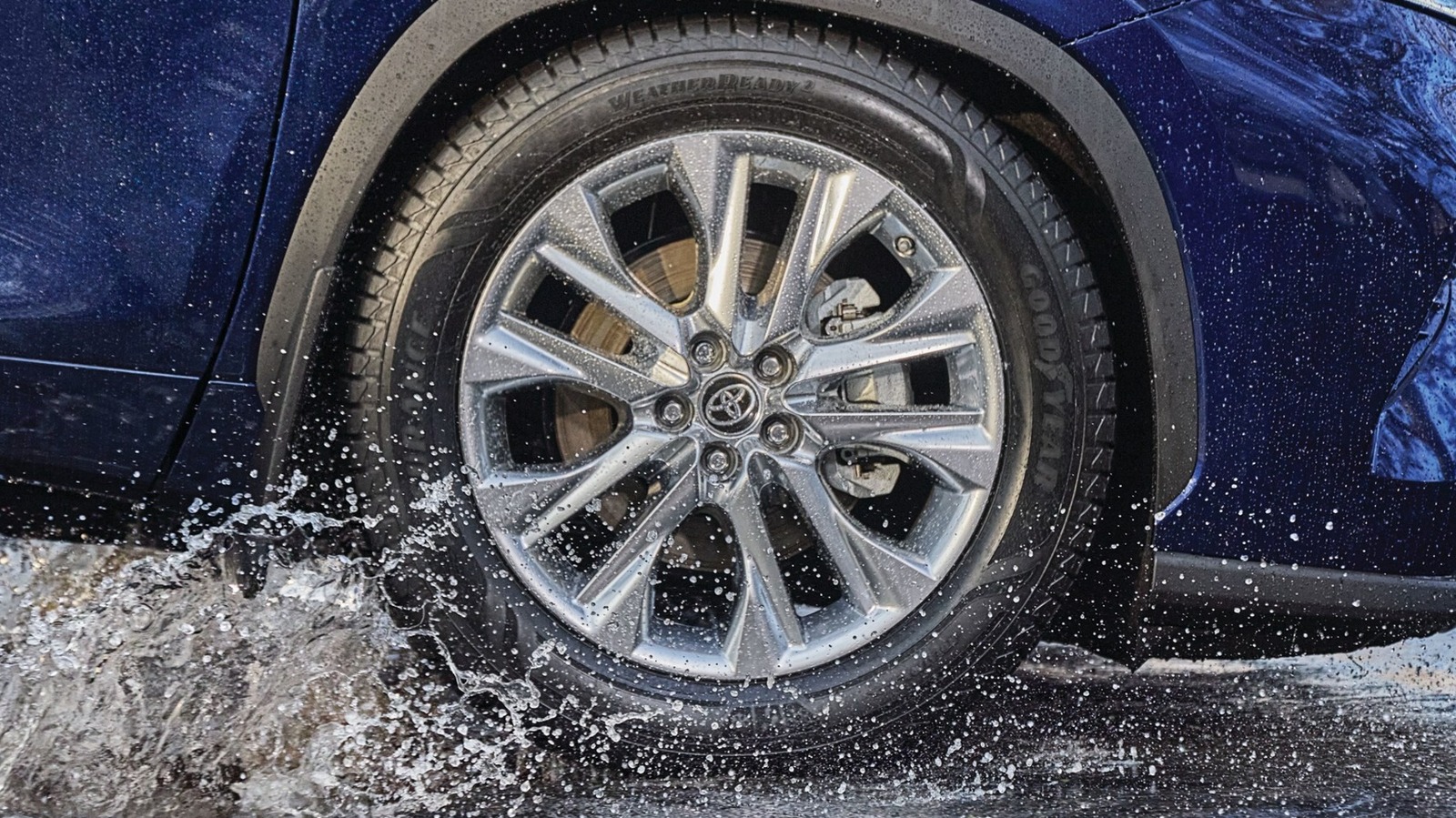

Getting the right set of tires for your vehicle is crucial for a safe, quiet, and smooth ride. For tackling all kinds of weather and road conditions, digging through the best all-season tires on the market is in your best interest before settling on your next set. Two notable all-season tires from tenured, reliable brands are the Michelin CrossClimate 2 and the Goodyear WeatherReady 2. While they do overlap in some areas, like the fact that they’re both all-season tires with V-shaped treads and 60,000 mile warranties that start at well over $100 each, make no mistake; these tires aren’t exactly the same.
These specific Michelin and Goodyear tires deviate in a few key areas. The CrossClimate 2s claim to be the longer-lasting of the two tires, providing around 23,000 more miles of drive time than the WeatherReady 2s. Thermal Adaptive Tread is included as well to prevent the tire from becoming brittle when faced with cold roads and low temperatures. Meanwhile, Goodyear’s tires are advertised as including a built-in Wear Gauge to track tread depth, AquaTred technology for improved traction in wet and slushy road conditions, and Evolving Traction Grooves to maintain tire grip on the road throughout the tire’s lifespan.
While this is all well and good, the big question is how do these tires actually compare when in use? Here’s what testing has shown about the CrossClimate 2 and the WeatherReady 2 when put through the same conditions.
How the CrossClimate 2 and the WeatherReady 2 perform
The only true way to know how the Michelin CrossClimate 2 and the Goodyear WeatherReady 2 tires stack up is to put them through their paces. That’s exactly what Jack Talks Tires on YouTube got the opportunity to do, using both sets of tires on a closed course. They were taken through wet and dry patches alike, around tight turns, and in quick braking scenarios. Overall, they did well and were pretty evenly-matched in their handling and braking. Still, there were a few areas where the WeatherReady 2 turned out to have a slight edge over the CrossClimate 2.
The area where the WeatherReady 2 proved its worth was the rough road simulation. On uneven, bumpy road, the WeatherReady 2 was noticeably quieter, likely thanks to Goodyear’s Comfort Flex technology: Sidewalls that flex to absorb road impact and create a smoother, quieter driving experience on bump and pothole-filled roads. The Evolving Traction Grooves also turned out to be a difference-maker for grip and handling, and Jack Talks Tires noted that the tire’s integrated Wear Gauge is a nice touch that the average driver will surely appreciate.
Of the major tire brands currently on the scene, few are at the level of Michelin and Goodyear. Thus, it’s not too surprising that the CrossClimate 2 and WeatherReady 2 are both durable, capable all-season tires that have a lot to offer drivers in need of a tire refresh. While the WeatherReady 2 scored a narrow victory over the CrossClimate 2 in some regards, odds are you’ll experience a similarly smooth and safe ride with either type.

Comments are closed.