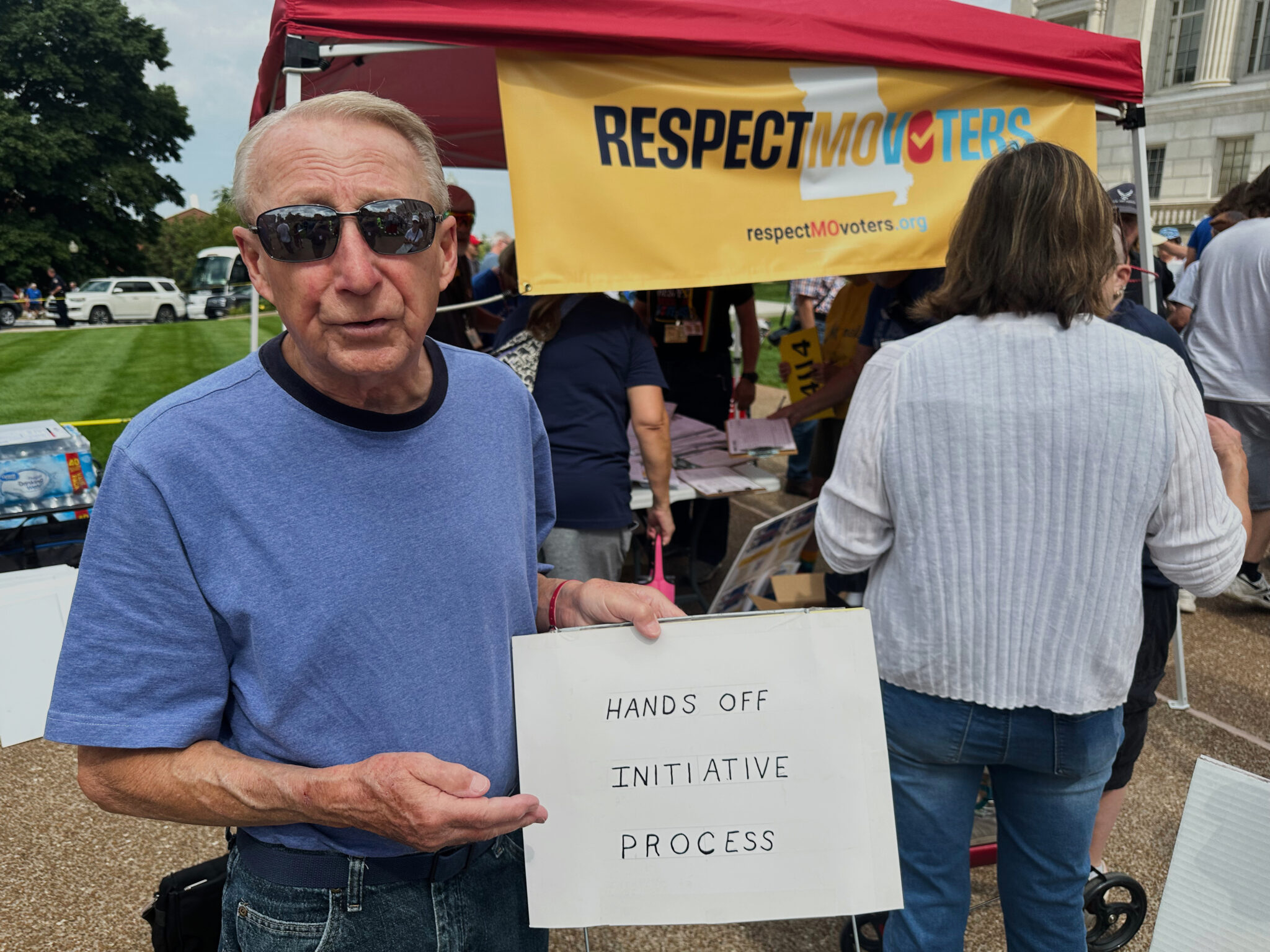
Missouri Amendment 4 Would Set Nation’s Toughest Ballot Initiative Standard/ TezzBuzz/ WASHINGTON/ J. Mansour/ Missouri voters will decide whether citizen-led constitutional amendments must win majority support in all eight congressional districts. Amendment 4 would establish the nation’s toughest geographic approval requirement while leaving legislative amendments subject to a simple statewide vote. Supporters say the change would require broad consensus, while opponents argue that one district could overrule a statewide majority.
Quick Look
- Missouri voters will decide Amendment 4 on Tuesday.
- Citizen initiatives would need majority support in all eight congressional districts.
- A simple statewide majority would no longer be enough.
- No other state has adopted or proposed such a requirement.
- The rule would apply only to citizen-led amendments.
- Amendments proposed by lawmakers would still require a statewide majority.
- Recent Missouri initiatives legalized marijuana and sports betting.
- Voters also approved abortion rights and Medicaid expansion.
- None would have passed under the proposed district standard.
- Those measures received 53% or less statewide.
- About one-third of states permit citizen-led constitutional amendments.
- Colorado generally requires 55% statewide approval.
- Florida requires 60%.
- Other states are considering higher thresholds.
- A competing Missouri proposal could appear on the November ballot.
- Its supporters submitted more than 300,000 signatures.
- That measure would restore majority rule and limit legislative interference.

Deep Look
Missouri considers unprecedented ballot standard
JEFFERSON CITY, Mo. — Missouri voters will decide Tuesday whether to create the nation’s most demanding approval standard for citizen-led constitutional amendments.
Proposed Amendment 4 would require an initiative to receive majority support in each of Missouri’s eight congressional districts.
Under current law, a constitutional amendment passes when it receives a simple majority of votes statewide.
No other state requires citizen initiatives to win every congressional district, and none has previously asked voters to consider that standard.
Recent initiatives would have failed
Missouri voters used the initiative process in recent years to approve policies that state lawmakers had declined to enact.
The amendments established abortion rights, legalized recreational marijuana and sports betting and expanded Medicaid eligibility for low-income adults.
Each measure won a statewide majority.
None received majority support in all eight congressional districts, meaning every one would have failed under Amendment 4.
The examples demonstrate how dramatically the proposal could change direct democracy in Missouri.
Progressive group warns of national precedent
Kelly Hall, executive director of the Fairness Project, said the proposal creates a standard unlike any other in the country.
“This is a first-of-its-kind,” said Kelly Hall, executive director of the Fairness Project, a national group that backs progressive ballot initiatives like the ones Missouri’s Republican lawmakers are hoping to quelch.
Hall believes the requirement would make successful citizen initiatives extraordinarily rare.
“It would be nearly impossible for citizens to participate meaningfully in any sort of direct democracy,” said Hall, who believes other states could try to copy Missouri’s proposal.
Opponents fear lawmakers elsewhere could adopt similar strategies if Missouri voters approve the measure.
Lawmakers seek more control over initiatives
Missouri’s proposal follows years of efforts by elected officials across the country to restrict citizen-led initiatives.
Some lawmakers argue that policies should move through the legislative process rather than be written directly into state constitutions.
Legislation typically receives public hearings, committee review, debate and revision before becoming law.
Citizen proposals may present voters with a finished measure that cannot be altered during the campaign.
Supporters of direct democracy respond that initiatives provide an essential alternative when legislatures refuse to act on popular issues.
National voting debate adds context
The campaign is unfolding as President Donald Trump seeks additional restrictions on voting eligibility and ballot procedures.
Trump has argued that tighter controls are necessary to protect election integrity.
Voting-rights advocates view Missouri’s proposal as part of a broader attempt to limit public participation and concentrate authority within elected institutions.
Missouri’s measure “fits into the larger narrative and story around what the future of democracy looks like in the United States,” said Chris Melody Fields Figueredo, executive director of the Ballot Initiative Strategy Center, which supports progressive ballot measures.
The amendment’s supporters reject the claim that requiring broader geographic agreement is undemocratic.
Only some states allow direct amendments
Approximately one-third of states allow citizens to bypass lawmakers by collecting signatures and placing proposed constitutional amendments on the ballot.
Several additional states permit citizen-initiated statutes but not constitutional changes.
In most states that allow citizen amendments, approval requires a simple statewide majority.
Colorado requires 55% support for most constitutional amendments.
Florida has a 60% statewide threshold.
Missouri’s proposal would differ by requiring multiple geographic majorities instead of one higher statewide percentage.
Voters have rejected tougher thresholds
Voters in Arkansas, Ohio and South Dakota recently rejected proposals to increase the approval percentage for constitutional amendments.
The issue has not disappeared.
South Dakota lawmakers placed another measure on the November ballot requiring 60% approval.
North Dakota voters will consider a similar proposal.
Utah voters will decide whether citizen-led tax increases should require 60% support.
The debates reflect growing legislative interest in making ballot initiatives more difficult to approve.
Missouri would create dual system
Amendment 4 would apply only to constitutional changes initiated by citizens.
Amendments placed on the ballot by the Missouri Legislature would continue to require only a simple statewide majority.
No other state has a similar dual approval standard.
Critics argue that the distinction privileges lawmakers by allowing their proposals to pass under easier rules.
Supporters say citizen initiatives need broader safeguards because they do not undergo the same review as measures debated in the Legislature.
Republican state Rep. Ed Lewis sponsored Amendment 4.
He argues that voters in every region should have a meaningful voice before Missouri’s constitution is changed.
Lewis says well-funded organizations have used large vote totals in St. Louis and Kansas City to overcome opposition across other parts of the state.
He believes constitutional amendments should reflect geographic as well as numerical support.
The proposal is intended to prevent urban areas from determining statewide constitutional policy without approval from more conservative districts.
Recent measures passed narrowly
The abortion-rights, marijuana, sports-betting and Medicaid-expansion amendments reached the ballot through citizen petitions between 2020 and 2024.
Missouri lawmakers had declined to enact those policies directly.
Each proposal passed with 53% or less of the statewide vote.
Their relatively narrow margins illustrate the effect Amendment 4 would have on closely divided issues.
A proposal could win hundreds of thousands more votes statewide but still lose if it falls short in one congressional district.
Lewis says standard is achievable
Lewis rejected claims that the district requirement would make amendments impossible.
Requiring “50% in each of our congressional districts is not a difficult barrier for anything that has a consensus,” Lewis said. But “it is a difficult barrier for either a very conservative or a very liberal initiative petition,” he said.
He argues that broadly supported reforms could still succeed.
Highly partisan measures would face greater difficulty because they would need approval in districts dominated by the opposing party.
“If you’re going to change the constitution, shouldn’t it be broadly accepted?” Lewis asked rhetorically.
Supporters cite U.S. Constitution
Backers compare Missouri’s proposed geographic requirement to the process for amending the U.S. Constitution.
Federal constitutional amendments require ratification by three-fourths of the states.
That system gives states a role beyond the national popular vote.
Opponents argue that congressional districts do not possess the same sovereign status as states.
They also note that district boundaries can be changed by lawmakers, potentially altering the difficulty of future ballot initiatives.
One district could defeat statewide majority
Critics say the proposal could undermine consensus rather than strengthen it.
An amendment could win overwhelming majorities in seven districts and still fail after losing the eighth by only a few votes.
That would give a small number of voters the power to override a much larger statewide majority.
“It is an astonishing level of unfairness, and it crushes our notion of one person, one vote and majority rule, which we learned about in school as kids,” said Scott Charton, a spokesperson for the Missouri Realtors campaign committees, which have backed previous initiatives.
The Realtors have supported earlier ballot measures and view the initiative process as an important political tool.
Republicans divided over proposal
Although Republican lawmakers sent Amendment 4 to voters, the party’s supporters are not united.
A recent Republican club meeting in Jefferson City revealed conflicting views about limiting citizen initiatives.
Some conservatives believe the Legislature should retain a stronger role in policymaking.
Others distrust lawmakers and want voters to preserve a direct method for changing the constitution.
The internal division makes the amendment’s outcome less predictable than a conventional party-line contest.
Supporter favors representative government
Rick Kolb supports the stricter approval requirement.
“Our country was founded as a republic not a democracy,” he said. When initiatives appear on the ballot, “everybody votes on these things that they haven’t put any thought into it.”
His argument reflects concern that voters may approve complicated constitutional provisions without studying their long-term effects.
Supporters believe elected representatives have more time, information and institutional support to evaluate policy.
Opponents respond that lawmakers can also act for partisan or special-interest reasons.
Republican opponent supports popular vote
Jim Bryan opposes Amendment 4.
He worries that voters in St. Louis or Kansas City could use the same district veto to block a conservative proposal supported throughout the rest of Missouri.
“The popular vote is what I want,” he said.
His position demonstrates that the geographic requirement could work against initiatives from either side.
A conservative amendment could fail in an urban district just as a progressive measure could fail in a rural one.
Competing initiative could reverse amendment
Tuesday’s vote may not settle the future of Missouri’s citizen initiative process.
A coalition called Respect Missouri Voters submitted more than 300,000 petition signatures for a competing constitutional amendment.
Election officials are verifying those signatures.
If enough are valid, the proposal could appear on the November ballot.
It would restore a simple statewide majority as the approval standard for citizen-led amendments, reversing Amendment 4 if both measures pass.
November proposal protects petition process
The Respect Missouri Voters amendment would prevent lawmakers from increasing the number of signatures required to qualify an initiative.
It would also stop the Legislature from reducing the period available for collecting signatures.
Additional provisions would prohibit other requirements intended to weaken initiative rights.
Supporters want constitutional protections that future legislative majorities could not alter easily.
They argue that repeated attempts to restrict initiatives demonstrate the need for stronger safeguards.
Legislative changes would require 80%
The competing proposal would also make it more difficult for lawmakers to reverse or change voter-approved initiatives.
It would require an 80% vote in both the Missouri House and Senate.
Current law generally allows lawmakers to modify statutes approved by voters through a simple legislative majority.
The proposed supermajority requirement would preserve voter decisions unless overwhelming bipartisan support exists for changing them.
That provision responds to recent instances in which lawmakers reversed policies approved at the ballot box.
Legislature repealed sick-leave law
Missouri lawmakers repealed a voter-approved paid sick-leave law last year.
They also placed a new constitutional amendment on the November ballot seeking to reverse abortion rights previously approved by voters.
Those actions angered initiative supporters who believe the Legislature is disregarding election results.
Lawmakers argue that elected representatives must retain the ability to correct flawed or harmful policies.
The competing proposal would sharply limit that power.
Coalition calls campaign nonpartisan
Respect Missouri Voters describes its initiative as nonpartisan.
The group notes that Democratic lawmakers also sought to restrict ballot initiatives before Republicans took control of the state government.
Its supporters argue that political leaders of either party may resist direct democracy when voters can override them.
“Politicians in power want all the power in their hands,” said Benjamin Singer, co-founder of Respect Missouri Voters. “They don’t want citizens to have a check on their power.”
The statement frames the debate as voters against institutional authority rather than Democrats against Republicans.
Vote could influence other states
Missouri’s decision may carry consequences beyond the state.
Approval could encourage lawmakers elsewhere to propose requirements based on congressional districts, counties or other geographic units.
Rejection could reinforce the pattern seen in Arkansas, Ohio and South Dakota, where voters resisted higher barriers.
The outcome will also determine whether Missouri residents retain the ability to enact closely contested policies through statewide majority votes.
At issue is not only how the constitution changes, but whether every voter’s ballot should carry equal weight in determining the result.
More on US News